
PURE Bioscience's Strategic Moves in Antimicrobial Innovation and Market Expansion
PURE Bioscience reports continued financial challenges but maintains a proprietary antimicrobial technology platform with regulatory footholds in food safety and healthcare markets.
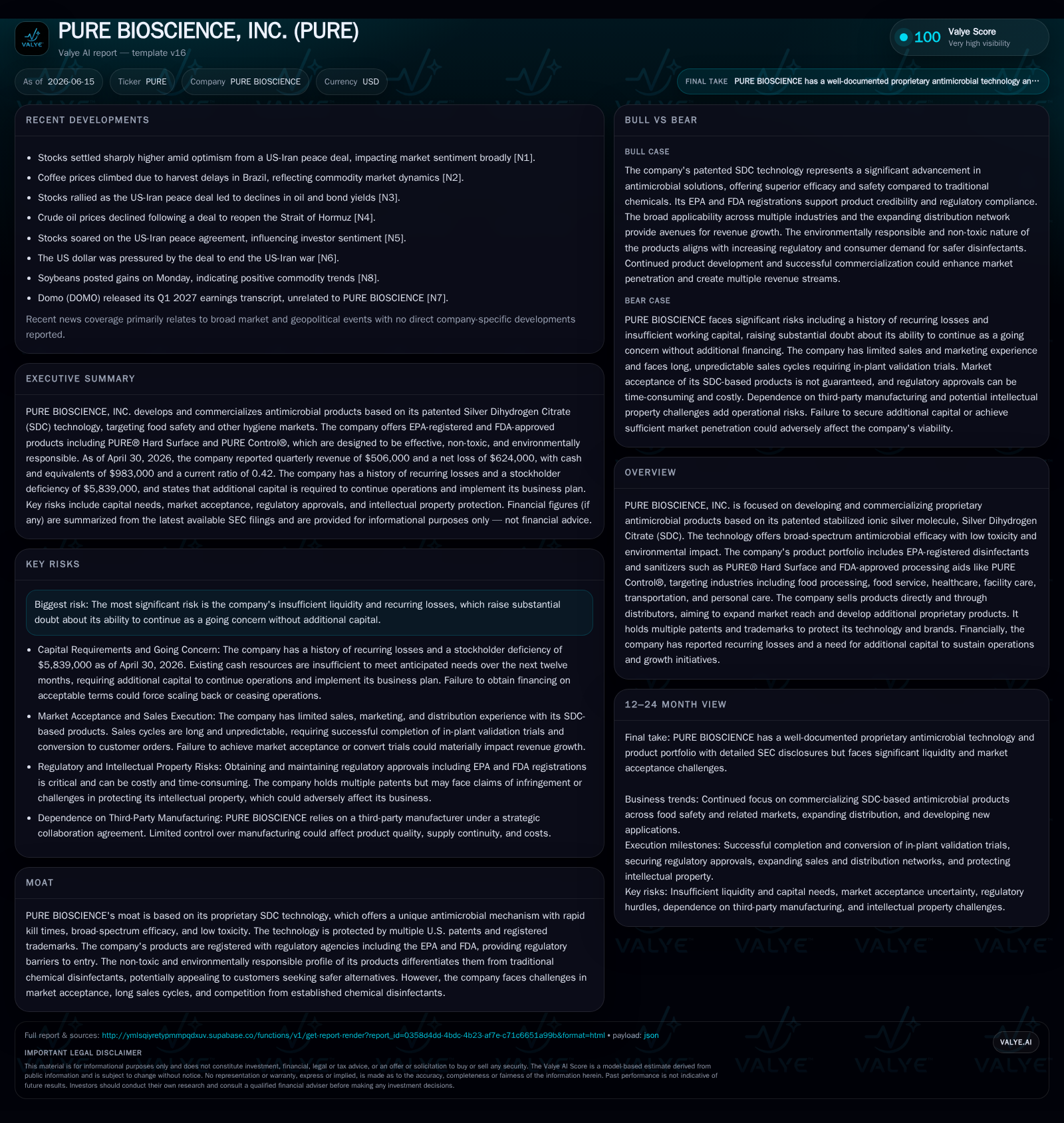
The latest quarterly filing dated June 15, 2026, reveals ongoing net losses totaling $1.87 million for the nine months ended April 30, 2026, with revenues at $1.66 million, signaling persistent cash burn and liquidity constraints that place the company’s operational continuity under pressure. Despite these headwinds, PURE Bioscience’s core business remains anchored in its patented Silver Dihydrogen Citrate (SDC) platform, offering broad-spectrum antimicrobial efficacy with favorable safety and environmental profiles. The company operates in specialty antimicrobials primarily servicing the food processing and healthcare sectors through EPA-registered disinfectants and FDA-approved processing aids, leveraging direct sales combined with an expanding distributor network. Regulatory approvals and successful in-plant validation trials are pivotal growth levers but entail long sales cycles and capital demands, forming a dual narrative of technological promise versus financial sustainability risk.
Latest Quarterly Operating Overview and Why It Matters Now
Silver Dihydrogen Citrate Platform: Business Model Focus on Safe, Effective Antimicrobials
At the core of PURE Bioscience’s business model is its patented Silver Dihydrogen Citrate (SDC) molecule—a stabilized ionic silver complex delivering broad-spectrum antimicrobial efficacy via a dual-action mechanism: silver ions deactivate microbial membrane proteins externally while also entering microbes to disrupt DNA replication internally [S1]. This confers rapid kill times coupled with a toxicity profile favorable to humans and animals owing to its non-caustic aqueous formulation.
The technology manifests in EPA-registered disinfectants such as PURE® Hard Surface sanitizer used across food-processing surfaces and transportation environments; alongside FDA-approved processing aids like PURE Control®, designed for direct application on raw poultry carcasses within regulated food handling operations [S1][S2]. These offerings meet stringent governmental requirements reflecting their safety and efficacy advantages over many traditional chemical disinfectants.
Revenue accrues through two primary channels: direct sales targeting end-use customers predominantly in fragmented food safety and healthcare verticals; plus an expanding third-party distributor network enabling broader geographic market access but adding layers to sales execution timelines due to necessary distributor training and customer integration support [S1]. The need for extensive in-plant validation trials—critical before adoption in regulated settings—further elongates sales cycles yet remains essential for converting product demonstrations into commercial orders.
Industry Competitive Context: Regulation, Peers and Product Positioning
PURE operates within the specialty chemicals antimicrobial segment characterized by substantial barriers including rigorous regulatory compliance (EPA registration, FDA approval) and quality standards governing product formulation consistency [S24]. Its patented SDC chemistry provides intellectual property defenses critical amid competition from entrenched incumbents like Ecolab (multi-category hygiene solutions), Clorox (disinfectant specialists), and Steris Corporation (healthcare sterilization products).
Regulatory hurdles play a bifurcated role by simultaneously protecting PURE’s innovations via EPA/FDA registrations creating high entry barriers while imposing lengthy approval cycles that delay revenue realization [S1]. Additionally, customers require successful in-plant validation trials demonstrating operational compatibility without disrupting existing workflows—an often costly process constraining rapid market penetration.
PURE’s value chain positioning spans formulation innovation using proprietary silver molecules through manufacturing finished antiseptic products distributed directly or via partners to end users across food processing lines or healthcare sites. Reliance on distributors extends market reach yet introduces complexities managing channel margins alongside ensuring appropriate product messaging aligned with regulatory claims.
Growth Catalysts: Market Drivers Anchored in Regulation & Adoption
Several structural tailwinds underpin potential growth avenues for PURE BioScience’s SDC-based portfolio. Heightened global regulatory scrutiny around food safety practices elevates demand for sanitized processing environments compliant with updated pathogen control norms.
Concurrently growing consumer awareness favoring non-toxic antimicrobials with reduced environmental footprints advances a market preference where conventional harsh chemical disinfectants face resistance due to toxicity concerns. These dynamics open doors for SDC’s unique profile combining efficacy with safety.
Geographic expansion plans leveraged through distribution network development aim at scaling diffusion beyond early adopter segments toward broader industry acceptance. Continued innovation via R&D investment targets new formulations enhancing application breadth or concentration profiles responding to diverse microbial threats or industry-specific needs.
Successful transition of pilot-stage validation trials into recurring commercial orders serves as direct evidence of product adoption rate improvement—a key KPI forecasting topline momentum. Achieving consistent customer retention coupled with increased order frequency signals strengthening market foothold despite underlying cyclical hurdles.
Risks Confronting PURE Bioscience: Financial Strain Meets Market Realities
Recurring losses accumulate as one of the most acute risks constraining PURE’s strategic flexibility and execution capacity [S2][S1]. Moreover, prolonged regulatory approval timelines—from FDA clearances for processing aids to full USDA endorsement—impose commercial gating factors delaying scale adoption potentially by months or longer dependent on agency review pace.
Competitive pressures derive not only from incumbent well-capitalized chemical disinfectant makers offering lower-cost solutions but also supply chain vulnerabilities affecting access to raw materials essential for SDC production potentially disturbing manufacturing cadence.
Intellectual property litigation risk also persists as another downside threat given reliance on patent strength to protect key technology advantages which may incur legal defense costs detracting limited resources [S24].
These challenges collectively suppress margin expansion prospects near term while complicating efforts toward profitability given fixed cost absorption difficulties inherent in early commercialization stages.
What To Watch Next: Milestones in Regulatory Progress And Commercial Execution
Key forward-looking indicators establishing future trajectory include progress toward USDA approval status specifically concerning direct food contact uses—the final frontier enabling wider poultry and meat processing applications.
In addition, measuring conversion rates from ongoing in-plant validation trials into sustained purchase contracts will provide insight on actual market acceptance beyond technical efficacy claims.
Capital raising events remain closely watched triggers as they directly affect runway extension possibilities vital for supporting operating expenses including R&D pipeline funding critical for next-generation antimicrobial formulations.
Distribution network expansion metrics will also merit attention as successful onboarding of distributors correlates strongly with geographic coverage increases directly impacting potential revenue size.
Close observation of collection patterns on accounts receivable coupled with vendor payment timing will help gauge working capital pressure fluctuations influencing short-term liquidity management effectiveness.
Concise Financial Profile Commentary Supporting Operating Narrative
As per recent disclosures at April 30, 2026 close, PURE retains approximately $983,000 cash reserves against substantially higher current liabilities approximating $3.65 million yielding a precariously low current ratio near 0.42 reinforcing near-term funding challenges [F1][S2]
Notably, the company reports no total debt, which simplifies the balance sheet but underscores reliance on fresh capital inflows rather than leverage facilities, limiting financial flexibility [F1]. Persistent negative earnings translate into recurrent negative operating cash flow exceeding $1.3 million over nine months further stressing available liquidity sufficiency claims [S2].
In aggregate this financial snapshot flags need for strategic prioritization balancing ongoing investment into product commercialization efforts against immediate survival imperatives governed by cash availability timelines.
This analysis synthesizes publicly filed SEC disclosures supplemented by sector-specific insights into specialty antimicrobial chemicals to contextualize PURE Bioscience’s current strategic situation emphasizing both promising technological strengths embodied by its SDC platform alongside significant financial constraints shaping its near-term outlook without imparting investment advice or forecasts.
Disclaimer: This is research-only, informational analysis and not investment advice. It may include AI-generated interpretation and general industry context. Always verify important details using primary sources.

Comments