
NovaBridge Biosciences Gains FDA Fast Track but Faces Internal Controls Overhaul
The June 2026 filings spotlight FDA Fast Track status for givastomig alongside auditor transition amidst ongoing remediation of IT general controls.
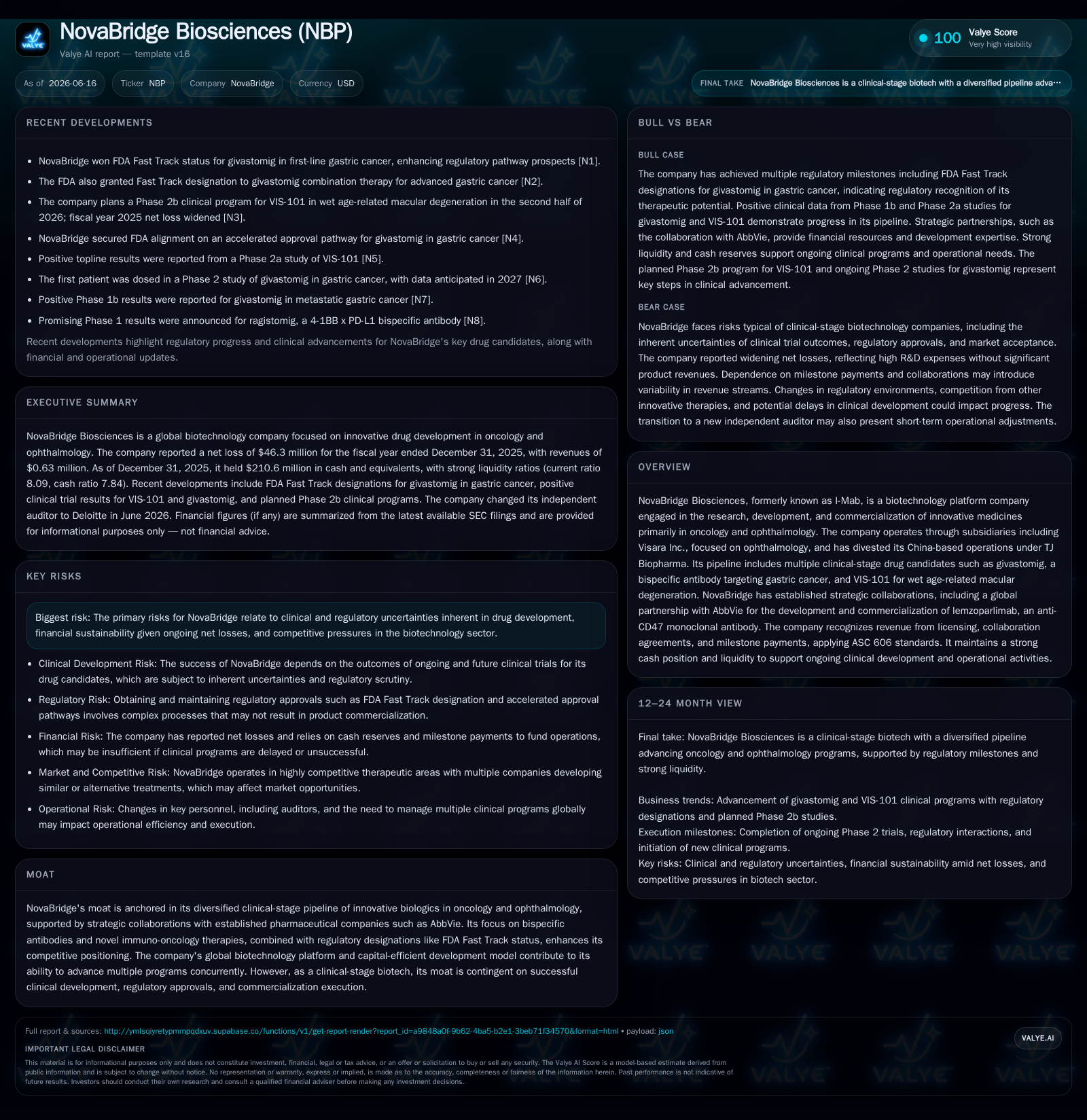
NovaBridge Biosciences’ latest SEC disclosures reveal a critical regulatory milestone with the FDA Fast Track designation granted to givastomig for first-line HER2-negative metastatic gastric cancer. This regulatory recognition underscores growing clinical validation for its oncology pipeline. Concurrently, the company announced dismissal of PricewaterhouseCoopers as auditors and onboarding Deloitte, reflecting continuing efforts to remediate material weaknesses in internal control over financial reporting, particularly information technology general controls. NovaBridge’s diversified biologics portfolio anchored by collaborations such as its global partnership with AbbVie supports its R&D-driven licensing revenue model. The company maintains a strong cash position exceeding $210 million, underpinning its sustained clinical development and operational runway. However, investor attention should remain attentive to execution risks in internal control reform and pivotal upcoming clinical milestones.
Recent Developments: FDA Recognition Meets Auditor Transition
In June 2026, NovaBridge Biosciences disclosed two significant developments shaping its near-term trajectory. First, givastomig — the company's lead bispecific antibody targeting HER2-negative metastatic gastric cancer — was granted FDA Fast Track designation [S3][N1][N2]. This designation signals FDA acknowledgment of the drug's potential to address an unmet medical need, offering opportunities for rolling reviews and accelerated approval pathways that can materially hasten time-to-market relative to traditional routes.
Simultaneously, NovaBridge announced the immediate dismissal of PricewaterhouseCoopers LLP (PwC) as its independent registered public accounting firm and appointed Deloitte Touche Tohmatsu Certified Public Accountants LLP as successor auditor effective June 16, 2026 [S2]. The decision aligns with continued work addressing previously identified material weaknesses specifically concerning information technology general controls (ITGCs) affecting internal control over financial reporting. No disagreements on accounting matters occurred with PwC; however, control deficiencies detailed in the April 2026 annual filing [S1] remain under active remediation.
These dual announcements mark a balancing act between advancing promising clinical assets toward commercialization while confronting governance shortcomings that heighten operational risk profiles.
Business Model: Licensing Revenue Anchored in Robust Clinical Pipeline
NovaBridge operates a biotech platform business model primarily generating revenue through licensing agreements and milestone payments governed under ASC 606 revenue recognition standards [S1]. Its portfolio strategically balances oncology and ophthalmology programs — the former focused on immuno-oncology biologics including givastomig; the latter managed via Visara Inc., which holds rights to VIS-101 targeting wet age-related macular degeneration (Wet AMD) [S1][S10].
The company's licensing income flows largely from collaborations with established pharmaceutical firms like AbbVie [S17]. The global partnership for lemzoparlimab embodies this approach: upfront payments plus milestones contingent on development advances underscore capital-efficient pipeline progression without full commercialization investment risk borne internally
Distributing R&D investments across therapeutic areas mitigates concentration risk while supporting multiple shots on goal through bispecific antibodies and monoclonal antibodies designed against precision oncology targets and ophthalmologic indications. Operating segments reflect this bifurcation between oncology and ophthalmology product candidates [S1][S8].
Revenue variability hinges on timing of milestone achievements rather than product sales at this clinical development stage; accordingly, NovaBridge remains reliant on successful trial progression and strategic partnering momentum.
Industry Context: Competing for Leadership in Oncology and Ophthalmology Biologics
Within biotechnology’s upstream segment encompassing discovery through clinic trials, NovaBridge competes alongside peers maintaining broad biologics pipelines featuring immuno-oncology and ophthalmology agents. Regulatory designations like the FDA Fast Track awarded recently enhance competitive positioning by potentially reducing regulatory hurdles and time-to-market relative to rivals lacking similar designations.
Strategic collaborations typified by the AbbVie license illustrate widely adopted industry models to share high R&D costs while securing resource leverage into late-stage development and commercialization arenas. Such partnerships are essential given pervasive developmental risks and capital intensity endemic in novel biologics innovation.
Challenges common across sector players include protracted pivotal trials, reimbursement negotiations post-approval, manufacturing scale-up complexities of biologics products, plus intellectual property protection dynamics. NovaBridge’s focus on bispecific antibodies aligns with emerging modality trends aiming to improve efficacy over monospecific therapies.
Growth Drivers: Clinical Milestones, Strategic Collaborations, and Regulatory Incentives
Advancement of givastomig through clinical phases is a core growth vector affirmed by FDA Fast Track status [S3], which can accelerate regulatory dialogue—typically enabling rolling data submissions or priority review windows.
Scaling collaborations such as the AbbVie deal finance ongoing R&D while embedding expertise critical for later-stage trials and commercialization execution [S17]. Milestone payments linked to trial initiations or completion can significantly boost episodic revenue ahead of product launch potentials.
Investment in Visara’s ophthalmology segment supports diversification into specialized biologics addressing high-prevalence conditions like Wet AMD — introducing multi-modality innovation potential beyond oncology [S10][S21].
Operational Risks: ITGC Remediation and Governance Challenges Underway
Material weaknesses in internal controls over financial reporting attributable primarily to ineffective IT general controls persisted through 2025 year-end as detailed in the latest annual report [S1]. Deficiencies involve program change management protocols, user access restrictions undermining segregation of duties across key systems, computer operations controls including data integrity safeguards, and software program development oversight.
Management has undertaken comprehensive remediation strategies deploying new IT vendors/personnel dedicated to systematic redesign of these controls. Actions include revising change management procedures requiring formalized request-approval-testing cycles before code migration plus enhanced role definitions ensuring clear accountability [S1]
The auditor transition from PwC to Deloitte reflects governance oversight response aiming at fresh independent scrutiny during control reform phases [S2]. Although no adverse opinions were recorded previously from PwC audits, continuing control lapses elevate operational risk perception among stakeholders.
Investor vigilance regarding timely full implementation is warranted given direct impact on financial statement reliability.
What to Watch Next: Trial Progress, Revenue Milestones & Control Improvements
Key forthcoming events include interim or pivotal clinical trial readouts for givastomig that will influence valuation through potential late-stage advancement or regulatory submissions. Secondary visibility into VIS-101’s development trajectory within ophthalmology could generate complementary newsflow.
Further licensing or collaboration deal announcements—either expansions with existing partners like AbbVie or new alliances—would materially affect short-to-medium term revenue visibility tied to milestone inflows.
Operationally, updates from audit committees or management disclosures detailing status breakthroughs in IT general controls remediation will be critical transparency markers influencing confidence in governance robustness.
Financial disclosures delineating R&D burn rates versus committed cash fuel will indicate runway sufficiency supporting planned clinical agendas.
This analysis is based solely on publicly available SEC filings up to June 16, 2026 ([S1], [S2], [S3]) complemented by financial data snapshots ([F1]) without speculative forecasts or endorsement.
Disclaimer: This is research-only, informational analysis and not investment advice. It may include AI-generated interpretation and general industry context. Always verify important details using primary sources.

Comments