
Oklo Inc. Advances Aurora Reactor Amid Supply Chain and Regulatory Milestones
Latest quarterly filing highlights progress on regulatory permits, market discussions, and construction planning for Oklo's modular fast reactors.
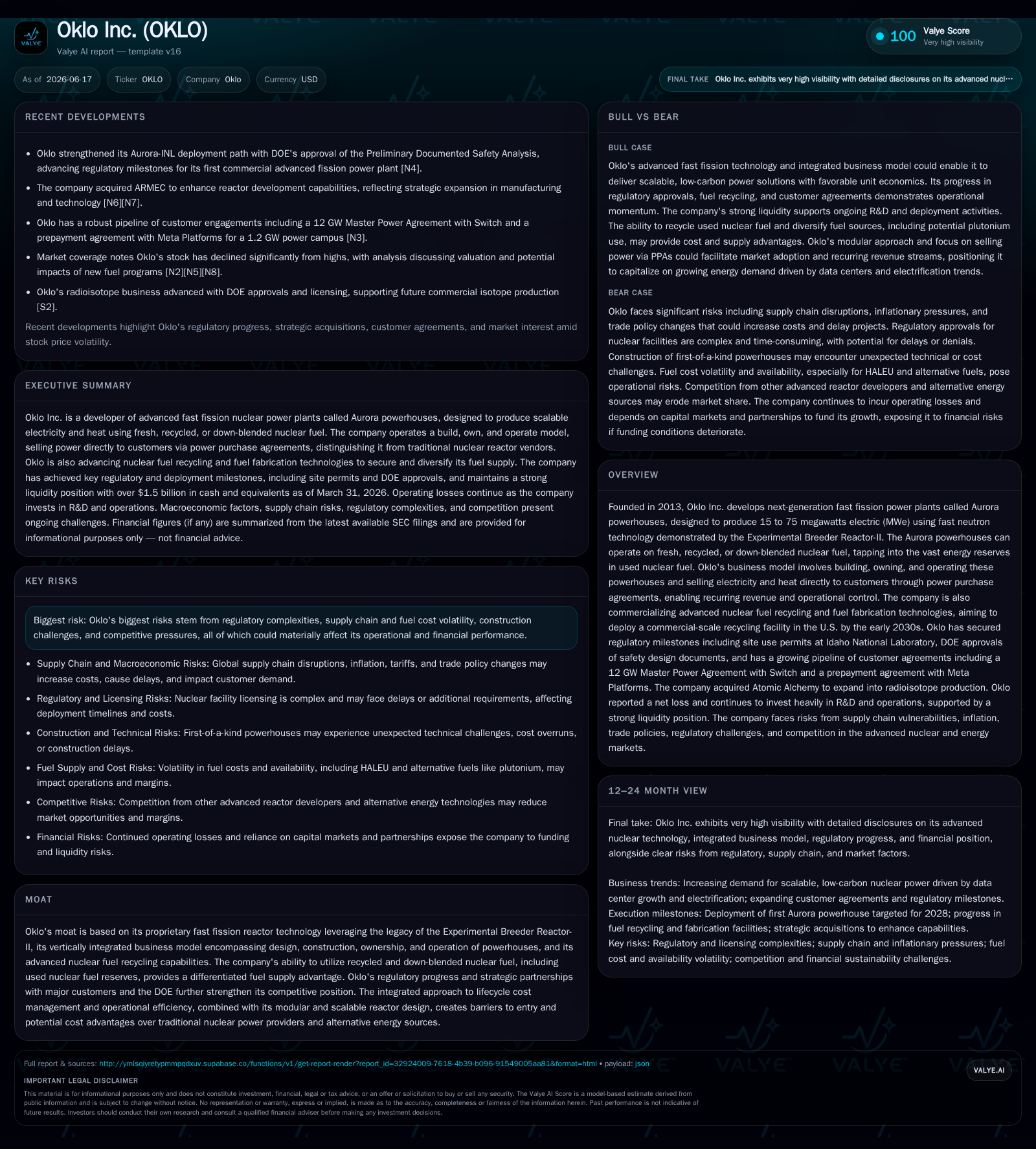
Oklo’s Q1 2026 10-Q underscores tangible headway in regulatory approvals, notably at Idaho National Laboratory, alongside fuel supply advancements pivotal to its Aurora fast fission powerhouses. The company’s vertically integrated model spans reactor design, ownership, operation, fuel recycling, and fabrication, targeting first absolute commercial deployment by 2028. While market engagement expands with partners like TVA and Meta Platforms, supply chain complexities and regulatory scrutiny remain key constraints shaping near-term execution risk and capital needs.
Quarterly Operating Update: Regulatory Progress & Market Engagements
Oklo’s most recent quarterly report filed on May 12, 2026 [S2], reveals distinct operational momentum centered on regulatory achievements and evolving commercial opportunities. The company secured a pivotal site use permit from the U.S. Department of Energy (DOE) at the Idaho National Laboratory (INL), coupled with an Environmental Compliance Permit following rigorous DOE environmental reviews [S2][S13]. These regulatory milestones concretely advance the feasibility of constructing their first Aurora powerhouse — a key step transitioning from R&D toward physical deployment.
Complementing these permits are successful submissions and approvals of critical safety documentation for the Aurora Fuel Fabrication Facility at INL including the Nuclear Safety Design Agreement and Preliminary Documented Safety Analysis (PDSA) [S2][S12]. These filings represent early stages in a five-step DOE authorization process that serves as a regulatory precursor before full licensing by the Nuclear Regulatory Commission (NRC). Furthermore, Oklo’s collaboration with Argonne and INL has yielded a comprehensive end-to-end demonstration of advanced fuel recycling processes — a tangible indicator of technical readiness in their proprietary fuel cycle advancement.
On the commercial front, Oklo disclosed expanded dialogues with major customers such as Tennessee Valley Authority (TVA), including prospects of recycling TVA’s used fuel and potential power sales from future Aurora units situated in TVA’s service region [S2][S13]. An earlier prepayment agreement inked with Meta Platforms aligns funding mechanisms directly to nuclear fuel procurement supporting the development of a sizable data center-focused power campus in Ohio [S13][S17]. These engagements underscore growing market validation especially within industrial and hyperscale computing sectors where baseload low-carbon power is increasingly coveted.
Despite this constructive progress, the company reiterates challenges prevalent across the advanced nuclear sector: supply chain constraints impacting procurement timelines for specialized reactor components, macroeconomic influences on construction costs, regulatory complexity entwined with safety assurance requirements, and technological design refinements necessary to meet stringent standards [S1][S2]. The evolving landscape requires continual adaptive risk management as milestones approach.
Innovative Business Model Centered on Aurora Powerhouses and Fuel Recycling
Oklo operates under an integrated business model encompassing the full lifecycle of advanced nuclear power production: reactor design derived from legacy Experimental Breeder Reactor-II (EBR-II) fast neutron technology; modular, transportable Aurora powerhouses configured between 15-75 MWe; ownership and operation ensuring delivery accountability; alongside complementary endeavors in advanced nuclear fuel recycling and fabrication [S1][S2]
Revenue generation is anticipated mainly through long-term power purchase agreements (PPAs) selling clean electricity and heat directly to end users or utilities who value reliable baseload low-carbon energy [S1]. This contrasts traditional large-scale nuclear players that often rely on wholesale electricity markets or regulated tariff models. Oklo’s ability to leverage recycled or down-blended fuel feedstocks — including high-assay low-enriched uranium (HALEU) sourced from recovered irradiated EBR-II material — creates a differentiated cost structure improving potential margin profiles over time.
Further cementing vertical integration strategy, Oklo is advancing a pilot-scale fuel fabrication facility concurrent with plans for an anticipated $1.68 billion commercial-scale Advanced Fuel Center in Tennessee dedicated to converting used nuclear fuel into reactor-ready assemblies [S2]. This facility is expected to capture synergies in lifecycle cost management by internalizing supply risks associated with specialty fuels ubiquitous across fast reactor technologies.
Embedded safety features inherited from fast fission designs—encompassing inherent feedback mechanisms enabled by fast neutrons—support project bankability by easing regulatory acceptance hurdles traditionally faced by conventional reactors [S1]. This foundational safety distinction paired with modular architectural scalability fosters credible prospects for deployment agility across client sites requiring outputs from 15 MWe up to targeted expansions beyond 100 MWe.
Industry Context: Competitive Landscape & Regulatory Partnerships
Within the advanced nuclear energy ecosystem, Oklo juxtaposes against peers such as NuScale Power—known for small modular light-water reactors—and TerraPower which pursues alternative designs like traveling wave reactors. Unlike these peers focused mainly on thermal spectrum reactors or different core architectures, Oklo specializes in fast fission technology validated historically by EBR-II operations [S1].
The role of the Department of Energy remains central for both fostering innovation and regulating early-stage projects via pathways such as the Reactor Pilot Program administered by DOE/NRC cooperation frameworks [S12][S22]. Additionally, relationships with national laboratories like INL provide critical support infrastructure—for site access permits, environmental compliance reviews, material provision (such as HALEU from legacy EBR-II stocks), and experimental data acquisition validating plutonium-fueled systems [S12][S22]. Such cooperative government-industry partnerships mitigate early-stage licensing uncertainties.
Competitive pressures derive not only from fellow advanced reactor pioneers but also traditional utilities operating established plants (e.g., Toshiba-backed operators) and emerging renewable sources incentivized by fluctuating subsidy regimes. In this context, Oklo bets its technical differentiation on exploiting recycled nuclear material reserves inaccessible to other conventional approaches—materializing an embedded resource moat while navigating nuanced pricing dynamics across deregulated electricity markets [S11]
Growth Drivers: Rising Baseline Demand & Vertical Integration Advantages
Underlying demand momentum emanates primarily from rapidly expanding data centers powering AI/cloud platforms whose continuous computing cycles necessitate steady baseload energy impervious to intermittent renewables’ volatility [S2]. Corporate entities like Meta Platforms exemplify this trend through direct investment vehicles financing dedicated nuclear infrastructure assembly onsite.
Government incentives continue reinforcing capital flows favoring decarbonization targets incorporating advanced nuclear solutions capable of replacing fossil baseload plants without grid instability. Oklo’s modular reactor scalability allows tailoring deployments aligning capacity increments precisely with customer appetite ranging from industrial heat provision to medium-scale electricity needs.
Technical advances in fuel recycling unlock enormous latent value embedded within stockpiles of used nuclear fuel previously treated as waste streams—estimated energy reserves equating approximately five times Saudi Arabia’s oil reserves—which drastically enhances domestic fuel security while potentially lowering procurement costs over plant lifecycles [S1]. The planned Advanced Fuel Center represents a novel capability consolidating fuel cycle control internally.
Together these factors form an integrated value proposition enabling incremental build-out of Aurora powerhouse units built around flexible size thresholds correlated closely with top-tier clients’ bespoke energy requirements under clear long-term PPAs secures recurring revenue trajectories post-construction completion.
Key Risks: Supply Chain Constraints, Regulatory Complexity, Commercial Execution
Despite promising vectors for growth, Oklo faces multifaceted risks typical to capital-intensive advanced nuclear ventures. Regulatory delays may arise—particularly relating to NRC licensing steps beyond DOE permits—delaying construction start or operation certification timelines impacting financial burn rates [S1][S2].
Supply chain vulnerabilities persist notably due to reliance on scarce suppliers producing highly specialized reactor components unique to fast neutron systems or custom fabricated instrumentation essential for operations. Global geopolitical instabilities could exacerbate material availability or inflate costs amid inflationary pressures already complicating budget adherence [S1][S2].
Fuel availability poses distinct challenges; although HALEU constitutes part of near-term fueling options pending full recycling rollouts, its current production remains constrained nationally requiring coordination amidst competing government programs that also include plutonium-based fuels within dilute-and-dispose frameworks [S1][S12]
Market adoption risks encompass uncertainties around securing binding PPAs rather than non-binding letters of intent or preliminary agreements which still limit revenue visibility [S1]. Contracts often include rights allowing customer backout due to shifting economics or policy change undermining project bankability until more mature operation history accrues
Personnel retention likewise figures among known risks given reliance on expertise-heavy staff pivotal for navigating evolving technical licensing regimes alongside complex project execution phases involving multi-year construction activities challenging bench strength across engineering disciplines [S1]
What to Watch: Milestones in Construction & Licensing, New PPA Signings, Fuel Recycling Facility Progress
Investors will want to monitor forward-looking milestones tightly tethered to key operational KPIs evident in forthcoming quarters:
- Complete submission and approval stages along DOE/NRC licensing pathways exceeding preliminary documented safety analyses,
- Constructive updates pertaining to physical site preparation activities at INL aligned with targeted late-2027/early-2028 Aurora powerhouse commissioning,
- Announcements evidencing formal binding PPAs beyond existing letters signaling material commercial traction,
- Progress on pilot-scale fuel fabrication facility commissioning plus groundwork on commercial Advanced Fuel Center investment license trajectory,
- Evidence around supply chain deepening reducing lead-time variability particularly sourcing specialized components uniquely tailored for fast-spectrum reactors [S2][S3]
Such markers collectively serve as leading indicators corroborating timeline fidelity amidst typical industry development fractals.
Financial Snapshot: Capital Resources Supporting Long Development Phase
As of March 31, 2026, Oklo holds $1.59 billion in cash and equivalents with current assets totaling approximately $2.23 billion against current liabilities near $37 million, resulting in a current ratio of about 60x, reflecting a strong short-term liquidity position ([F1]). Low outstanding debt of approximately $42.6 million as of June 30, 2024, and a net cash position of about $1.55 billion at the same date indicate a conservative leverage stance ([F1]). Capital management remains critical given the multiyear horizon before achieving cash flow breakeven after first unit commercialization.
This analysis synthesizes publicly filed SEC reports through June 2026 focusing specifically on operational updates grounded in hard disclosures without forecasting speculative timelines or outcomes beyond stated company positions. It contextualizes Oklo’s development within broader advanced nuclear sector attributes emphasizing technological differentiation balanced against systemic risks endemic to pioneering clean energy infrastructure projects.
Disclaimer: This is research-only, informational analysis and not investment advice. It may include AI-generated interpretation and general industry context. Always verify important details using primary sources.

Comments