
Strive's Bitcoin Treasury Strategy Faces Integration and Market Challenges
Latest quarterly disclosures reveal capital structure adjustments and emerging risks amid bitcoin-driven asset management expansion.
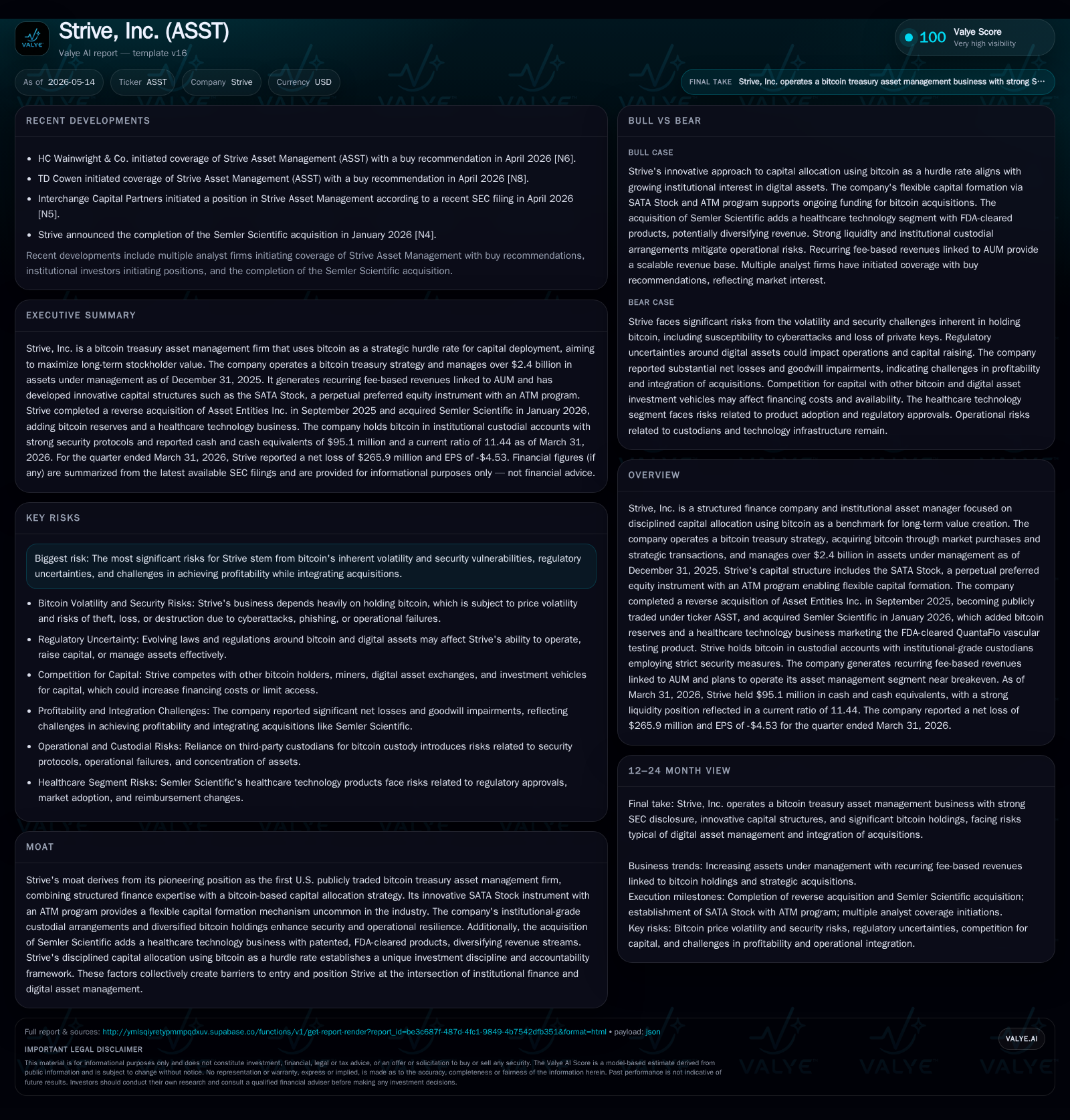
Strive, Inc., the first U.S. publicly traded bitcoin treasury asset manager, reported in its latest quarter notable private exchanges of convertible notes for SATA Stock and steady operational positioning. The company maintains over $2.4 billion in AUM anchored by a bitcoin hurdle rate strategy and innovative perpetual preferred equity known as SATA Stock, enabling flexible capital formation. Recent developments include acquisition integration risks from Semler Scientific's healthcare business and continuing regulatory challenges, while Strive aims to balance growth in bitcoin reserves with discipline amid inherent market volatility.
Recent Operating Update: Q1 2026 Dynamics
Strive’s latest quarterly filing dated May 14, 2026 [S2] reveals that the company executed privately negotiated exchanges where holders of $90 million principal amount of Semler Scientific’s 4.25% Convertible Senior Notes swapped their debt holdings for approximately 929,999 shares of Strive's Variable Rate Series A Perpetual Preferred Stock (SATA Stock). This move highlights active balance sheet management to reduce debt via equity issuance without public offerings. No repurchases of Class A common stock occurred during the quarter.
The accompanying May 14 8-K [S3] confirms release of Q1 financial results with no material changes to risk factors disclosed previously. The detailed release underscores Strive’s commitment to transparent reporting as it navigates a complex consolidation phase post its reverse acquisition in September 2025.
Other operating remarks from the latest filings suggest steady liquidity levels with cash and equivalents at approximately $95 million as of quarter-end [F1], supported by a healthy current ratio exceeding 11x. This liquidity foundation is critical given bitcoin market volatility and integration expenses related to recent acquisitions.
Business Model: Bitcoin Treasury Asset Management with Structured Finance Innovation
Strive functions at the crossroads of institutional asset management and structured finance innovation centered on bitcoin. Its core strategy employs bitcoin not just as an asset class but as the hurdle rate benchmark guiding all capital allocation decisions [S1]. This uncommon approach demands outperforming a currency believed to appreciate over time rather than traditional fiat benchmarks.
Revenue generation stems primarily from managing over $2.4 billion in assets under management (AUM) as of December 2025 [S1]. Fee structures align with increasing AUM, positioning Strive for scalable recurring income streams. Fee income is supplemented by strategic deployment of balance sheet assets into bitcoin purchases directly or through market transactions.
The unique SATA Stock instrument illustrates Strive’s drive to modernize capital markets financing—offering investors a perpetual preferred equity security combined with an at-the-market (ATM) program allowing nimble capital raises absent reliance on fixed-income or common stock issuances [S1]. This flexibility supports both liquidity needs and responsive deployment without diluting common shareholders excessively.
Post-acquisition integration includes operations acquired from Semler Scientific—a healthcare technology company marketing its FDA-cleared QuantaFlo vascular diagnostic device. This diversification introduces a non-bitcoin revenue stream potentially stabilizing operating income over time but requires navigating complex regulation inherent in medtech sectors [S1].
Industry Structure and Competitive Position
Strive occupies a pioneering niche as the first U.S.-based publicly traded firm deploying a bitcoin treasury strategy supported by structured finance mechanisms. Within the broader structured finance and digital asset ecosystem, few competitors combine these elements at scale.
Key competitors are fragmented across traditional asset managers expanding into crypto exposure; however, most lack Strive’s unique perpetual preferred instrument structure or explicit bitcoin hurdle rate framework. Moreover, institutional custody relationships enhancing security posture underscore the firm’s operational resilience against cyber or fraud risks.
The healthcare business segment inherited from Semler Scientific distinguishes Strive further by blending fintech-style capital allocation with regulated medical device commercialization—a juxtaposition requiring sophisticated compliance capabilities.
Growth Drivers
- Bitcoin Reserve Expansion: As markets permit, Strive deploys excess cash into purchasing bitcoin incrementally to grow reserve assets measured against a appreciating benchmark.
- Capital Formation via SATA Stock: ATM issuance capability enables ongoing financing tied to convertible preferred shares offering flexibility to fund bitcoin accumulations or acquisition opportunities without traditional bank borrowing.
- Acquisition-Led Diversification: Healthcare technology revenues from QuantaFlo devices provide an additional top-line source beyond crypto asset appreciation dynamics.
- Market Adoption Trends: Increasing institutional appetite for regulated bitcoin exposure could expand Strive’s AUM base through managed accounts or partnership arrangements.
- Operational Leverage: Scaling fee-bearing assets improves margins amidst controlled operating costs focused around single-digit million dollar profitability targets [S1].
Risks and Watchpoints
- Bitcoin Volatility: The intrinsic price swings in bitcoin can materially fluctuate asset valuations affecting returns relative to SATA Stock dividend costs and net income stability.
- Regulatory Environment: The healthcare segment faces continuing oversight due to prior False Claims Act settlements triggering corporate integrity agreements [S6]. Any non-compliance risks could escalate penalties or curtail operations.
- Integration Complexity: Merging Semler Scientific operations while maintaining disciplined focus on core treasury strategies presents execution risk possibly weighing on near-term profitability.
- Capital Structure Dilution: Frequent issuances under ATM programs require careful monitoring to manage shareholder dilution especially if bitcoin markets remain turbulent.
- Legal Contingencies: Pending shareholder litigation concerning disclosures around DOJ investigations into Semler activities adds uncertainty although current expectations deem no material adverse impact likely [S6].
What to Watch Next
Key indicators for upcoming quarters include:
- Updates on total bitcoin holdings growth relative to available cash flow.
- Volume and pricing details for any additional SATA Stock issuances via ATM programs signaling capital formation tempo.
- Progress reports on FDA clearance expansions or new product launches related to QuantaFlo diagnostics enhancing healthcare revenues.
- Regulatory filings or announcements addressing compliance adherence within acquired healthcare operations.
- Operating margin trends reflecting cost control amid scaling efforts.
- Any changes in dividend policies or adjustments in dividend rates on the preferred stock tranche impacting investor yield perception [S16].
Financial Snapshot (As of March 31, 2026) [F1]
Latest financial snapshot
| Metric | Value | Period |
|---|---|---|
| Cash & equivalents | $95mm | |
| 2026-03-31 | ||
| Current assets | $151mm | |
| 2026-03-31 | ||
| Current liabilities | $13mm | |
| 2026-03-31 | ||
| Current ratio | 11.44x | |
| 2026-03-31 |
Source: SEC companyfacts cache [F1].
This analysis synthesizes SEC filings through May 14, 2026 ([S1], [S2], [S3], etc.) alongside financial snapshot data ([F1]) without offering investment advice or recommendations.
Disclaimer: This is research-only, informational analysis and not investment advice. It may include AI-generated interpretation and general industry context. Always verify important details using primary sources.

Comments