
AMREP’s Land Concentration: Opportunity and Exposure in New Mexico’s Real Estate Cycle
AMREP Corporation’s substantial landholdings in Sandoval County anchor its value, but recent declines in land sales and operating income highlight the risks inherent in geographic and customer concentration. With a strong balance sheet but variable revenues, the company’s future hinges on local housing demand, regulatory approvals, and its ability to diversify both its customer base and geographic footprint.
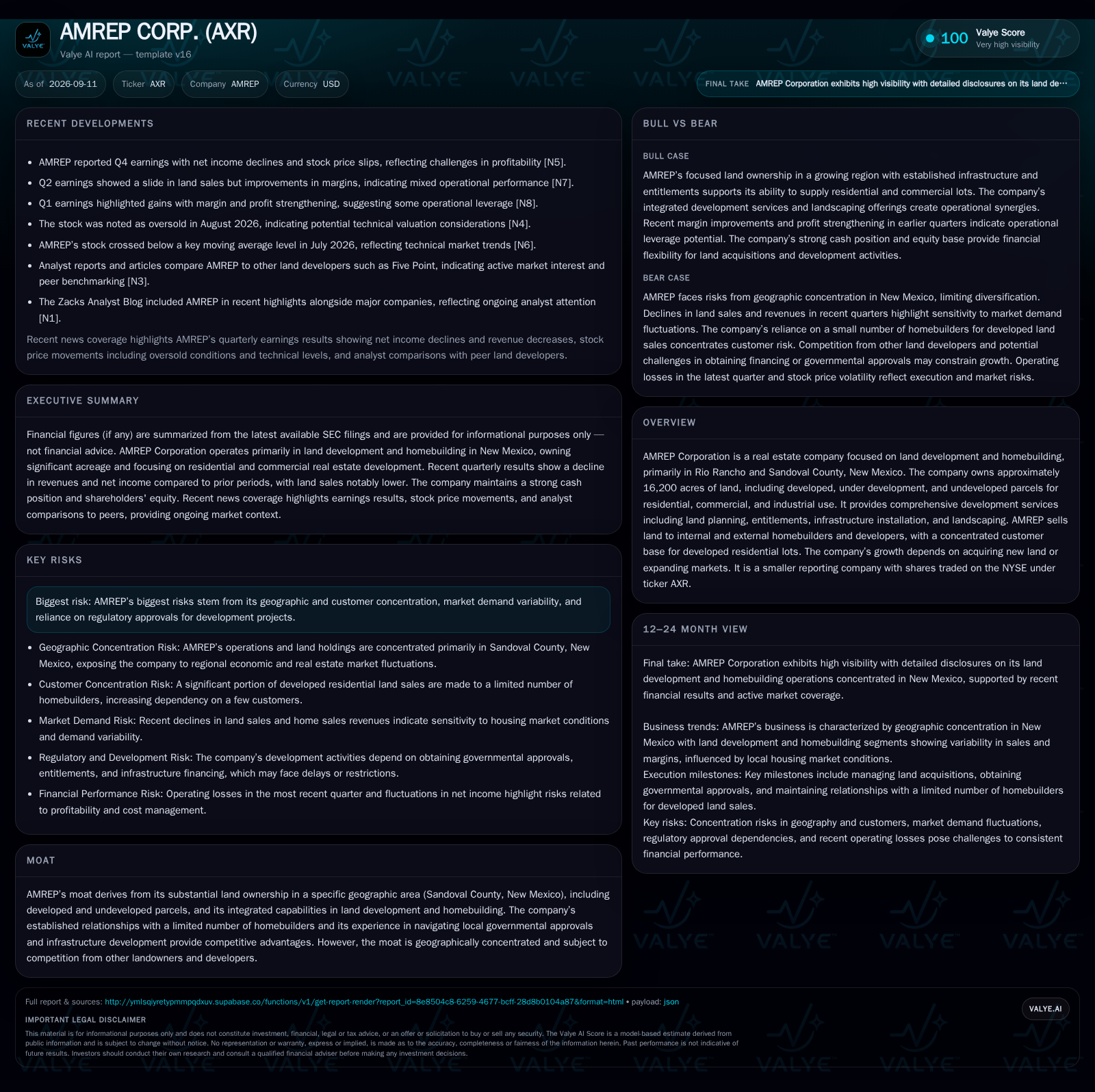
AMREP is a land developer and homebuilder with 16,200 acres concentrated in Sandoval County, NM. Recent quarters saw a sharp drop in land sales and a swing to operating loss, despite a robust cash position. The company’s performance is tightly linked to local housing trends and a small set of customers, exposing it to demand shocks and competitive risks. Growth depends on successful land acquisitions, regulatory approvals, and potentially broader market reach. Watch for sales rebound, customer diversification, and capital deployment as tests of the thesis. [S1] [S2] [N5] [N7] [N8]
AMREP Corporation’s profile as a land developer and homebuilder is defined by its dominant land position in Sandoval County, New Mexico—a region with a history of population growth but also exposure to real estate cycle fluctuations. Despite holding nearly 16,200 acres and maintaining a strong cash position, AMREP’s recent financial results show significant revenue and profit volatility, with the latest quarter marked by a sharp drop in land sales and a swing to operating loss. The company’s fortunes are closely tied to the health of the local housing market, a concentrated customer base, and its ability to secure new projects. The question for investors is whether AMREP can translate its asset base into sustained earnings and reduce its vulnerability to market swings.
Recent Revenue Decline Tests the Resilience of AMREP’s Land Business
The most striking current fact is the significant decline in AMREP’s revenues for the quarter ended July 31, 2026: total revenues dropped to $6.05 million from $17.85 million in the prior year period, with land sale revenues falling sharply to $173,000 from $7.49 million. This contraction drove an operating loss of $163,000, compared to a prior-year profit. Despite these setbacks, AMREP retains $48.7 million in cash and cash equivalents and $141.1 million in shareholder equity, suggesting reported liquidity position to weather market volatility or pursue new investments. The company’s land sales remain concentrated among just three homebuilders, highlighting customer dependency. These facts underscore AMREP’s exposure to regional real estate cycles and the importance of both cash management and customer diversification in its business model. [S1] [S2]
How AMREP’s Land Model Converts Acreage into Cash Flow
AMREP’s economics are fundamentally driven by converting raw land into finished lots for sale or lease to homebuilders and commercial developers. The company’s value chain includes land acquisition, entitlement, infrastructure development, and site improvements—activities that require significant upfront capital and long lead times before revenue is realized. Pricing is influenced by local market demand, lot size, and development stage, with higher-margin sales possible when market conditions are robust and infrastructure is already in place.
The fixed cost base (land carrying costs, development expenses, regulatory approvals) creates operating leverage: when volumes are high, incremental sales can drop through at attractive margins, but when volumes fall—as in the most recent quarter—fixed costs can quickly erode profitability. AMREP’s strong cash position may allow it to acquire land counter-cyclically or invest in infrastructure when competitors pull back, but this strategy is only effective if demand recovers. The company’s model is capital-intensive and exposed to the timing of both sales and regulatory approvals, making cash flow lumpy and sensitive to local housing cycles.
Concentration as Double-Edged Sword: Moat and Exposure in Sandoval County
AMREP’s competitive position is defined by its large, contiguous landholdings in Sandoval County, which provide scale advantages in development planning, infrastructure negotiation, and local regulatory navigation. The company’s integrated approach—combining land development, entitlement, and landscaping services—may offer operational synergies and lower costs per lot relative to smaller landholders.
However, this concentration is also a vulnerability. AMREP faces direct competition from other regional developers and landowners, as well as from substitute geographies if builders or buyers shift preferences. Its limited geographic footprint means market share is high locally but nonexistent elsewhere, and its customer concentration—sales to just three homebuilders—puts pricing and volume at risk if any partner slows activity or switches to a competitor. Regulatory delays, shifts in local zoning, or a downturn in the New Mexico housing market could disproportionately affect AMREP’s results.
Unlocking Value: What a Local Housing Rebound Could Mean for AMREP
A favorable scenario for AMREP would see a resurgence in housing demand in the Rio Rancho/Sandoval County area, driving increased lot sales and improved pricing. If new single-family home starts return to or exceed previous highs, AMREP could sell more lots at higher margins, leveraging its fixed cost base for stronger profitability. Successful acquisition and entitlement of new parcels would further extend the runway for growth.
Confirmation of this scenario would come from a sustained increase in quarterly land sale revenues, a broader customer base (reducing reliance on three buyers), and visible commitments from homebuilders for future development phases. Signs of local population or job growth, as well as positive trends in building permits, would further support the outlook. Conversely, if land sales and starts remain stagnant, the upside case would be undermined.
Local Market Cyclicality Likely to Drive Volatile, But Positive, Earnings
The most plausible mid-term path for AMREP is continued earnings volatility tied to the rhythms of the New Mexico housing market. The company is likely to experience periods of strong revenue and margin when housing starts are robust, followed by leaner quarters when demand slows. Its strong balance sheet provides a buffer to absorb swings and potentially invest opportunistically, but sustained growth will require either a broader customer base or expansion into new geographies.
Evidence supporting this scenario would include a return to operating profitability in subsequent quarters, stabilization or growth in land sale revenues, and continued reported liquidity position. If operating losses persist or customer concentration worsens, the base case would shift toward a more bearish outlook.
Prolonged Weakness in Sales Could Erode Asset Value and Strategic Options
In a negative scenario, a continued slump in local housing demand—due to economic downturn, oversupply, or shifting demographics—would suppress land sales for multiple quarters. Fixed development and holding costs could lead to recurring operating losses, gradually eroding cash reserves and limiting AMREP’s ability to invest in new projects or weather further adversity. Customer concentration risk would be heightened if one or more homebuilders reduce purchases or exit the market.
Evidence for this outcome would include several consecutive quarters of low or negative land sale revenues, shrinking cash balances, or asset impairments. Regulatory or legal hurdles that delay new developments would further exacerbate downside risk. A lack of new land acquisitions or pipeline announcements would also signal limited growth prospects.
Milestones That Will Test AMREP’s Ability to Convert Land into Profitable Growth
Quarterly land sale revenues and volume of lots sold, especially compared to prior-year periods, will indicate whether demand is recovering or deteriorating.
The number and diversity of homebuilder customers—if disclosed—would show whether AMREP is reducing its customer concentration risk.
Cash and cash equivalents relative to development and acquisition outlays will reveal whether the company is deploying capital to expand its land base or simply preserving liquidity.
Updates on new land acquisitions or pipeline development announcements can serve as leading indicators for future growth.
The frequency and scale of regulatory approvals or entitlements obtained for new projects would help assess execution risk.
Trends in local housing starts and building permits in Rio Rancho/Sandoval County will provide external validation of market conditions.
Disclosure of any asset impairments or write-downs would signal pressure on land values or project economics.
Any expansion into new geographic markets or diversification of business segments would be a notable strategic development.
Disclaimer: This is research-only, informational analysis and not investment advice. It may include AI-generated interpretation and general industry context. Always verify important details using primary sources.

Comments