
Mesabi Trust: Royalty Revenue Volatility and the Iron Ore Price Threshold Dilemma
Mesabi Trust’s income model is exposed to iron ore price swings, with recent quarters seeing bonus royalties vanish as product prices fell below the critical threshold. The Trust’s cash reserves and structure offer resilience, but its fate remains tightly coupled to commodity cycles and third-party decisions.
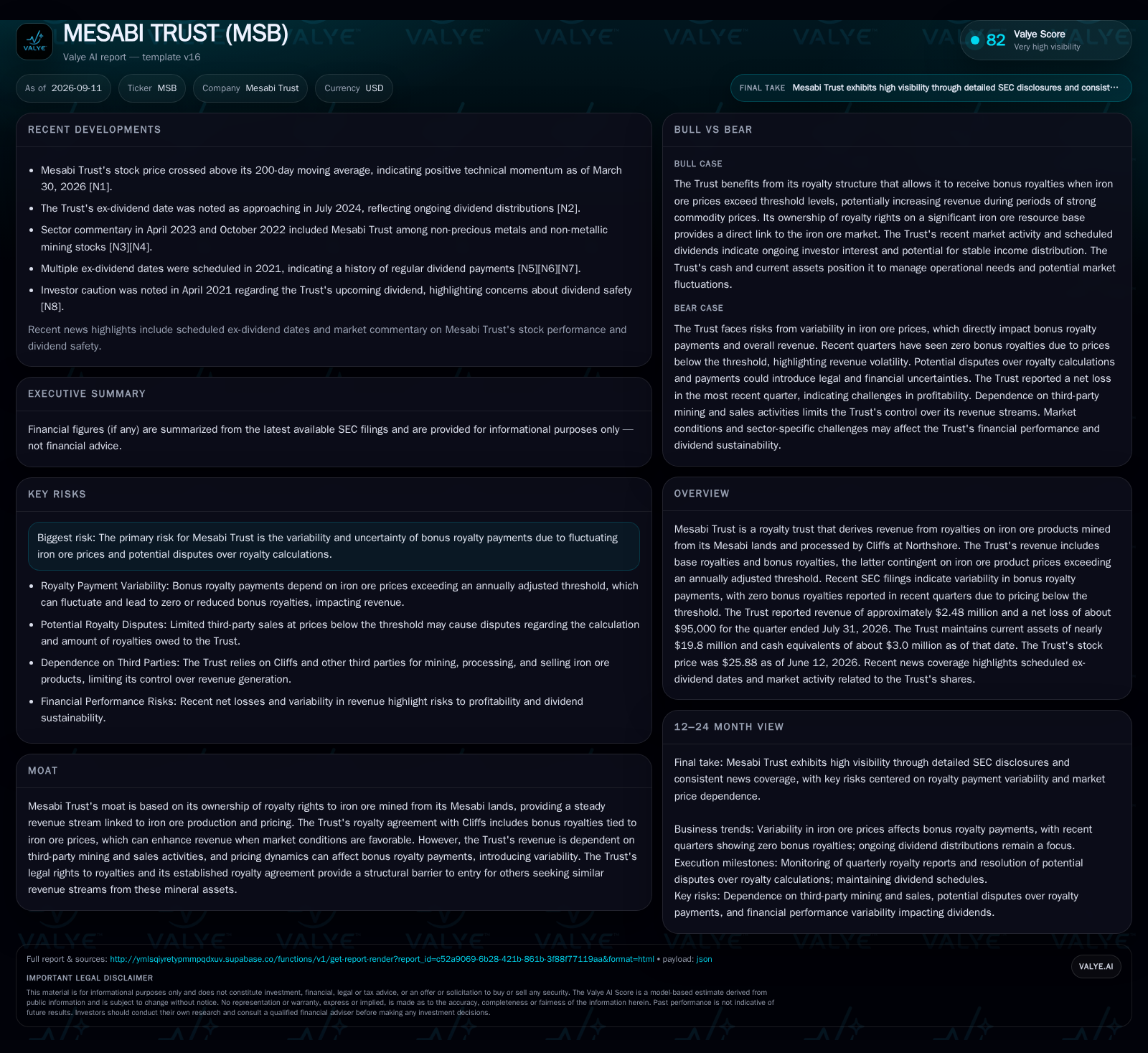
Mesabi Trust’s most recent quarters saw zero bonus royalties, a rare event driven by iron ore prices falling below the annual threshold. This led to a net loss despite a $2.48 million revenue quarter and highlights the Trust’s acute sensitivity to commodity pricing. With $19.8 million in current assets and $3 million in cash, Mesabi remains solvent but faces ongoing uncertainty about future royalty flows and dividend sustainability, as bonus payments hinge on volatile market conditions and third-party operator actions. [S2]
Mesabi Trust’s royalty-revenue structure offers investors direct exposure to the iron ore market, but that exposure cuts both ways. Recent quarters have delivered a stark demonstration of this reality: with iron ore product prices falling below the all-important threshold, the Trust received no bonus royalties—a first in many years. This has led to a net loss, and raises pointed questions about the sustainability of future distributions, especially as the Trust’s fortunes are largely determined by pricing and actions taken by its mining operator, Cliffs. The company’s healthy current asset base offers some buffer, but its fate remains tied to commodity cycles and royalty agreement mechanics. [S2]
Bonus Royalty Drought Shifts Mesabi’s Risk Profile
The most material recent development is that Mesabi Trust received zero bonus royalties in the fiscal quarters ended April 30 and July 31, 2026, due to Cliffs selling iron ore products below the $71.70 per ton threshold—a first in many years. This resulted in reported revenue of $2.48 million for the July quarter and a net loss of approximately $95,000, or -$0.0072 per share. As of July 31, 2026, the Trust’s current assets were $19.8 million, with $3 million in cash and equivalents. These facts matter because bonus royalties historically contributed significant upside, and their absence exposes the Trust to greater volatility and downside risk, particularly if iron ore prices remain subdued or if disputes over royalty calculations intensify. [S2]
How Royalty Mechanics Drive Revenue Volatility
Mesabi Trust’s business model is straightforward but highly sensitive to external forces. The Trust does not operate mines; instead, it receives base royalties on all iron ore produced and sold from its lands, plus bonus royalties if realized sales prices exceed an annually adjusted threshold ($71.70/ton in 2026). Base royalties provide a degree of revenue stability, but bonus royalties—ranging from 0.5% to 3% of gross proceeds—can represent a significant share of income in strong markets. The Trust’s cost structure is lean, with minimal operating expenses, which means that changes in royalty inflows have a near one-to-one impact on distributable cash and bottom-line results.
However, Mesabi’s economics are largely outside its control, as both production volumes and sales prices are determined by Cliffs, the operator. The Trust does not require significant capital expenditure, but its cash flow is exposed to sharp swings in commodity prices and the mix of end-market demand (e.g., steel mills versus export customers). Operating leverage is high in the sense that incremental bonus royalties flow almost entirely to the bottom line, magnifying both upturns and downturns. If iron ore prices remain below the threshold for extended periods, the Trust’s revenue could shrink to the level of base royalties alone, challenging dividend sustainability.
Structural Advantages and Inherent Limitations in the Royalty Trust Model
Mesabi Trust’s moat stems from its exclusive royalty rights on a substantial iron ore resource—an asset that cannot be easily replicated or bypassed. This provides a structural barrier to entry for would-be competitors and ensures a direct economic link to regional iron ore production. In an environment of rising commodity prices, the Trust can benefit disproportionately from its bonus royalty feature.
However, its competitive position is constrained by a total dependence on Cliffs for mining, processing, and sales. The Trust cannot influence operating decisions, cost management, or sales strategy. This dependency introduces not only volatility but also counterparty risk: disputes over royalty calculations or changes in Cliffs’ production strategy could materially affect Mesabi’s revenue stream. Furthermore, the global iron ore market is influenced by macroeconomic trends, international trade policies, and steel industry cycles, all of which are beyond the Trust’s control. Substitution risk from alternative iron sources or shifts in steelmaking technology could also erode the long-term value of the Trust’s royalty stream.
Commodity Price Rally Could Restore Bonus Royalties and Dividend Momentum
A plausible upside scenario is a recovery in global iron ore prices, driven by increased steel demand, supply disruptions elsewhere, or favorable macroeconomic conditions. If realized prices for Cliffs’ iron ore products move back above the $71.70/ton threshold, bonus royalties would resume, potentially at historically strong levels. This would restore Mesabi’s revenue growth and support robust dividend distributions, which have historically attracted income-oriented investors.
Evidence that would confirm this scenario includes Cliffs reporting higher realized sales prices in future quarters, a return to positive net income for Mesabi, and announcements of resumed or increased dividend payments. Additional confirmation would come from industry data showing rising benchmark iron ore prices and improved steel mill utilization rates. Conversely, if Cliffs’ sales prices remain below the threshold or if disputes over royalty calculations persist, this upside would be delayed or muted.
Sustained Threshold Volatility Keeps Distributions Uncertain
The most plausible middle path is continued volatility around the bonus royalty threshold, with iron ore prices occasionally crossing above but frequently falling below the trigger point. Under this scenario, Mesabi Trust would see lumpy revenues, some quarters with only base royalties and others with modest bonus payouts. Dividend distributions could become less predictable, reflecting this variability.
This scenario would be confirmed by quarterly results showing intermittent bonus royalty payments, ongoing references to price threshold mechanics in SEC filings, and dividend announcements that fluctuate in size or frequency. Falsification would require a sustained trend in iron ore prices—either consistently above or below the threshold—leading to a more stable revenue pattern.
Prolonged Iron Ore Weakness and Disputes Threaten Trust Economics
A sustained period of low iron ore prices, driven by weak global demand, overcapacity, or technological shifts, could keep realized prices below the bonus royalty threshold for multiple years. In this environment, Mesabi Trust’s revenue would shrink to base royalties alone, potentially insufficient to cover all expenses or maintain meaningful distributions. The risk is compounded by possible disputes with Cliffs over royalty calculations, which could lead to legal costs or delayed payments.
This downside would be confirmed by consecutive quarters with only base royalties, ongoing net losses, reductions or suspensions of dividends, and disclosures of unresolved disputes in SEC filings. A further negative indicator would be a declining cash balance, suggesting that the Trust is funding distributions or operations from reserves rather than royalty income.
Data Points That Will Define Mesabi Trust’s Trajectory
Quarterly disclosure of realized iron ore product prices by Cliffs—if disclosed—relative to the bonus royalty threshold, as this directly determines the potential for bonus payouts.
The frequency and magnitude of bonus royalty payments in upcoming quarters, which will clarify the volatility or stability of Mesabi’s revenue stream.
Dividend announcements and ex-dividend dates, as changes in payout policy or amounts will signal underlying cash flow health and management’s outlook.
Updates on any disputes or legal proceedings with Cliffs regarding royalty calculations, as these could materially impact revenue timing and amounts.
Trends in Mesabi’s cash and current asset balances, particularly if net losses persist, as this will indicate the sustainability of operations and distributions.
Industry benchmarks for iron ore prices and steel production, which provide leading indicators for the Trust’s potential revenue swings.
Any changes in Cliffs’ operational strategy, production volumes, or mix of end customers, as these factors influence both the volume and price realization for Mesabi’s royalty stream.
SEC filing commentary on the annual adjustment of the bonus royalty threshold, as shifts in this benchmark could alter the probability of future bonus payments.
Disclaimer: This is research-only, informational analysis and not investment advice. It may include AI-generated interpretation and general industry context. Always verify important details using primary sources.

Comments