
Guidewire’s Cloud Platform: Subscription Strength Fuels Insurance Innovation
Guidewire Software’s focus on cloud-native, AI-augmented core systems for property and casualty insurers has delivered stable profitability and reported liquidity position. As the insurance industry accelerates digital transformation, Guidewire’s multi-year contracts and deep integration into insurer operations create high switching frictions, but long sales cycles and intensifying competition remain persistent counterforces.
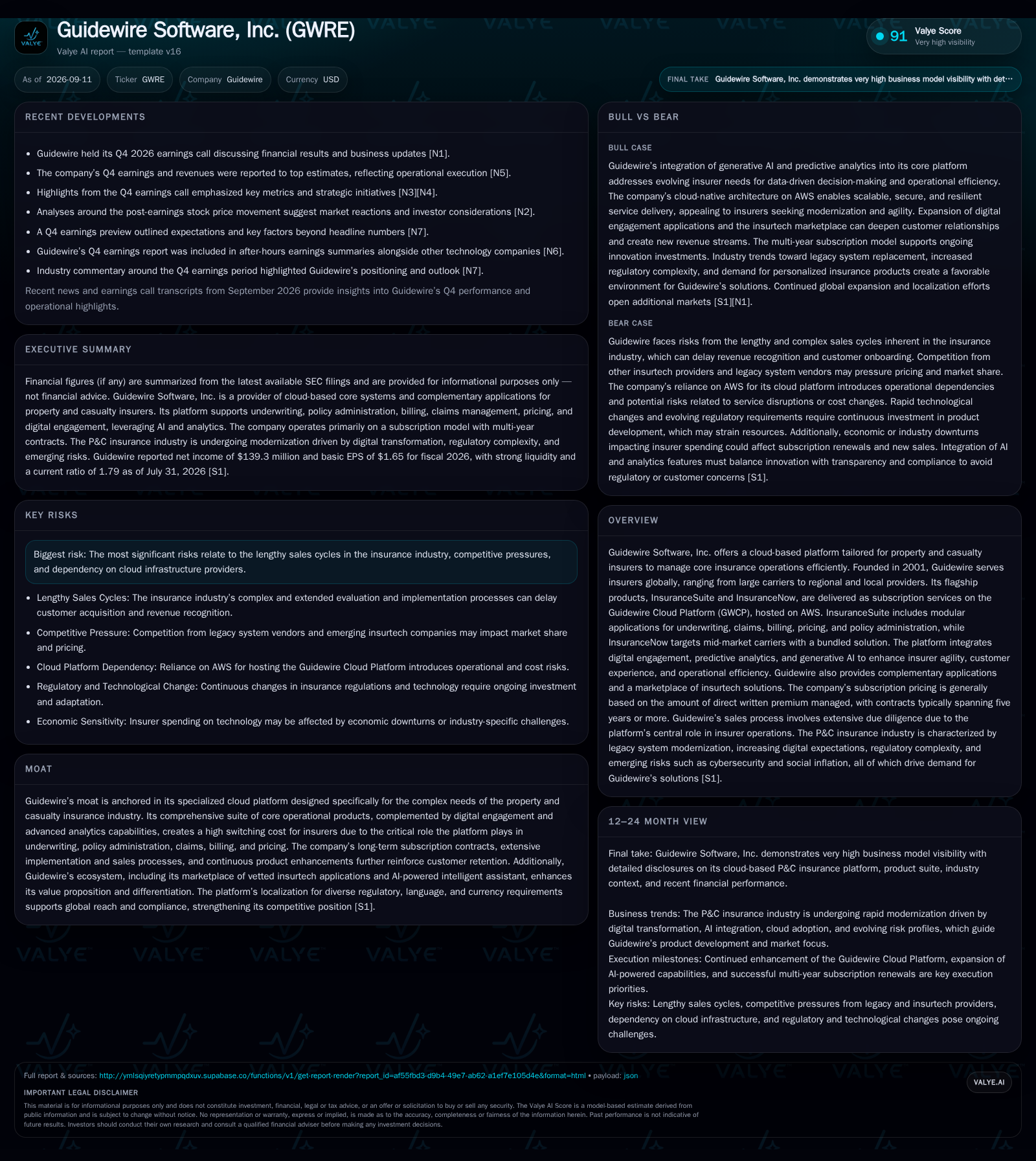
Guidewire Software reported $139.3 million in net income and a current ratio of 1.79 for fiscal 2026, reflecting solid profitability and liquidity. Its core cloud platform—delivered via multi-year subscription contracts—anchors the company in the ongoing modernization of P&C insurance operations. While Guidewire benefits from product breadth and embeddedness in insurer workflows, competitive and technological pressures, along with the industry’s inherently lengthy sales cycles, present ongoing challenges to growth and margin expansion. The evolution of AI-powered capabilities and customer renewal trends will be critical watchpoints for sustaining Guidewire’s moat [S1].
Guidewire Software sits at the intersection of insurance industry modernization and cloud-based enterprise software. The company’s core platforms—InsuranceSuite and InsuranceNow—are purpose-built for the complex, regulated world of property and casualty (P&C) insurance, offering end-to-end policy, billing, claims, and analytics solutions. Guidewire’s 2026 results show both profitability and a robust balance sheet, but the company’s future trajectory hinges on its ability to deepen customer entrenchment, leverage AI and data analytics, and outpace competitors in a market where switching costs are high but sales cycles are long. The next phase of growth will likely be shaped by the interplay between digital transformation urgency among insurers and Guidewire’s execution on cloud and AI initiatives [S1].
Performance Trends and Strategic Positioning Overview
Guidewire reported net income of $139.3 million and basic EPS of $1.65 for the fiscal year ended July 31, 2026, supported by cash and cash equivalents of $372.9 million and a current ratio of 1.79 as of that date. These figures signal continued profitability and a sound liquidity position; these figures do not by themselves establish operating, investment, or financing capacity.
The company’s core offerings, InsuranceSuite and InsuranceNow, are delivered as subscription services on the Guidewire Cloud Platform, hosted on AWS, and are deeply embedded in insurer operations. Guidewire’s typical contract structure is multi-year—often five years or longer—with pricing generally tied to the amount of Direct Written Premium managed on its platform [S1].
Recent quarterly earnings topped estimates, and management highlighted ongoing investments in AI, analytics, and digital engagement capabilities as central to the company’s competitive strategy [N1] [N5]. The combination of robust core functionality, evolving AI features, and a high-touch sales process positions Guidewire as a critical partner for insurers undergoing digital transformation.
Subscription Model’s Role in Revenue Growth and Margin Stability
Guidewire’s business model centers on multi-year subscription contracts for its cloud-based platforms, with pricing most often indexed to the volume of direct written premium (DWP) managed by each insurer. This structure aligns Guidewire’s revenue growth potential with the scale of its customers’ insurance businesses and provides a degree of recurring revenue visibility. The five-year (or longer) initial contract terms, often followed by annual renewals, help anchor long-term relationships and lower churn risk [S1].
The company’s cost structure features a mix of fixed costs—such as ongoing R&D, cloud operations, and customer support—and variable costs tied to professional services and incremental cloud hosting expenses. Gross margins may expand as more customers migrate to standardized cloud offerings and as AI-powered automation reduces support and implementation costs over time. However, the need for continuous investment in product development, AI, and compliance to keep pace with regulatory and technological change can limit operating leverage, particularly if the pace of new sales or upsells slows.
Guidewire’s liquidity position, with $372.9 million in cash and a current ratio of 1.79, suggests it is well-capitalized for continued investment in product innovation and potential bolt-on acquisitions, though capital intensity remains moderate versus pure software peers [S1].
Competitive Moats Built on Switching Costs and Ecosystem Integration
Guidewire’s competitive advantage is rooted in the mission-critical nature of its core P&C insurance platforms. Deep integration into underwriting, policy administration, billing, and claims workflows could increase switching costs: insurers face operational risk, regulatory complexity, and high implementation burdens when considering migration to alternative systems. This embeddedness is amplified by Guidewire’s extensive due diligence and reference-driven sales process, which can slow new logo growth but cements high retention among existing customers [S1].
The company’s moat is reinforced by its breadth of complementary applications (e.g., advanced rating, reinsurance management, digital engagement via the Jutro platform, and embedded AI assistants). Its insurtech marketplace and support for localization (regulatory, language, currency) enhance adoption in diverse global markets. Counterforces remain: established legacy vendors still serve large portions of the market, and new insurtech entrants are leveraging cloud-native architectures and AI to pursue segments where Guidewire is not yet entrenched. Additionally, dependency on AWS for hosting and the rapid evolution of AI capabilities create both operational risk and the need for ongoing differentiation.
AI Enhancements and Renewal Efficiencies as Growth Catalysts
A favorable scenario for Guidewire would see insurers accelerating legacy system replacement in response to regulatory mandates and competitive pressure for digital agility. In this world, Guidewire’s investments in generative AI, predictive analytics, and omnichannel digital engagement—coupled with its proven track record—position it as the default partner for large-scale P&C modernization projects.
Upside would manifest as above-trend net new customer wins, consistent multi-year renewals at higher contract values (driven by DWP growth and adoption of new modules), and rising gross margins as cloud migration and AI automation cut support and implementation costs. Confirmation would come from reported increases in new logo bookings, higher attach rates for analytics and AI modules, and commentary on expanding wallet share within the existing customer base. Sustained double-digit revenue growth, margin expansion, and stable or rising renewal rates would further validate the scenario.
Incremental Cloud Adoption and Product Updates Support Consistent Progress
The most plausible medium-term outcome is that Guidewire continues to convert legacy on-premises customers to its cloud platform at a measured pace, with renewals and upsells offsetting the slow, reference-driven sales cycle for new logos. The company maintains its role as a core technology partner for large and mid-market insurers, with subscription revenue growing in line with industry modernization trends and customer DWP expansion.
Margins gradually improve as more customers move to standardized cloud offerings and as incremental AI features streamline operations, but rising R&D and compliance costs limit dramatic operating leverage. Confirmation would be visible in stable renewal rates, modest improvements in gross and operating margins, and steady cash generation. Signs of product stickiness—such as limited customer churn and incremental adoption of complementary modules—would support this scenario.
Extended Sales Cycles and Pricing Challenges Limit Expansion Potential
A negative outcome could materialize if macroeconomic headwinds, regulatory uncertainty, or technological disruption cause insurers to delay modernization projects, resulting in elongated sales cycles and deferred revenue recognition. Intensified competition from both legacy vendors and agile insurtechs may force Guidewire to discount pricing or increase sales incentives, eroding margins.
Downside indicators would include declining or stagnating new bookings, lower renewal rates, margin compression due to competitive pricing or rising cloud costs, and increased customer churn. If reported financials reveal a slowdown in subscription revenue growth, negative operating leverage, or unexpected increases in customer acquisition cost, the thesis of high switching frictions and product indispensability would be called into question.
Key Developments Influencing Guidewire’s Market Position
Recurring revenue growth rate—particularly the proportion attributable to cloud-based subscriptions and new module adoption.
Renewal rates and net retention, if disclosed, to gauge customer stickiness and upsell effectiveness.
Gross margin trends as a function of cloud migration and operational efficiency gains from AI-driven automation.
Pace of new customer bookings and the time-to-close for large contracts, which would reveal whether sales cycles are lengthening or shortening.
Customer adoption and satisfaction with new AI-powered modules and digital engagement tools—product attach rates would be a useful indicator, if disclosed.
Any changes in Guidewire’s relationship with AWS or cloud hosting costs, given the operational dependency.
Geographic expansion metrics, especially traction in non-U.S. markets where regulatory and localization requirements are high.
R&D and product development spend as a percentage of revenue, to assess ongoing investment in innovation versus cost discipline.
Disclaimer: This is research-only, informational analysis and not investment advice. It may include AI-generated interpretation and general industry context. Always verify important details using primary sources.

Comments