
Allbirds 2026 Q2 Update: Closing U.S. Retail Stores and Focusing on E-Commerce
Allbirds shifts from physical retail to a digitally-led model supported by strong liquidity as it navigates a fundamental business transition.
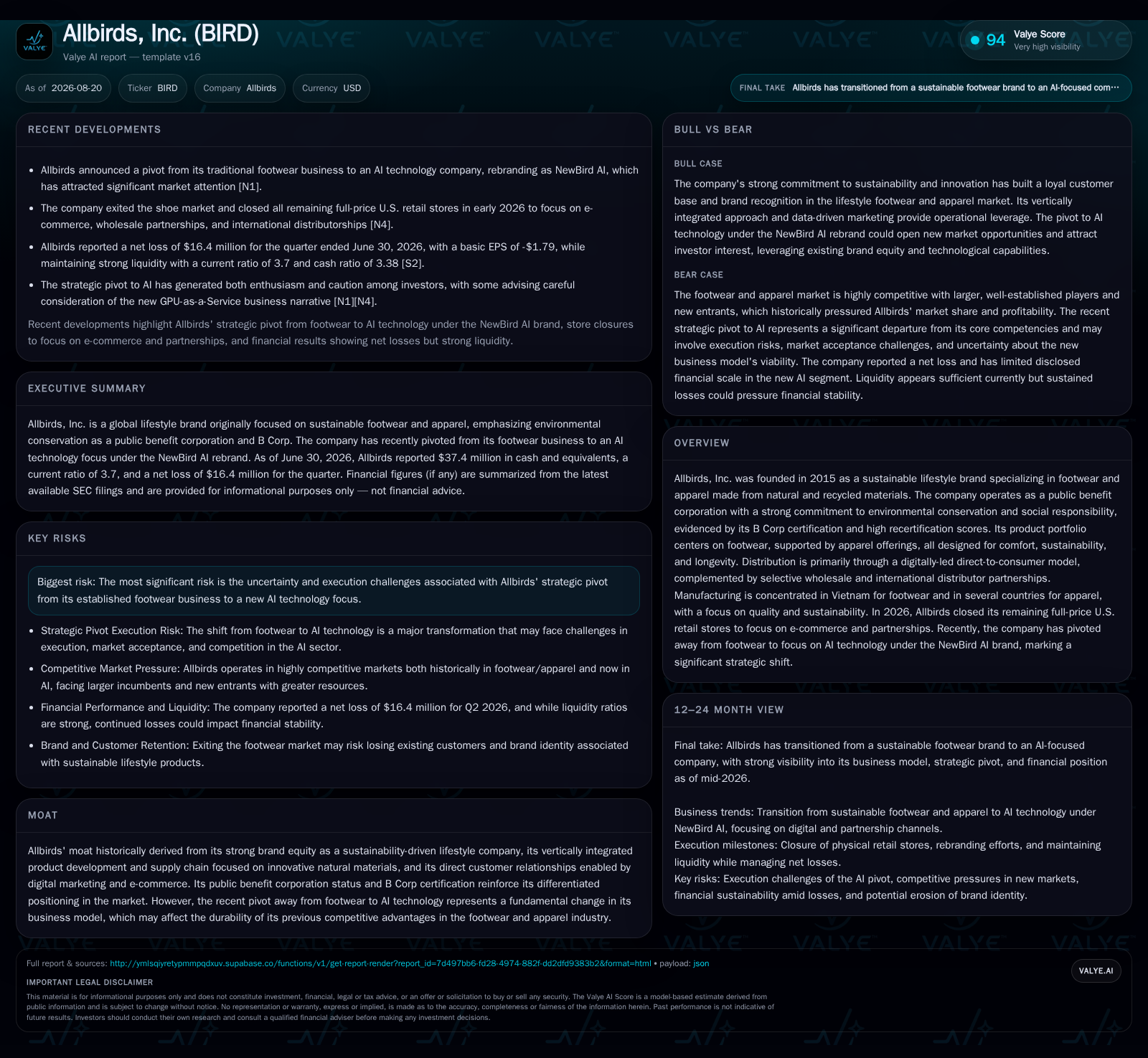
In Q2 2026, Allbirds, Inc. completed the closure of its remaining full-price U.S. retail stores, marking a strategic pivot toward a direct-to-consumer digital business supplemented by partnerships. This shift reflects a fundamental change in its footwear-driven revenue model. The company maintains a strong liquidity position with $37.4 million in cash and equivalents and a current ratio of 3.7 as of June 30, 2026, providing financial flexibility to support this transition. Execution risks remain as Allbirds seeks to grow its digital channels and integrate new AI technology initiatives.
Q2 2026 Operating Update and Strategic Pivot
In Q2 2026, Allbirds, Inc. closed its remaining full-price U.S. retail stores, marking a strategic shift from traditional brick-and-mortar footwear retail to a digitally-led direct-to-consumer (DTC) model and selective wholesale partnerships [S1][S2]. This transition fundamentally changes the company’s revenue drivers, as footwear—historically the majority of sales—is impacted by the elimination of physical retail locations.
The pivot aims to reduce fixed retail expenses, lowering the cost base, but introduces risks of short-term revenue disruption by removing direct consumer touchpoints and increasing reliance on digital marketing and partnerships [S1][S2]. Success depends on Allbirds’ ability to grow e-commerce channels and maintain customer engagement without physical stores.
Financial Position and Liquidity Analysis
As of June 30, 2026, Allbirds held $37.4 million in cash and equivalents and reported a current ratio of 3.7, indicating strong liquidity and ample working capital to support the transition [F1]. Current assets totaled $40.9 million against current liabilities of $11.1 million. Total debt was $17.4 million as of March 31, 2026, reflecting manageable leverage relative to liquidity [F1].
Maintaining sufficient cash and working capital could be important to fund the transition and manage operational needs during this period.
Business Model and Competitive Positioning
Allbirds operates as a digitally-led lifestyle brand focused on sustainable footwear and apparel made from natural and recycled materials [S1]. Its vertically integrated product development combines strategy, sustainability, design, sourcing, and production to deliver comfortable, durable, and environmentally responsible products. Materials include superfine ZQ certified merino wool, tree fibers, and sugarcane, offering benefits like temperature regulation and odor control.
Revenue is generated primarily through direct sales on e-commerce platforms, supplemented by wholesale and international partnerships [S1]. The closure of physical stores shifts channel mix, potentially affecting gross margins and cash conversion. Margins depend on product and channel mix, cost of goods sold—including sustainable materials—and promotional activities. The digital-first approach leverages Allbirds’ strong brand equity and sustainability credentials to maintain customer loyalty and drive repeat purchases.
The company’s direct-to-consumer strategy is supported by organic marketing fueled by valuable content and a rich data ecosystem, enabling a diversified marketing funnel that optimizes return on investment [S1]. This is increasingly important as the retail footprint contracts.
Competitive advantages include strong brand equity as a sustainability-driven lifestyle brand, vertically integrated product development, and direct customer relationships through digital and wholesale channels. Constraints include risks from the strategic pivot and loss of physical retail presence.
Scenario Analysis and Risks
Two primary scenarios emerge from the strategic pivot. In a bullish case, successful execution of digital and AI initiatives could enhance operating margins and customer engagement, offsetting retail closures. Indicators would include sequential digital revenue growth, improved gross margins, and positive customer metrics [S1][S2][F1]
The bear case involves execution challenges causing prolonged revenue declines and margin pressure [S2][F1]. Loss of retail presence may reduce brand visibility and sales, while AI investments could increase expenses without immediate returns. Although fixed retail costs decline, short-term revenue disruption risks rise.
Key watchpoints include quarterly digital revenue growth, gross margin trends reflecting channel and product mix, operating expenses related to AI initiatives, cash burn and liquidity in coming quarters, and customer acquisition and retention post-store closures [F1][S2]. These will be critical to assessing Allbirds’ ability to navigate this business model transformation.
Business Economics Considerations
Closing full-price U.S. retail stores reduces fixed costs such as leases, utilities, and retail personnel, improving operating leverage if digital sales scale effectively. However, digital channels involve higher variable costs for customer acquisition, fulfillment, and returns. Balancing these costs against e-commerce scalability is essential.
Wholesale and international partnerships introduce margin variability and reliance on third-party execution. Sustainable materials may carry higher costs than conventional alternatives, so managing cost of goods sold, inventory turnover, and markdowns is vital to maintain gross margins.
Cash conversion cycles may improve with faster inventory turnover and direct receivables control in a digital model. However, loss of retail stores could impact customer acquisition costs and lifetime value, key metrics in DTC businesses.
Grounded Watchpoint
A critical watchpoint is Allbirds’ ability to sustain and grow digital sales to offset revenue lost from store closures. The removal of physical retail eliminates a significant revenue and brand presence channel. Monitoring e-commerce growth, digital marketing effectiveness, and customer retention will provide early signals of pivot success.
Additionally, the financial impact of AI technology initiatives requires close observation. While potentially beneficial long-term, these investments may increase near-term operating expenses. Tracking AI-related expenses alongside gross margin trends will be essential to evaluate cost management during this strategic shift.
The closure of Allbirds’ remaining full-price U.S. retail stores marks a structural shift reducing fixed retail costs but introducing short-term revenue disruption risks. Business economics considerations highlight changes in cost structure, margin dynamics, and cash conversion inherent in the digital transition. Key watchpoints include digital sales growth, margin trends, AI-related operating expenses, and liquidity metrics, which will be critical to assessing Allbirds’ ability to execute its strategic pivot and sustain competitive positioning in the sustainable lifestyle market.
Disclaimer: This is research-only, informational analysis and not investment advice. It may include AI-generated interpretation and general industry context. Always verify important details using primary sources.

Comments