
CTO Realty Growth Q2 2026: Portfolio Stability and Capital Recycling Support Earnings Beat
CTO Realty Growth’s Q2 2026 results highlight stable rental income and portfolio diversification, underpinning cash flow resilience amid retail sector risks.
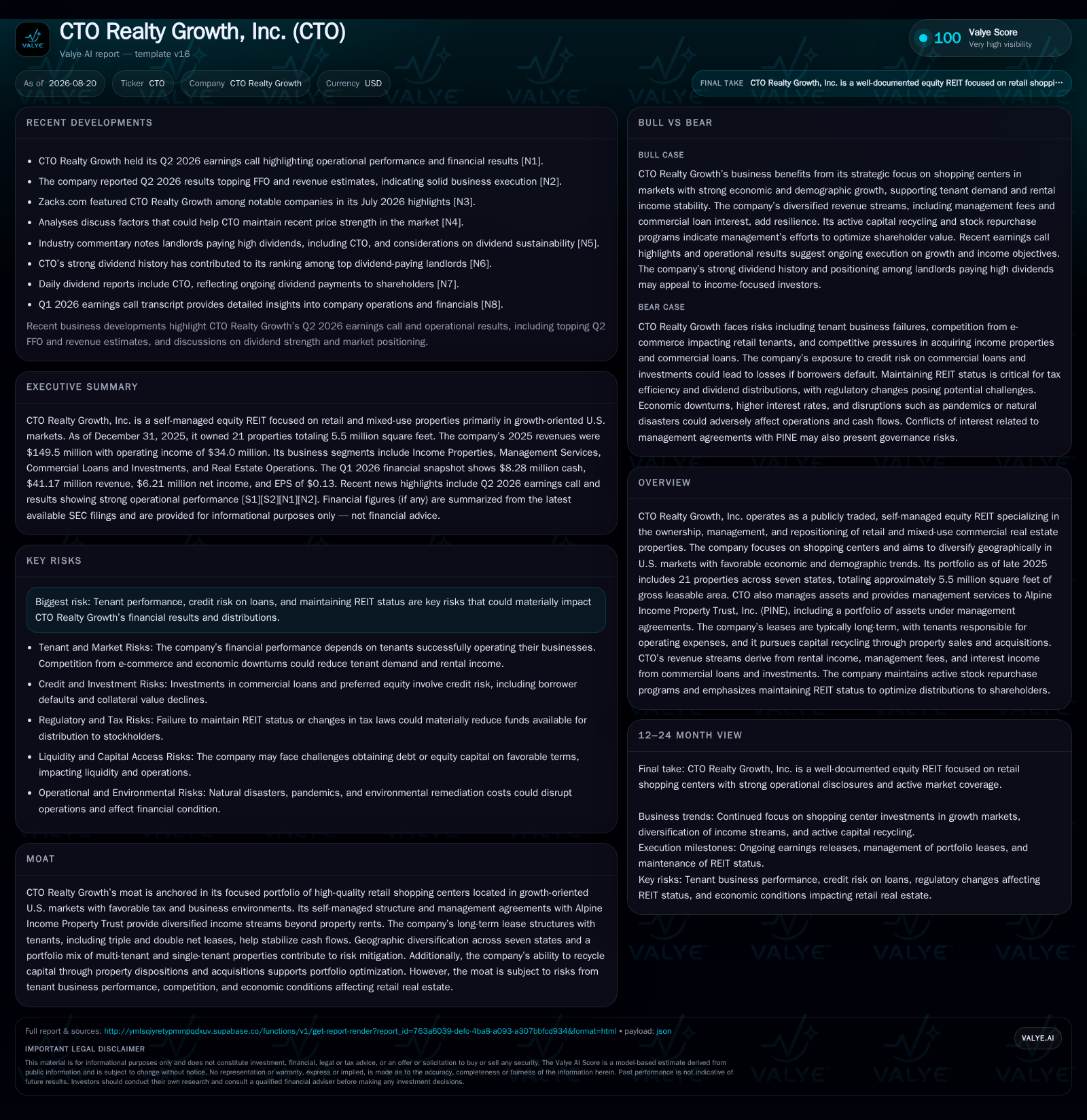
CTO Realty Growth, Inc. reported stable operating performance for Q2 2026, driven by a diversified portfolio of 21 retail and mixed-use properties across seven U.S. states. The company’s long-term triple and double net leases support predictable rental income, while capital recycling through property sales and acquisitions continues to optimize the portfolio. Management fees from asset management agreements with Alpine Income Property Trust provide additional revenue diversification. As of Q1 2026, the company maintained net debt of approximately $641 million with cash of $8.3 million, reflecting leverage consistent with prior periods but warranting monitoring given retail market risks.
Q2 2026 Operating Performance and Portfolio Update
CTO Realty Growth, Inc. reported stable operating results for the second quarter of 2026, reflecting resilience in its retail-focused real estate portfolio amid ongoing sector challenges [S2]. The company’s portfolio comprises 21 retail and mixed-use properties totaling approximately 5.5 million square feet of gross leasable area, geographically diversified across seven U.S. states [S1][S2]. This geographic spread helps mitigate localized economic risks and supports consistent rental income streams.
The company’s leases are predominantly long-term triple and double net leases, under which tenants assume responsibility for operating expenses such as maintenance, taxes, and insurance [S1][S2]. This lease structure reduces landlord cash flow volatility by limiting CTO’s exposure to fluctuating property operating costs, thereby supporting the predictability and stability of rental income.
The Q2 2026 results included an earnings beat, driven by stable rental income and supplemented by management fees, confirming the effectiveness of CTO’s portfolio composition and lease strategy in maintaining cash flow stability [S2]. The long-term nature of the leases and tenant responsibility for expenses underpin this stability, which is crucial in the retail real estate sector where tenant performance can be cyclical.
Business Model and Revenue Diversification
CTO Realty Growth’s business model centers on owning and managing retail shopping centers and mixed-use commercial properties leased primarily under triple and double net leases [S1]. Tenants pay rent plus operating expenses, which supports margin stability by shifting typical landlord costs to tenants. This structure is a common approach in retail REITs to stabilize cash flows and reduce operating expense variability.
Beyond rental income, CTO generates management fees through asset management agreements with Alpine Income Property Trust, providing a meaningful and diversified revenue stream [S1]. This diversification reduces reliance solely on rental income and can enhance overall revenue stability.
Capital recycling is an ongoing activity for CTO, involving the sale of select properties and acquisition of new assets as part of portfolio management [S1][S2]. If the company divests underperforming or non-core assets and acquires properties in growth-oriented markets, this could potentially enhance earnings growth prospects and align the portfolio with favorable demographic and economic trends.
Balance Sheet and Financial Position
Capital allocation continues to emphasize portfolio optimization through property sales and acquisitions rather than expansion of leverage or equity issuance [S2]. This disciplined approach supports maintaining balance sheet stability while pursuing earnings growth.
Risks and Scenario Analysis
Tenant credit risk remains a key vulnerability for CTO, as retail tenants’ financial health directly affects occupancy rates and rental income [S1][S2]. The retail real estate sector is subject to cyclical economic conditions, including shifts in consumer behavior and retail sales trends, which can impact tenant performance and leasing activity.
One plausible bull scenario is that an improvement in retail market conditions and tenant credit quality could drive higher occupancy rates and rental rate growth for CTO. This would enhance cash flow, support dividend growth, and validate the company’s focus on growth-oriented markets and long-term leases [S1][S2]. Confirmation would come from rising same-property net operating income, improved lease renewal rates, and positive management commentary.
Conversely, a bear scenario involves intensifying retail sector headwinds leading to increased tenant defaults, higher vacancies, and rent concessions. This would pressure cash flows and distributions, especially if capital recycling efforts are hampered [S1][S2]. Signs confirming this scenario would include rising tenant delinquencies, negative same-property performance, and leasing challenges highlighted by management.
Conclusion and Watchpoints
CTO Realty Growth’s Q2 2026 operating results demonstrate stable rental income and an earnings beat supported by its diversified retail portfolio and long-term lease structures. The company’s capital recycling strategy and management fee income contribute to portfolio optimization and revenue diversification, respectively. However, tenant credit risk and retail market cyclicality remain critical risks requiring close monitoring.
Key watchpoints for investors include upcoming occupancy and lease renewal rates, trends in tenant credit quality and delinquency, capital recycling activity through property acquisitions and dispositions, and management commentary on retail market conditions. Additionally, future balance sheet disclosures will be important to assess any changes in leverage or liquidity that could affect financial flexibility.
Overall, CTO’s portfolio and business model support cash flow stability amid retail sector uncertainties, but the company’s performance will continue to depend on tenant health and effective portfolio management.
Disclaimer: This is research-only, informational analysis and not investment advice. It may include AI-generated interpretation and general industry context. Always verify important details using primary sources.

Comments