
Chubb Ltd Q2 2026: Underwriting Discipline and Investment Income Drive Earnings Growth
Chubb Ltd’s Q2 2026 results highlight stable underwriting profitability and a 12.3% rise in net investment income, supported by a strong capital base and diversified global operations.
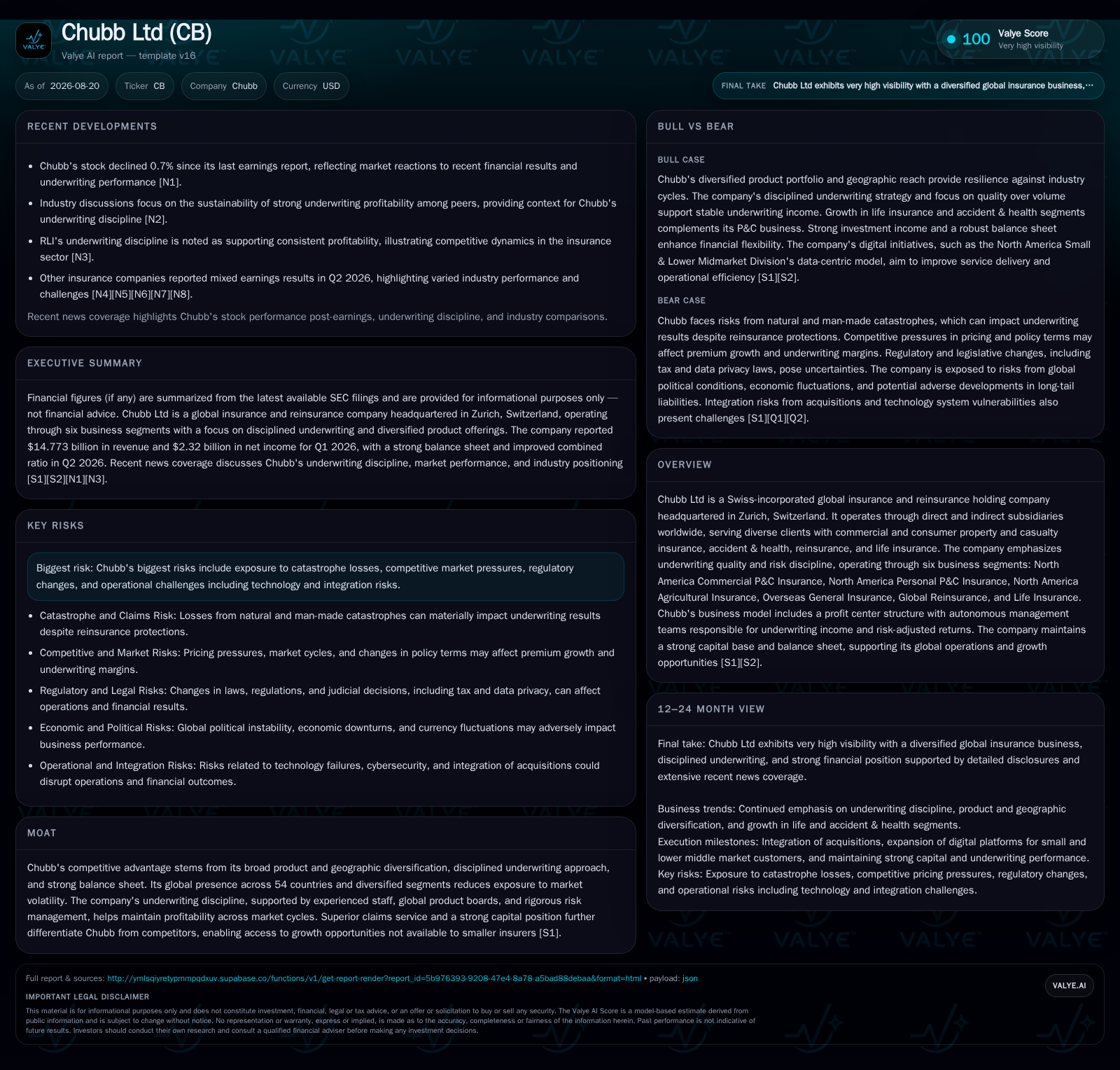
In Q2 2026, Chubb Ltd demonstrated continued underwriting discipline with stable property and casualty (P&C) operating results excluding its Life Insurance segment. Net investment income increased 12.3% year-over-year to $1.76 billion, reflecting effective asset management. The company maintains a strong capital position with $75.4 billion in shareholders’ equity and manageable debt of $18.1 billion, underpinning its underwriting capacity and financial flexibility. Geographic and product diversification across 54 countries and six business segments further supports earnings stability amid market and regulatory challenges.
Chubb Ltd reported stable underwriting income and a 12.3% increase in net investment income to $1.76 billion for Q2 2026 compared to Q2 2025, reflecting disciplined risk selection and effective pricing strategies across its property and casualty (P&C) and Corporate segments [S2]. These results highlight Chubb's ability to generate profitable underwriting income while growing investment returns, which are critical drivers of the company's earnings and capital generation. The company excludes its Life Insurance segment from these measures due to its differing economic behavior, focusing instead on the P&C operations that are most economically similar [S2].
The company’s approach emphasizes quality underwriting over volume, employing clearly defined authorities and global product boards to maintain consistency and best practices worldwide. This strategy supports a profitable book of business throughout market cycles, reducing volatility from catastrophe losses and competitive pricing pressures [S1]. The stable underwriting results in Q2 2026 demonstrate Chubb’s ability to sustain earnings through disciplined risk management.
Investment Income Growth and Asset Management
Net investment income, a critical contributor to Chubb’s overall earnings and cash flow, increased by 12.3% year-over-year to $1.76 billion in Q2 2026, up from $1.57 billion in Q2 2025 [S2]. This growth reflects effective asset management, particularly higher income from fixed maturities and private equity investments. Investment income enhances the company’s financial flexibility by providing cash flow that supports dividend payments and capital deployment.
The investment portfolio’s composition and yield are central to sustaining this income growth [S2]. Chubb’s ability to manage its investment assets prudently amid changing interest rate environments is a key factor in maintaining earnings stability. The increase in net investment income contributes materially to the company’s profitability and capital generation, complementing underwriting income.
Capital Resources, Liquidity, and Balance Sheet Strength
As of June 30, 2026, Chubb reported total financial debt of $18.1 billion, up modestly from $17.2 billion at the end of 2025, alongside shareholders’ equity of $75.4 billion, reflecting a strong capital base [S2][S13]. This capital position supports underwriting capacity, credit ratings, and the company’s ability to maintain dividend policies.
Liquidity is maintained through multiple sources, including a $3.0 billion syndicated credit facility expiring in December 2030, additional credit lines totaling $4.3 billion, and repurchase agreements amounting to $3.4 billion with maturities over the next two months [S13]. The company’s positive cash flows from underwriting and investment activities further underpin operational stability.
Maintaining financial covenants and access to capital markets remains essential for Chubb’s flexibility. While the current credit facilities provide a buffer against short-term timing mismatches in cash flow, any disruption in credit availability could pose risks [S13]. To date, Chubb has not experienced difficulty accessing credit or establishing new facilities, which supports its ongoing operations and strategic initiatives.
Business Model and Competitive Positioning
Chubb operates globally in 54 countries through six business segments, offering a diversified mix of property and casualty insurance, accident and health insurance, reinsurance, and life insurance products [S1][S2]. This geographic and product diversification reduces exposure to localized risks, market cycles, and catastrophe events, supporting earnings stability and growth opportunities.
The company’s revenue model centers on premiums collected from commercial and consumer policyholders worldwide [S1]. Underwriting income arises from premiums minus claims and expenses, while investment income is generated from invested premiums and reserves. Life insurance segment income also contributes but is analyzed separately due to its distinct economic profile.
Chubb’s competitive advantage lies in its disciplined underwriting, broad diversification, and strong capital base. The company enforces strict underwriting standards and risk selection criteria, supported by global product boards and a robust audit function. Superior claims and risk management services further enhance its market position [S1].
Economic Implications and Risk Considerations
The stable underwriting income and increased net investment income in Q2 2026 suggest Chubb’s potential to generate earnings and maintain capital adequacy [S2]. Underwriting discipline helps control loss and expense ratios, which are important to profitability in the cyclical insurance industry. Meanwhile, investment income growth may bolster cash flow, potentially enabling capital deployment and shareholder returns.
However, the insurance sector remains exposed to catastrophe losses, competitive pricing pressures, and investment market volatility. Chubb’s diversified operations and capital position could provide some resilience, but adverse developments might erode underwriting margins and investment returns.
Watchpoints for Investors
Key metrics to monitor in upcoming quarters include the combined ratio, which measures underwriting profitability, and the trajectory of net investment income amid changing interest rates. Capital adequacy and debt levels should also be observed to assess financial flexibility. Additionally, disclosures on catastrophe losses and reserve developments will provide insight into risk exposures and underwriting performance.
Conclusion
Chubb Ltd’s Q2 2026 results affirm its disciplined underwriting approach and effective asset management, yielding stable P&C underwriting income and a 12.3% increase in net investment income. Supported by a robust capital base and diversified global operations, the company maintains financial strength and competitive positioning. Continued focus on underwriting discipline and investment income growth will be critical to sustaining earnings stability and capital generation in a dynamic market environment.
Disclaimer: This is research-only, informational analysis and not investment advice. It may include AI-generated interpretation and general industry context. Always verify important details using primary sources.

Comments