
Franklin Electric Q2 2026: 6% Sales Growth Driven by Acquisitions and Price Realization
Franklin Electric's Q2 2026 results reflect successful integration of acquisitions and pricing strategies, supporting revenue and operating income growth.
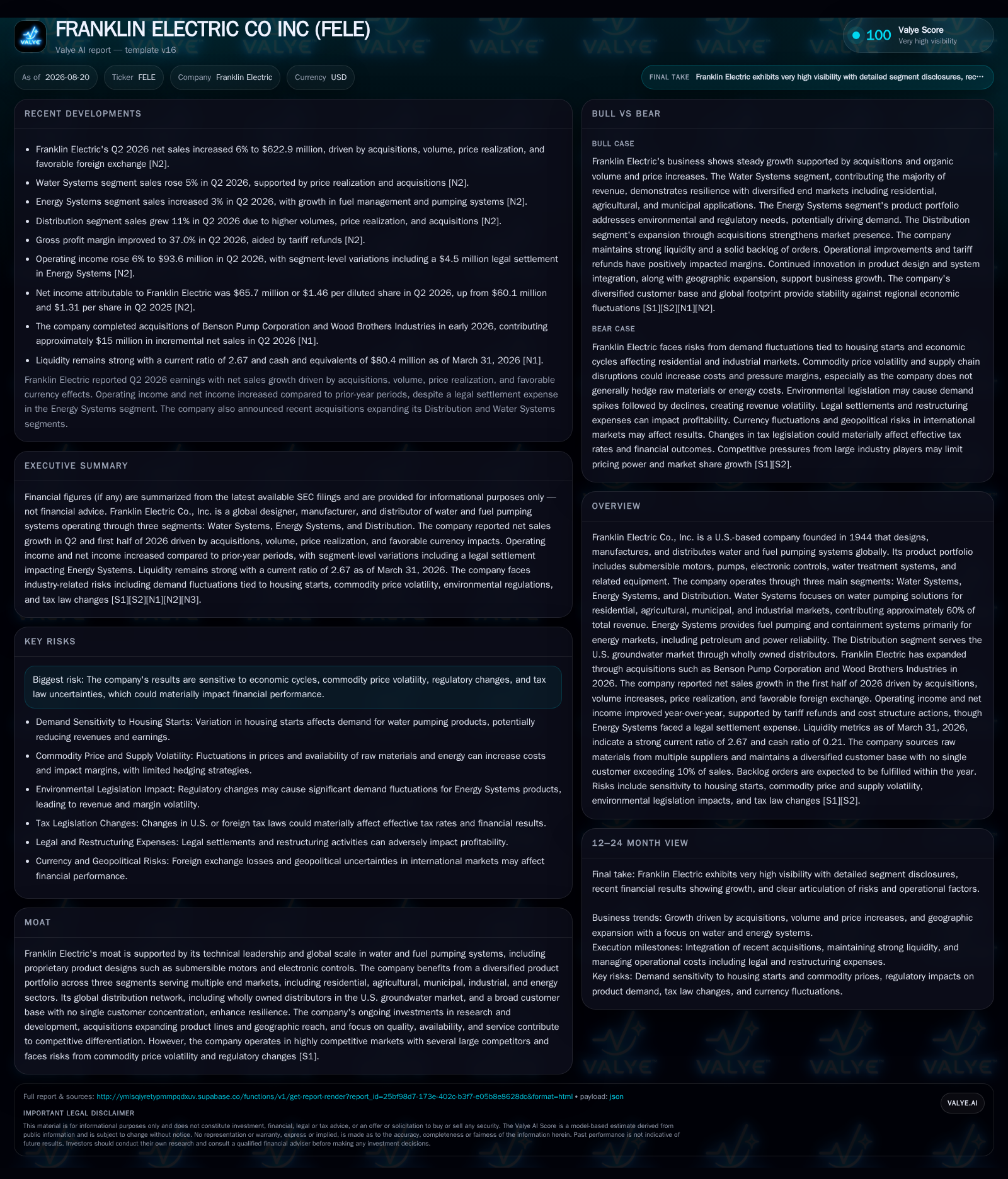
Franklin Electric Co., Inc. reported a 6% increase in net sales to $622.9 million in Q2 2026 compared to Q2 2025, driven by acquisitions, price and volume increases, and favorable foreign currency effects. Operating income rose 7% year-over-year to $141.7 million for the first six months of 2026, with gains primarily from the Water Systems and Distribution segments. The acquisitions of Benson Pump Corporation and Wood Brothers Industries contributed approximately $15 million in incremental sales, expanding the company's Distribution and Water Systems segments and supporting its strategic growth objectives.
Q2 2026 Operating Performance and Revenue Growth Drivers
Franklin Electric Co., Inc. reported net sales of $622.9 million in the second quarter of 2026, reflecting a 6% increase from $587.4 million in the same period of 2025 [S2]. The company’s operating income for the first six months of 2026 rose 7% to $141.7 million from $132.2 million in the prior year, with the Water Systems and Distribution segments delivering the majority of this improvement [S2].
Within the Water Systems segment, operating income increased by $4.4 million year-over-year to $109.7 million for the first half of 2026, reflecting improved segment profitability and operational leverage [S2]. The Distribution segment also showed strong performance, with operating income increasing by $4.5 million to $22.7 million year-to-date [S2].
Acquisition Impact and Strategic Expansion
In April 2026, Franklin Electric acquired Benson Pump Corporation, a professional groundwater distributor based in Arkansas, which operates within the Distribution segment [S2]. The following month, in May 2026, Franklin Electric acquired Wood Brothers Industries, a water treatment wholesale supplier based in Nebraska, which now operates as a subsidiary of the Water Systems segment [S2].
The addition of Benson Pump and Wood Brothers Industries enhances Franklin Electric’s distribution capabilities and water treatment product portfolio, aligning with its core markets and customer base, which includes water well contractors, specialty distributors, OEMs, and industrial and petroleum equipment distributors. These acquisitions are significant as they provide incremental revenue and support the company’s objective of expanding its footprint in the water systems and distribution markets [S2]
Financial Performance and Foreign Exchange Effects
Foreign currency transaction losses declined to $2.5 million in Q2 2026 from $4.5 million in Q2 2025, largely due to reduced transaction losses associated with the Argentine Peso and Turkish Lira relative to the U.S. dollar [S2]. This reduction in foreign exchange expense partially mitigated the overall expense impact on earnings, contributing positively to net income and cash flow.
Business Model and Competitive Positioning
Franklin Electric operates in the industrial manufacturing sector focused on water and energy systems, designing, manufacturing, and distributing water and fuel pumping systems, including submersible motors, pumps, electronic controls, water treatment systems, and related parts. Its customer base comprises water well contractors, specialty distributors, OEMs, and industrial and petroleum equipment distributors, among others [S1].
The company generates revenue primarily through transactional sales worldwide, facilitated by a combination of its employee sales force, independent manufacturing representatives, and wholly owned distributors [S1]. Trade terms are customary with limited extended credit, and product availability and quality are key drivers of customer demand. Franklin Electric’s competitive positioning is supported by technical leadership, proprietary patents, a diversified product portfolio, and a broad distribution network, although it faces competition from large peers such as Grundfos, Pentair, and Xylem.
Risks and Industry Context
Franklin Electric’s business is subject to risks common in the water and energy systems manufacturing sector. Demand is sensitive to economic cycles, including fluctuations in housing starts and commodity prices, which affect end markets such as residential water systems and energy infrastructure. Raw material cost volatility, especially in steel, copper, and plastics, can impact margins if the company is unable to pass through increased costs to customers [S1].
Additionally, tariffs and trade policy uncertainties pose risks to supply chain costs and competitive positioning. The company faces potential challenges from regulatory changes affecting groundwater pumping and environmental legislation impacting the Energy Systems segment. Integration risks related to recent acquisitions also warrant monitoring, as operational disruptions or cost overruns could affect near-term profitability [S1][S2].
Outlook and Watchpoints
The recent acquisitions of Benson Pump and Wood Brothers Industries materially contributed to Franklin Electric’s Q2 2026 revenue growth and segment expansion, supporting its strategic growth objectives. Price realization and volume growth alongside favorable foreign exchange translation indicate underlying demand resilience and pricing power in core markets. Continued successful integration of these acquisitions and stable market conditions could drive sustained revenue and operating income growth.
Investors should monitor subsequent quarterly filings for trends in revenue and operating income, progress on acquisition integration, foreign exchange impacts, raw material cost trends, and any developments related to tariffs or trade policy. These factors will be critical in assessing whether Franklin Electric can maintain its growth trajectory and margin expansion amid industry cyclicality and competitive pressures.
Disclaimer: This is research-only, informational analysis and not investment advice. It may include AI-generated interpretation and general industry context. Always verify important details using primary sources.

Comments