
Unum Group Q2 2026: Premium Growth and Underwriting Discipline Support Operating Resilience
Unum Group's Q2 2026 results demonstrate solid premium growth driven by disciplined underwriting and pricing amid claims and investment income pressures.
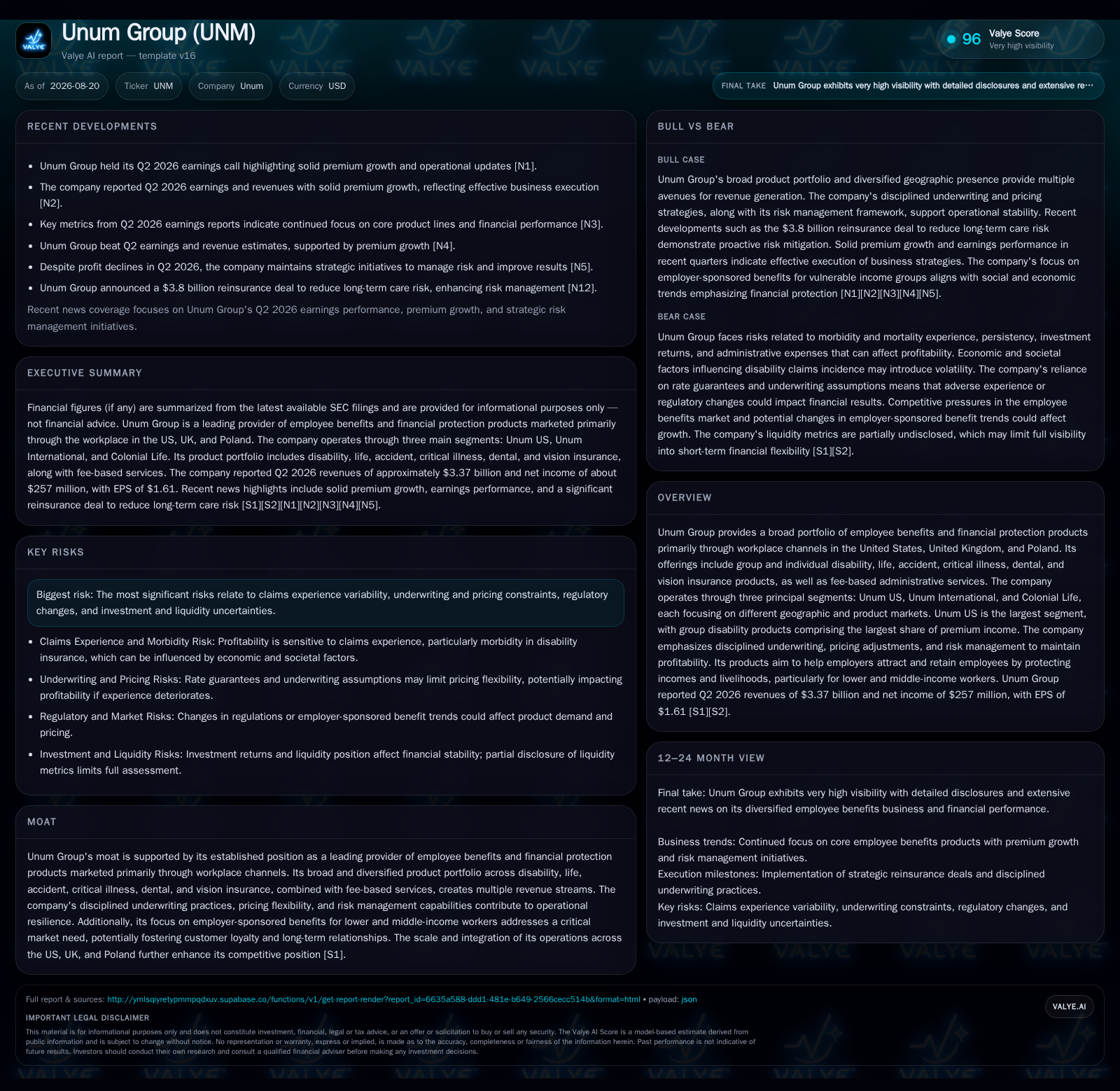
In Q2 2026, Unum Group achieved premium growth through disciplined underwriting and pricing actions across its core employee benefits segments, particularly in the US group disability market. Despite profitability pressures from claims experience variability and investment income volatility, the company’s diversified portfolio and risk management strategies underpin its operating resilience. With $3.76 billion in total debt as of June 30, 2026, Unum maintains capital flexibility to navigate regulatory and economic risks affecting claims and pricing.
Unum Group reported premium growth in the second quarter of 2026 compared to the same period in 2025, driven by disciplined underwriting and pricing actions within its largest operating segment, Unum US, particularly in group disability insurance [S2]. This premium expansion is significant as it supports the company's revenue growth and profitability sustainability amid a competitive and risk-sensitive employee benefits insurance market where effective pricing discipline and claims management are essential [S1].
Profitability in Q2 2026 was challenged by variability in claims experience and volatility in investment income. Claims incidence and severity can fluctuate due to economic and societal factors, which, combined with investment returns sensitive to interest rate changes, exert pressure on underwriting margins and overall earnings [S2]. These dynamics underscore the importance of Unum’s risk management and capital deployment strategies to absorb such fluctuations and maintain financial resilience.
Business Model and Product Portfolio
Unum Group operates primarily in the United States, United Kingdom, and Poland, offering a diversified portfolio of employee benefits and financial protection products marketed mainly through workplace channels [S1]. Its product suite includes group and individual disability insurance, life insurance, accident, critical illness, dental, and vision insurance, along with certain fee-based administrative services. These products help employers attract and retain talent while providing financial protection for employees against illness, injury, or death.
Revenue is generated primarily from insurance premiums paid by employers and individual policyholders, supplemented by fees for administrative services and investment income [S1][S2][S4]. Premiums are priced based on underwriting assumptions and are subject to regulatory approval and repricing provisions. Margins and cash flow depend heavily on claims experience, underwriting discipline, pricing adjustments, investment returns, administrative expense control, and regulatory factors.
Risk Factors and Claims Experience
Unum faces significant risks related to claims experience variability, regulatory constraints, and economic conditions. Claims incidence and severity for disability and other benefits are influenced by complex factors including unemployment rates, consumer confidence, medical advances, and societal attitudes toward work and disability [S4]. Regulatory bodies may limit the company’s ability to obtain rate increases or require changes to meet minimum loss ratio requirements, potentially affecting product profitability [S7].
The company’s liability for future policy benefits is based on actuarial estimates that can be affected by changes in mortality, morbidity, claim incidence, policy lapses, and interest rates. Adverse developments in any of these areas could materially impact earnings and capital adequacy [S4]. Additionally, legislative changes and regulatory scrutiny pose ongoing challenges that require careful monitoring.
Capital Structure and Financial Position
As of June 30, 2026, Unum Group reported total debt of $3.76 billion, reflecting its capital structure and liquidity position [F1]. This level of indebtedness aligns with the company’s capital management strategy aimed at maintaining financial flexibility to support claims obligations, growth initiatives, and shareholder returns [S2].
Capital adequacy and liquidity are critical in the insurance sector to absorb claims volatility and investment income fluctuations. Unum’s approach to capital deployment emphasizes balancing operational needs with risk management, enabling it to navigate the cyclical nature of claims experience and economic conditions.
Scenario Analysis and Investment Implications
One possible scenario is that continued disciplined underwriting and pricing, combined with effective claims management, could sustain Unum’s premium growth and improve profitability, enhancing shareholder returns [S2][F1]. This outcome would be supported by stable or improving claims experience, regulatory environments allowing pricing flexibility, and favorable investment income trends.
Conversely, a bear case could arise if adverse claims experience, regulatory constraints limiting pricing, and prolonged low investment yields materially pressure profitability and capital position [S4][S7][F1]. Confirmation of this scenario would include declining underwriting margins, capital adequacy deterioration, and negative regulatory actions.
A base case envisions steady premium growth with moderate claims and investment volatility, resulting in stable profitability and capital adequacy, consistent with Unum’s diversified portfolio and risk management capabilities.
Conclusion and Watchpoints
Unum Group’s Q2 2026 premium growth, supported by disciplined underwriting and pricing actions, demonstrates operational resilience in a challenging claims and investment environment. The company’s diversified employee benefits portfolio and capital management strategies provide a foundation to absorb volatility and sustain revenue growth.
Key watchpoints include subsequent quarterly premium growth and underwriting margin trends, claims incidence and severity in core disability products, regulatory developments affecting pricing flexibility, investment income and portfolio yield changes, and capital adequacy including debt refinancing or repayment events. Monitoring these factors will be essential to assess Unum’s ability to maintain profitability and capital strength amid ongoing market uncertainties.
Disclaimer: This is research-only, informational analysis and not investment advice. It may include AI-generated interpretation and general industry context. Always verify important details using primary sources.

Comments