
Cardinal Health Q4 2026: Specialty Pharma Growth and MSO Acquisition Drive Revenue Expansion
Fiscal 2026 revenue growth at Cardinal Health was propelled by branded and specialty pharmaceuticals and the acquisition of Solaris Health's MSO platform, with tariff refunds and opioid litigation shaping near-term margins.
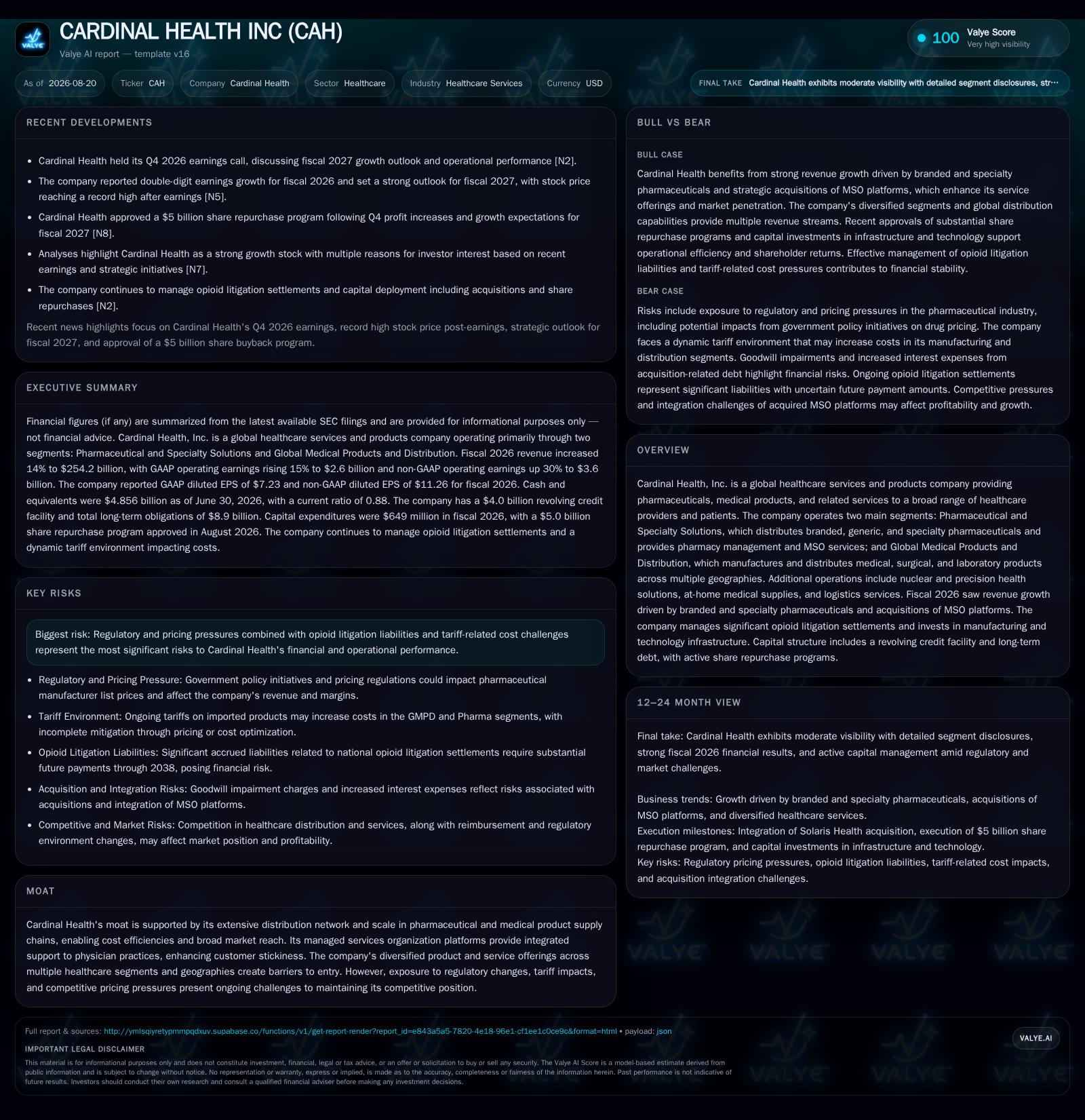
Cardinal Health's fiscal 2026 results show revenue growth primarily driven by branded and specialty pharmaceuticals alongside the November 2025 acquisition of Solaris Health, a urology-focused managed services organization (MSO). The U.S. Supreme Court’s 2026 ruling invalidating IEEPA tariffs initiated a refund process that eases cost pressures and supports margin improvement, although opioid litigation settlements continue to pose financial risks. The Solaris Health acquisition expands Cardinal Health’s managed services offerings, potentially enhancing customer retention and diversifying revenue beyond traditional distribution. Investors should monitor quarterly specialty pharma and MSO revenue trends, margin developments from tariff refunds and litigation expenses, and progress on litigation settlements.
Completed in November 2025, this acquisition involved a cash payment of approximately $1.9 billion and the issuance of common units valued at around $500 million [S1]. The integration of Solaris Health expands Cardinal Health’s managed services portfolio, adding physician practice support services that complement its existing pharmaceutical distribution business. This diversification potentially enhances customer retention by embedding Cardinal Health more deeply into provider operations [S1].
The specialty pharmaceutical segment is a critical growth driver in the healthcare distribution industry, where demand for complex, branded therapies continues to rise. Cardinal Health’s ability to capture this demand alongside expanding MSO services positions it to reshape its revenue base and service offerings, potentially strengthening its competitive positioning in the healthcare supply chain [S1][S2]
Regulatory and Litigation Risk Developments
A significant regulatory development in fiscal 2026 was the U.S [S1]. Supreme Court’s February ruling that invalidated tariffs imposed under the International Emergency Economic Powers Act (IEEPA) in 2025. These tariffs had increased costs on certain imported goods and materials relevant to Cardinal Health’s operations. Following the ruling, U.S. Customs and Border Protection initiated a phased refund process starting in April 2026 to return tariff payments to affected parties, including Cardinal Health.
This refund process reduces prior cost pressures and improves the company’s near-term margin outlook [S1]. However, the tariff refund benefit is likely transitional rather than structural, as it addresses a discrete regulatory event rather than ongoing operational factors.
Meanwhile, opioid litigation settlements remain a material risk for Cardinal Health. The company continues to manage significant expenses related to these settlements, which impact cash flow and the overall risk profile [S1]. These liabilities influence capital allocation decisions and earnings stability, underscoring the importance of monitoring ongoing litigation developments.
Balance Sheet and Liquidity Position
As of June 30, 2026, Cardinal Health reported cash and cash equivalents of $4.856 billion and total debt of $7.004 billion, resulting in net debt of approximately $2.148 billion [F1]. The current ratio stood at 0.88, indicating current liabilities exceed current assets, which reflects working capital pressure typical in distribution businesses with large inventory and payables balances [F1].
The company reported cash and equivalents of $4.856 billion and total debt of $7.004 billion as of June 30, 2026, resulting in a net debt position of approximately $2.148 billion [F1]. Current liabilities exceeded current assets, with a current ratio of 0.88, indicating working capital deficit [F1].
Business Model and Competitive Positioning
Cardinal Health operates as a critical intermediary in the healthcare supply chain, generating revenue primarily through distribution margins on pharmaceuticals—including branded, generic, and specialty drugs—and medical products [S1]. The company also earns fees from managed services, such as pharmacy management and MSO platforms, which provide integrated support to healthcare providers.
The acquisition of Solaris Health aligns with a broader industry trend where healthcare distributors expand into managed services to diversify revenue and deepen customer relationships [S1]. This integration can drive cost efficiencies and enhance customer retention by offering end-to-end solutions beyond traditional product distribution.
However, the company faces constraints from regulatory changes, pricing pressures, and ongoing litigation liabilities, which can compress margins and increase operating expenses [S1]. The invalidation of IEEPA tariffs alleviates some cost pressures, but opioid litigation remains a significant financial and operational challenge.
Scenario Analysis and Investment Implications
One possible bull case for Cardinal Health is sustained growth in branded and specialty pharmaceuticals combined with successful integration and expansion of MSO platforms like Solaris Health. Confirmation of this scenario would include quarterly revenue growth in specialty pharmaceuticals and MSO services, improving margin trends, and positive commentary on integration progress.
Conversely, a bear case involves intensified regulatory pricing pressures and escalating opioid litigation costs that offset benefits from acquisitions and tariff refunds [S1][F1]. Increased litigation expenses could lead to margin erosion and cash flow constraints, limiting capital allocation flexibility despite revenue growth. The Supreme Court’s invalidation of IEEPA tariffs and the ensuing refund process reduce cost pressures and support margin improvement, though this effect is likely temporary. Ongoing opioid litigation settlements remain a material risk factor affecting cash flow and financial flexibility. The Solaris Health acquisition notably expands Cardinal Health’s managed services capabilities, potentially enhancing customer stickiness and diversifying revenue streams beyond traditional pharmaceutical distribution. Future performance will hinge on the successful integration of MSO services, management of litigation liabilities, and the evolving regulatory environment.
Disclaimer: This is research-only, informational analysis and not investment advice. It may include AI-generated interpretation and general industry context. Always verify important details using primary sources.

Comments