
DexCom Q2 2026: Growth Supported by G7 Product and Reimbursement Expansion
DexCom’s Q2 2026 results highlight revenue growth associated with Dexcom G7 adoption and expanded reimbursement, alongside reported liquidity and convertible debt metrics.
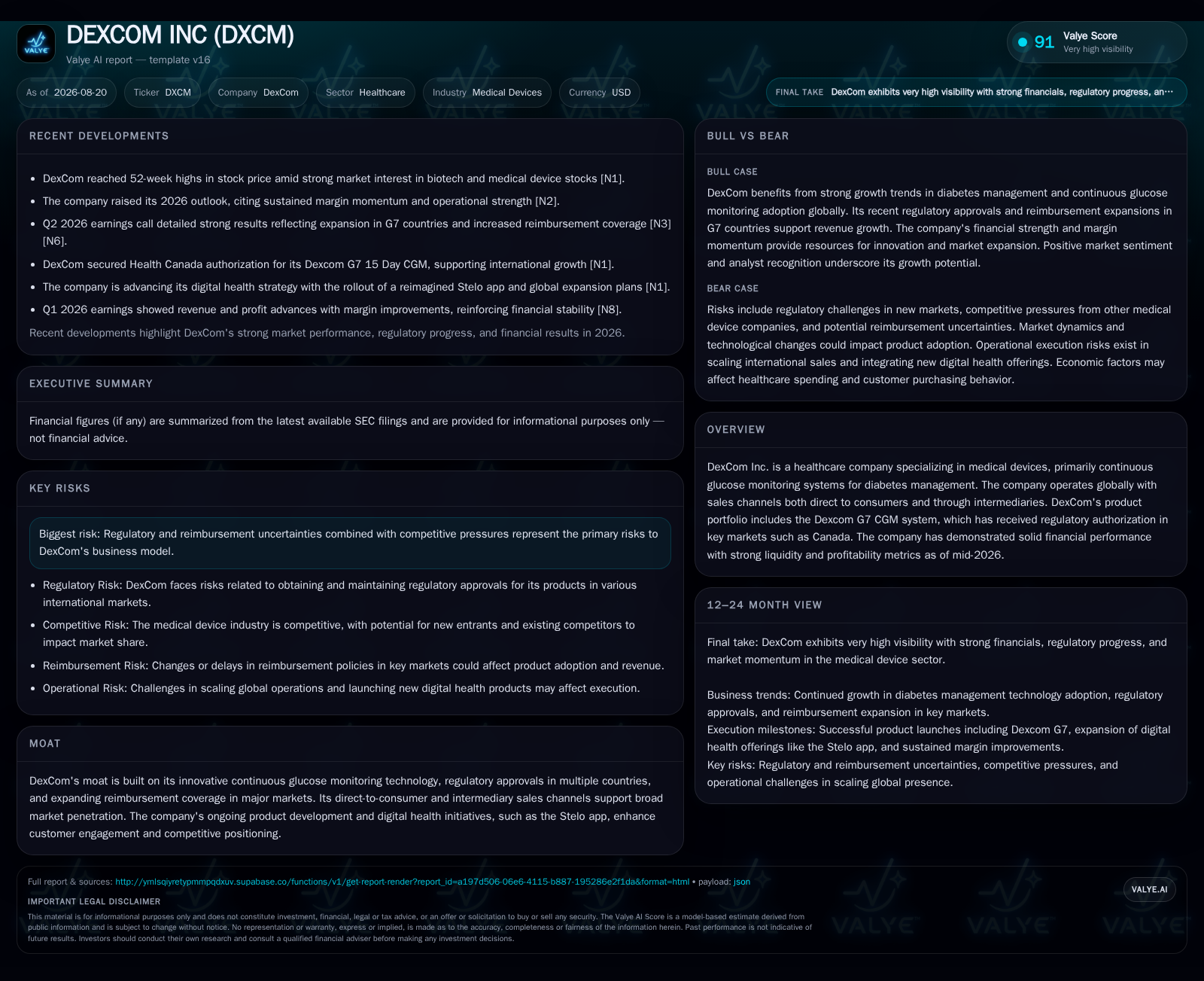
DexCom Inc. reported continued revenue growth in Q2 2026 fueled by the commercial adoption of its Dexcom G7 continuous glucose monitoring system and broader reimbursement coverage, primarily in the U.S. market. The company operates a single segment focused on disposable sensors and reusable transmitters, with most revenue generated domestically. DexCom's balance sheet remains solid with $1.105 billion in cash and equivalents and a current ratio of 1.73 as of June 30, 2026, supported by $1.25 billion in convertible notes due 2028, indicating manageable near-term debt maturities. These factors underpin DexCom’s competitive positioning and financial stability as it navigates the evolving diabetes management device market.
DexCom Inc. reported growth in revenue for the second quarter of 2026, associated with increased adoption of its Dexcom G7 continuous glucose monitoring system and expanded reimbursement coverage, as detailed in its July 30, 2026 10-Q filing [S2]. The company generates the majority of its revenue in the United States through sales of disposable sensors and reusable transmitters and receivers. This growth, together with reported liquidity metrics, may influence DexCom's near-term growth trajectory, competitive positioning, and financial profile.
Q2 2026 Operating Segment and Revenue Drivers
DexCom manages its business as a single operating and reportable segment focused on the sale of disposable sensors and reusable transmitters and receivers [S2]. The company reports that this segment structure is consistent with how its chief operating decision maker evaluates performance and allocates resources. The majority of revenue is generated in the United States [S2].
The primary driver of revenue growth in Q2 2026 was the commercial adoption of the Dexcom G7 continuous glucose monitoring (CGM) system, the company's latest product innovation in diabetes management technology [S2]. The G7 system offers enhanced features and improved usability compared to prior models, which has supported increased patient uptake. Alongside product innovation, expanding reimbursement coverage in key markets, particularly within the U.S., has played a crucial role in facilitating broader patient access and accelerating adoption. Reimbursement expansion is a critical industry KPI because it directly impacts the affordability and accessibility of CGM devices for patients, thereby supporting recurring sensor sales and overall revenue growth.
Recurring revenue from disposable sensors constitutes a vital component of DexCom's business model, combining initial device sales with ongoing consumable sensor purchases, which are reimbursed by payers including insurance companies and government programs [S2]. The company reported cash and cash equivalents totaling $1.105 billion, current assets of approximately $4.087 billion, and current liabilities of $2.358 billion, resulting in a current ratio of 1.73 [F1]. This positive working capital position indicates that DexCom has sufficient short-term assets to cover its short-term liabilities, which is important for maintaining day-to-day operations and funding investments in product development and market expansion.
On the debt front, DexCom holds $1.25 billion in unsecured senior convertible notes due in 2028, with no convertible notes maturing before that date [S2]. The absence of near-term debt maturities reduces refinancing risk and provides the company with capital structure flexibility. Additionally, the if-converted value of these 2028 Notes did not exceed their outstanding principal amount as of June 30, 2026, indicating no immediate incentive for note holders to convert their debt into equity [S2]. Customers purchase disposable glucose sensors and reusable transmitters and receivers primarily for diabetes management. The recurring nature of sensor sales is a key economic driver, as it provides ongoing revenue streams beyond initial device purchases.
Margins and cash flow conversion are influenced by product mix, manufacturing efficiencies, and reimbursement rates [S1]. Recurring sensor sales contribute significantly to cash flow, enabling DexCom to invest in innovation and commercial activities. The company's competitive advantage is based on its innovative CGM technology, regulatory approvals, reimbursement coverage, and a sales approach that includes both direct-to-consumer and intermediary channels
Competitive positioning in the CGM market is influenced by product innovation, regulatory approvals, and reimbursement coverage. DexCom’s G7 system represents a significant product advancement, and its commercial adoption is supported by expanding reimbursement policies that improve patient access. This would likely improve margins through scale and favorable product mix, supported by regulatory approvals and successful marketing execution [S2][S1]. Confirmation of this scenario would come from increased revenue growth rates in subsequent quarters, improved gross margins, and positive updates on reimbursement coverage. Conversely, slower-than-expected adoption rates, regulatory setbacks, or reimbursement contraction would refute this outlook.
- Base Case: DexCom maintains steady growth driven by existing product adoption and reimbursement coverage, with stable margins and liquidity supporting ongoing operations and incremental investments. This scenario aligns with current filings showing solid adoption and financial health without material disruptions [S2][F1]. Confirmation would involve consistent revenue and margin trends, stable cash flow generation, and no material changes in debt or liquidity. Loss of reimbursement coverage, regulatory delays or denials, or increased competitive pricing pressure would confirm this scenario. Stable or growing revenue, maintained or improved margins, and strong liquidity metrics would refute it.
Conclusion and Watchpoints
DexCom’s Q2 2026 results indicate that the company’s revenue growth is associated with the commercial adoption of its Dexcom G7 continuous glucose monitoring system and expanding reimbursement coverage, particularly in the U.S. market [S2]. The company reports a single operating segment focused on sensors and transmitters. Reported liquidity includes $1.105 billion in cash and equivalents and convertible debt maturing in 2028, which may affect its near-term financial profile [F1].
Investors and observers should monitor subsequent quarterly revenue growth and margin trends, updates on reimbursement coverage expansions or contractions, regulatory approvals in new geographic markets, convertible debt conversion activity or refinancing announcements, and changes in cash flow and working capital. These factors will provide critical signals regarding DexCom’s ability to sustain its competitive position and financial health amid evolving market dynamics.
This watchpoint is particularly important given the structural nature of the CGM market, which is driven by chronic diabetes prevalence and regulatory/reimbursement environments but remains susceptible to cyclical elements such as product upgrade cycles and competitive dynamics. Maintaining reimbursement coverage and managing competitive pressures will be key to sustaining DexCom's growth and financial strength going forward.
Disclaimer: This is research-only, informational analysis and not investment advice. It may include AI-generated interpretation and general industry context. Always verify important details using primary sources.

Comments