
enCore Energy Q2 2026: Progress in Uranium Extraction and Strong Balance Sheet Amid Exploration Stage Status
enCore Energy advances uranium extraction at Texas ISR facilities while maintaining financial flexibility and progressing South Dakota permitting.
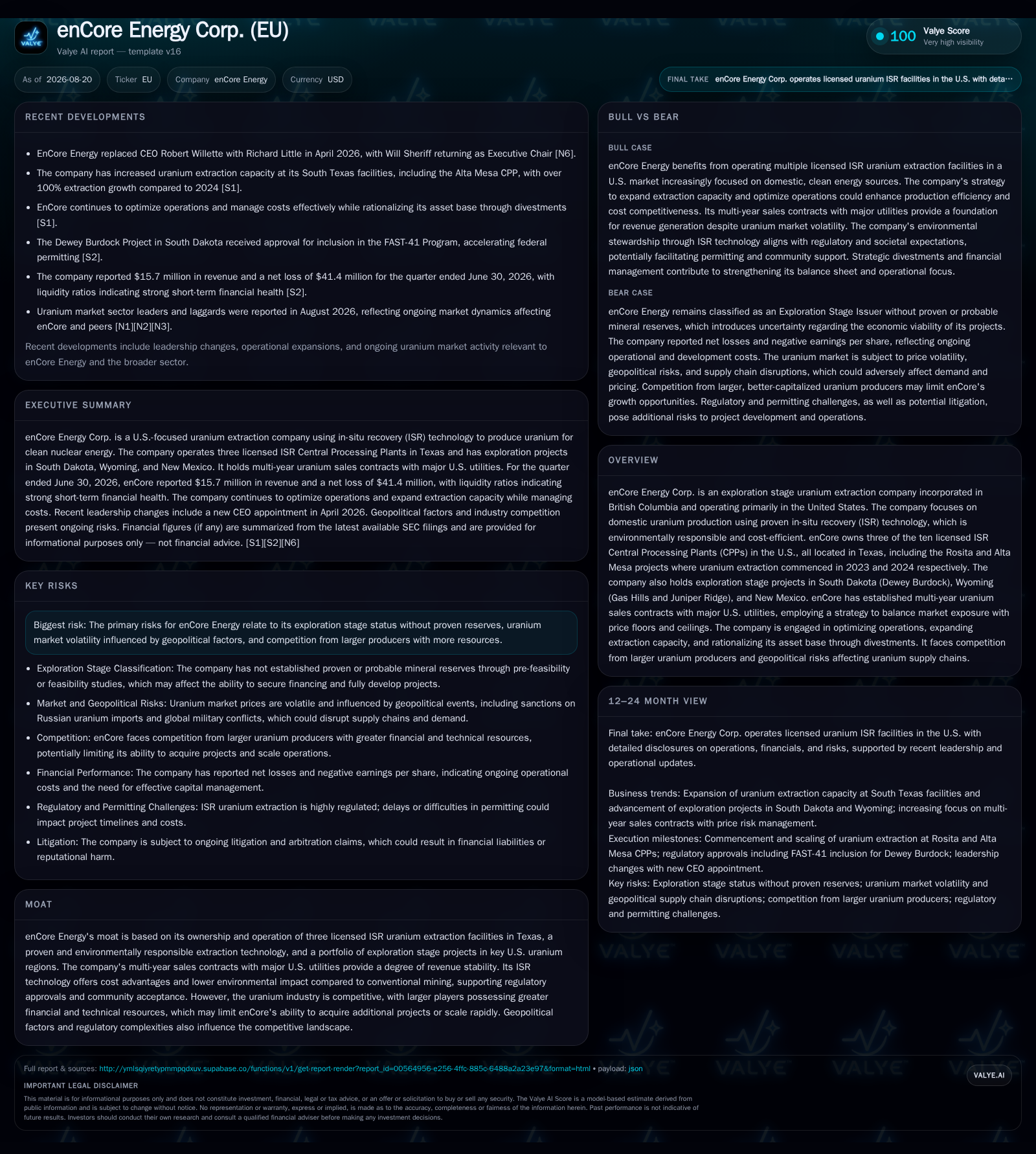
In Q2 2026, enCore Energy Corp. continued uranium extraction operations at its Rosita and Alta Mesa ISR Central Processing Plants in Texas, marking key operational milestones despite retaining its classification as an Exploration Stage Issuer due to the absence of proven or probable mineral reserves. The company also achieved permitting approval for infrastructure construction at its Dewey Burdock project in South Dakota, advancing its development pipeline. Financially, enCore reported $21.8 million in cash and equivalents and $110.5 million in long-term debt net of issuance costs, resulting in a net debt position of approximately $88.6 million and a current ratio of 8.0, indicating liquidity supportive of ongoing investments.
Operational Progress at Texas ISR Facilities
enCore Energy Corp. has made significant strides in uranium extraction at its Texas in-situ recovery (ISR) facilities during 2023 and 2024. The company commenced uranium extraction at the Rosita Central Processing Plant (CPP) in 2023, followed by the Alta Mesa CPP in 2024, establishing itself as one of only three uranium extraction operations currently active in the United States and the first in Texas in a decade [S1]. These licensed ISR facilities utilize proven technology to extract uranium concentrate (U3O8) efficiently and with reduced environmental impact compared to conventional mining.
The operational commencement at Rosita and Alta Mesa represents a material transition toward commercial uranium production. While the company has begun extraction, it remains classified as an Exploration Stage Issuer under SEC regulations because it has not yet established proven or probable mineral reserves through pre-feasibility or feasibility studies, a prerequisite for development stage classification [S1]. This distinction underscores that although uranium concentrate production has started, the company’s revenue generation and production scale are contingent on future reserve confirmation and operational ramp-up.
Permitting and Development Pipeline
Progress at the Dewey Burdock project in South Dakota further advances enCore’s development pipeline. In Q2 2026, the Bureau of Land Management approved infrastructure construction for Dewey Burdock, a significant permitting milestone that enables the company to proceed with project development activities [S2]. Dewey Burdock is an ISR uranium project with existing source material licensing from the U.S. Nuclear Regulatory Commission and underground injection permits from the Environmental Protection Agency. It is included in the FAST-41 Program, a federal initiative designed to accelerate permitting for critical mineral projects, reflecting the strategic importance of domestic uranium supply [S2].
This permitting progress at Dewey Burdock complements the company’s operational focus in Texas and supports its strategy to build uranium extraction capacity in South Texas while advancing exploration and development projects in South Dakota and Wyoming. Successful advancement through permitting stages is critical to unlocking future production capacity and scaling uranium supply to meet growing demand.
Financial Position and Capital Structure
As of June 30, 2026, enCore Energy reported $21.8 million in cash and cash equivalents alongside $110.5 million in long-term debt net of unamortized issuance costs, resulting in a net debt position of approximately $88.6 million [S2][F1]. The company’s current assets of $99.5 million against current liabilities of $12.4 million yield a current ratio of 8.0, indicating strong short-term liquidity [F1].
The long-term debt primarily consists of $115 million in Convertible Senior Notes due 2030, carrying an effective interest rate of 6.6% inclusive of amortized debt issuance costs [S2]. This capital structure may provide enCore with financial flexibility to fund ongoing uranium extraction operations and permitting activities without immediate refinancing pressure, depending on operational cash flow and market conditions. The company’s capital management could support its growth strategy amid a tightening domestic uranium market if these factors align.
Business Model and Market Position
enCore’s business model centers on supplying uranium concentrate to primarily U.S. utilities and other buyers seeking domestic uranium for nuclear power generation. The company leverages proven ISR technology to extract uranium at its licensed Central Processing Plants in South Texas, including Rosita and Alta Mesa [S1]. This technology offers cost and environmental advantages by recovering uranium in situ without extensive surface mining.
Revenue generation is expected to derive from uranium extraction operations at these CPPs, supported by multi-year baseload contracting strategies that aim to provide revenue stability regardless of uranium market price fluctuations [S1]. However, as an Exploration Stage Issuer without established proven or probable reserves, enCore’s current revenue and margin profiles remain undeveloped pending reserve confirmation and production scale-up.
Competitive positioning benefits from ownership of three licensed ISR CPPs in the U.S., a relatively rare asset base within the domestic uranium supply chain. The company’s focus on expanding extraction capacity in Texas and progressing exploration projects in South Dakota and Wyoming aligns with structural demand growth driven by nuclear power’s role in clean energy generation and supportive government policies.
Risks and Investment Considerations
Key risks for enCore include the timing and outcome of establishing proven or probable mineral reserves, which are necessary to transition from exploration to development stage and to unlock commercial revenue streams. Operational challenges or cost overruns at ISR facilities could impede production ramp-up. Regulatory and permitting risks remain material, particularly given the complex environmental and community considerations associated with uranium projects.
Uranium market volatility also poses a risk to revenue and margin stability, despite the company’s baseload contracting approach. Additionally, competition from larger integrated uranium producers with broader resource bases may constrain market share and pricing power.
Conclusion
enCore Energy’s commencement of uranium extraction at the Rosita and Alta Mesa ISR facilities marks a significant operational milestone, moving the company closer to commercial production despite its current exploration stage classification [S1][S2]. The permitting approval at Dewey Burdock further advances its development pipeline, positioning enCore to expand domestic uranium supply capacity.
Financially, the company’s liquidity and net debt position as of Q2 2026 may provide some flexibility to continue investing in operations and permitting activities [S2][F1]. The business model’s reliance on ISR technology and baseload contracting could underpin future revenue potential, contingent on reserve establishment and successful operational scale-up.
Investors should monitor SEC filings for proven or probable mineral reserve disclosures, quarterly operational updates on uranium extraction volumes, permitting milestones at Dewey Burdock, and changes in liquidity or capital structure. Uranium market price trends and contract renewals with utilities will also be key indicators of the company’s evolving commercial prospects.
Disclaimer: This is research-only, informational analysis and not investment advice. It may include AI-generated interpretation and general industry context. Always verify important details using primary sources.

Comments