
Fate Therapeutics Q2 2026: Clinical Progress Advances Pipeline Amid Continued Operating Losses
Fate Therapeutics reported Q2 2026 results showing clinical milestones in autoimmune and oncology programs alongside sustained operating losses and solid liquidity.
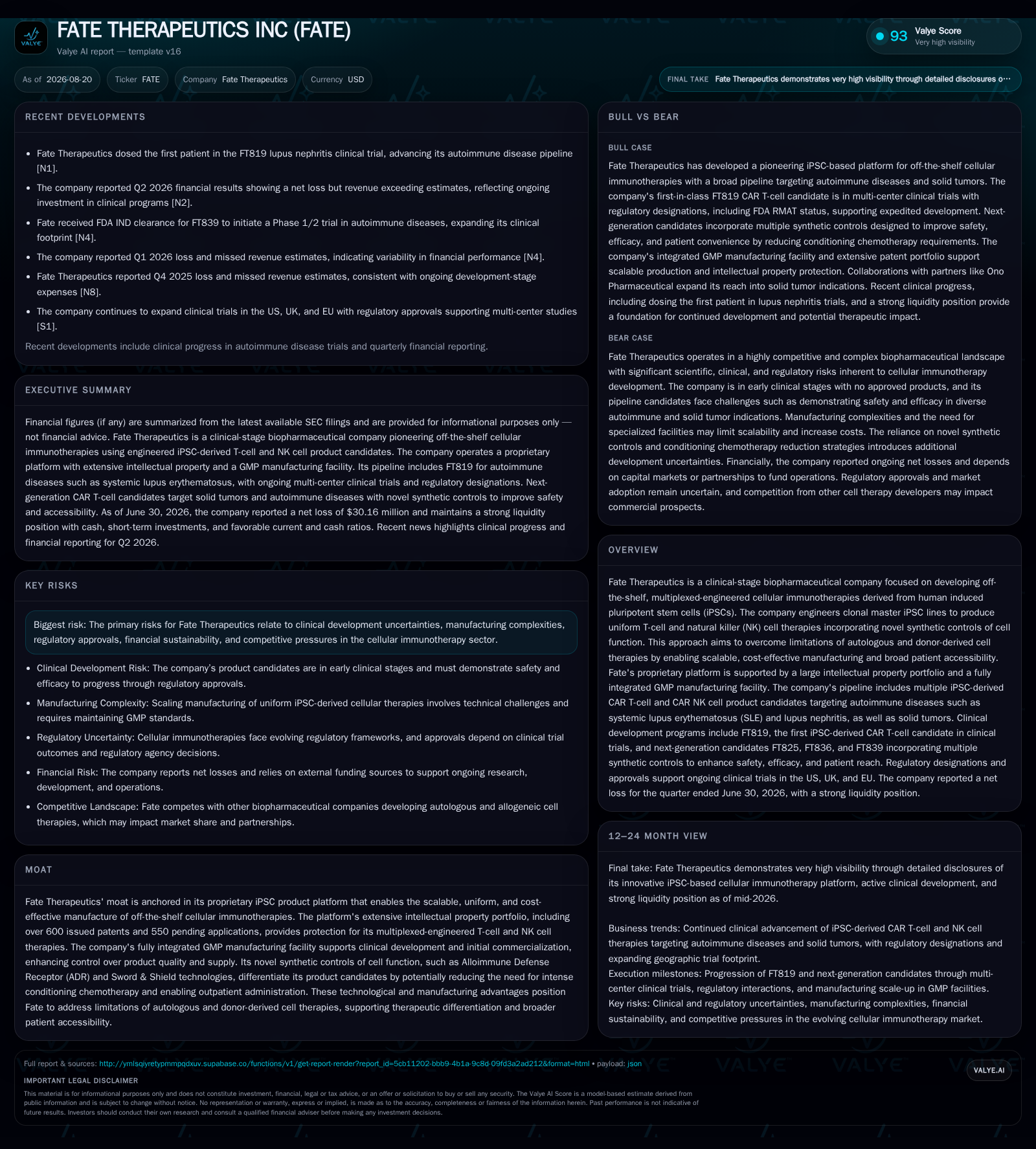
Fate Therapeutics advanced its off-the-shelf iPSC-derived cellular immunotherapy pipeline in Q2 2026, including dosing the first patient in the FT819 lupus nephritis trial and securing FDA IND clearance for FT839. The company continues to operate at a net loss driven by increased R&D and manufacturing scale-up expenses typical of clinical-stage biotechs. As of June 30, 2026, Fate maintained strong liquidity with $32.4 million in cash and a current ratio of 4.85, supporting its ongoing clinical and manufacturing activities. These developments underscore Fate’s progress in de-risking its pipeline while sustaining capital to fund near-term operations.
Q2 2026 Operating and Clinical Update
In the quarter ended June 30, 2026, Fate Therapeutics advanced multiple clinical programs within its off-the-shelf cellular immunotherapy pipeline. Notably, the company dosed the first patient in its FT819 trial targeting lupus nephritis, marking a significant clinical milestone for this autoimmune indication [S2][N3]. Additionally, Fate received FDA clearance of the Investigational New Drug (IND) application for FT839, allowing the initiation of a Phase 1/2 clinical trial in autoimmune diseases [S2][N4]. These developments reflect tangible progress in Fate’s pipeline maturation and regulatory engagement, critical steps toward eventual commercialization.
The operating loss was primarily driven by increased research and development expenses related to clinical trial activities and the scale-up of Good Manufacturing Practice (GMP) production capabilities [S2]. Such expenses are typical in the sector, where companies invest heavily in trial execution, manufacturing process development, and technology transfer before generating product revenues.
Financial Position and Capital Allocation
As of June 30, 2026, Fate Therapeutics held $32.4 million in cash and cash equivalents, supported by a current asset base of $157.95 million against current liabilities of $32.59 million, resulting in a current ratio of 4.85 [F1]. This liquidity position indicates sufficient near-term financial resources to fund ongoing clinical trials and manufacturing operations without immediate refinancing needs. The company’s balance sheet shows no material debt, which is notable for a clinical-stage biotech reliant on capital markets and collaboration revenues for funding.
Capital allocation during this period focused on advancing clinical trials, scaling GMP manufacturing processes—including partnerships with contract manufacturing organizations (CMOs)—and further developing the proprietary iPSC platform. These investments are essential to support the complex and resource-intensive nature of cellular immunotherapy development and production.
Business Model and Competitive Positioning
Fate Therapeutics operates as a clinical-stage developer of off-the-shelf, multiplexed-engineered cellular immunotherapies derived from human induced pluripotent stem cells (iPSCs). The company’s proprietary cellular programming approach involves engineering clonal master iPSC lines that serve as renewable starting material for manufacturing uniform T-cell and natural killer (NK) cell therapies. This platform aims to overcome limitations of autologous cell therapies by enabling scalable, consistent, and on-demand production of multiplexed cellular products.
Currently, Fate’s revenues stem primarily from collaboration agreements, research licenses, and grants, as it has yet to commercialize any products [S1][S2]. Ultimately, the company’s business model anticipates generating revenue from product sales post regulatory approval, milestone payments under collaboration agreements, and potential royalties.
The company’s competitive positioning benefits from its integrated GMP manufacturing capabilities and extensive intellectual property portfolio. However, it faces inherent clinical and regulatory risks typical of novel cell therapy developers, as well as the challenge of establishing commercial infrastructure for future product launches.
Industry Context and Risk Factors
The clinical-stage cellular immunotherapy sector is characterized by high capital intensity, long development timelines, and significant regulatory scrutiny. Key performance indicators for companies in this space include clinical trial progression milestones, cash runway and liquidity ratios, R&D expense trends, and manufacturing scale-up capabilities. Fate’s progress in dosing patients and securing IND clearances aligns with these critical KPIs.
Risks include potential clinical trial failures or delays, manufacturing bottlenecks, regulatory setbacks, and the need for continued financing. The complexity of engineering and producing iPSC-derived therapies adds further operational challenges. Monitoring these factors is essential for assessing Fate’s development trajectory.
Analytical Conclusions and Scenario Analysis
Fate Therapeutics’ clinical progress in Q2 2026, highlighted by dosing the first patient in the FT819 lupus nephritis trial and obtaining FDA IND clearance for FT839, demonstrates concrete advancement in its iPSC-derived cell therapy pipeline [S2][N3][N4]. These milestones help de-risk the company’s future commercialization potential by evidencing regulatory and operational achievements.
The company’s liquidity position as of June 30, 2026—with $32.4 million in cash and a current ratio of 4.85—provides a financial buffer to sustain ongoing clinical and manufacturing investments without immediate capital pressures [F1][S2]. This is a critical factor for a clinical-stage biotech where continuous funding is required to progress multiple trials and scale manufacturing.
Looking ahead, one possible positive scenario is that Fate successfully advances its lead clinical candidates through pivotal trials and obtains regulatory approvals, potentially establishing a first-mover advantage in off-the-shelf iPSC-derived cell therapies. This would enable scalable commercialization and significant revenue growth, contingent on positive clinical outcomes, manufacturing scale-up, and favorable reimbursement [S1][S2][S3]. Conversely, clinical trial failures or manufacturing challenges could delay development programs, increase cash burn, and pressure liquidity, negatively impacting valuation and operational continuity [S2][F1][S1]. These factors will provide critical insight into Fate’s operational execution and financial sustainability as it advances its pipeline.
In summary, Fate Therapeutics’ Q2 2026 results demonstrate clinical progress consistent with its development-stage status and a financial position typical of a clinical-stage cellular immunotherapy company. While operating losses continue, the company’s advances in pipeline development and manufacturing capacity, supported by available liquidity, may enable it to continue pursuing further development and de-risking of its innovative iPSC-derived therapies, subject to successful execution and funding availability.
Disclaimer: This is research-only, informational analysis and not investment advice. It may include AI-generated interpretation and general industry context. Always verify important details using primary sources.

Comments