
Steel Dynamics Q2 2026: Earnings Growth Supported by Vertical Integration and Aluminum Expansion
Steel Dynamics reported a significant net income increase in Q2 2026 driven by stable steel demand, metals recycling gains, and aluminum segment growth.
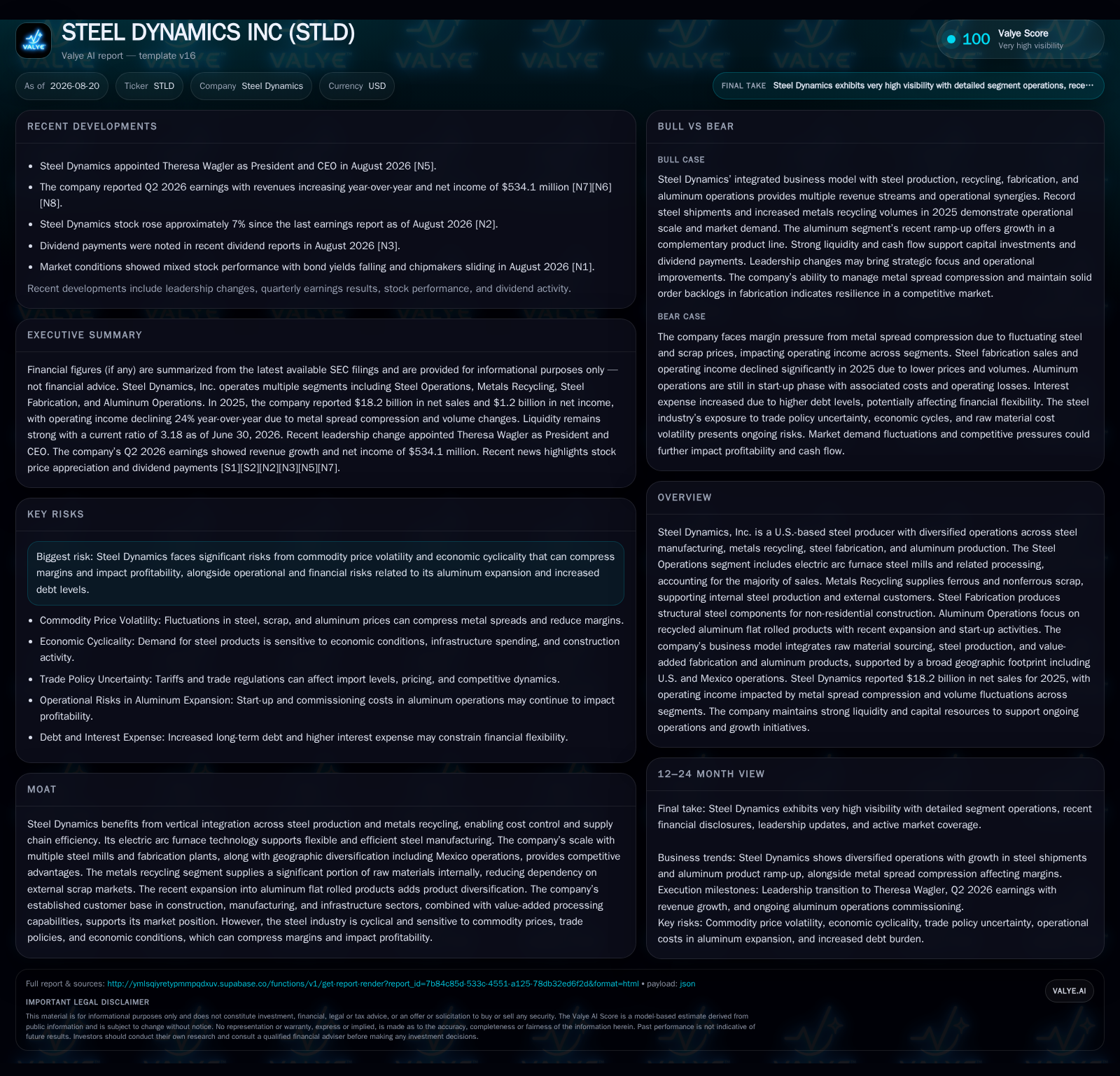
Steel Dynamics Inc’s Q2 2026 net income rose to $530.8 million from $301.2 million in Q2 2025, reflecting operational resilience amid metal spread compression. The company’s vertical integration and improved metals recycling volumes and pricing contributed to earnings growth. Expansion of aluminum operations into recycled flat rolled products adds diversification that may reduce steel market cyclicality. Liquidity remains solid with a current ratio of 3.18 as of June 30, 2026.
Q2 2026 Operating Performance and Earnings
Steel Dynamics Inc reported a net income of $530.8 million for the second quarter ended June 30, 2026, marking a substantial increase of $229.6 million compared to $301.2 million in the same quarter of 2025 [S2]. This improvement signals operational strength amid a steel industry environment characterized by metal spread compression, where the difference between steel product prices and raw material costs has been under pressure. The company’s ability to grow earnings despite these margin headwinds reflects resilient demand and effective cost management.
The metals recycling segment contributed notably to this earnings growth through higher volumes and improved pricing of ferrous and nonferrous scrap metals [S1]. By internally supplying raw materials via recycling operations, Steel Dynamics reduces its exposure to volatile raw material costs, which is a critical factor in maintaining steel production margins. This vertical integration supports supply chain efficiency and cost control, helping offset the impact of compressed metal spreads in steel and steel fabrication segments.
Business Model and Segment Overview
Steel Dynamics operates an integrated business model encompassing steel production primarily through electric arc furnace (EAF) technology, metals recycling, steel fabrication, and aluminum operations [S1]. Customers across construction, manufacturing, and infrastructure sectors purchase steel products, fabricated structural components, recycled metals, and increasingly, flat rolled aluminum products.
Revenue generation depends on shipment volumes, product mix, and pricing, including premiums for specialized steel and aluminum grades and value-added processing. The company recognizes steel fabrication revenues over time based on contract completion percentages, while other segments recognize revenue at shipment or delivery.
The metals recycling segment’s enhanced volumes and pricing in 2025 improved operating income, underscoring its role in supplying cost-effective raw materials internally [S1]. Meanwhile, the aluminum operations segment expanded production and shipments of recycled flat rolled aluminum products starting in late 2025, including industrial and automotive quality products [S1]. This diversification into aluminum broadens Steel Dynamics’ product portfolio beyond steel, potentially reducing earnings volatility linked to the cyclical steel market.
Financial Position and Capital Allocation
As of June 30, 2026, Steel Dynamics maintained a current ratio of 3.18, with $7.28 billion in current assets against $2.29 billion in current liabilities, indicating a liquidity buffer supportive of operational flexibility [F1]. Cash and equivalents stood at approximately $567.7 million [F1]. The company’s long-term debt carrying amount was $4.2 billion as of the same date, with a fair value near $4.0 billion [S2].
Steel Dynamics also employs exchange traded futures contracts to manage commodity price risk associated with its nonferrous metal inventory, primarily aluminum and copper, mitigating exposure to price fluctuations without speculative intent [S2].
On August 14, 2026, the company announced a third quarter 2026 cash dividend [S3]. This announcement indicates the company’s continuation of shareholder distributions concurrent with its operational activities.
Industry Context and Cyclicality
The steel and metals manufacturing industry is inherently cyclical, influenced by commodity price volatility, trade policies, and economic demand cycles. Key performance indicators include steel shipment volumes, metal spread, segment operating income, and metals recycling metrics. Vertical integration and product diversification, such as Steel Dynamics’ aluminum expansion, serve as structural advantages that can mitigate cyclical earnings swings.
Electric arc furnace technology underpins flexible steel manufacturing, and metals recycling operations reduce raw material cost exposure, both critical in managing margin pressures. Diversification into aluminum products opens new markets and revenue streams, potentially smoothing demand fluctuations tied to traditional steel sectors.
Analytical Conclusions and Scenarios
The year-over-year increase in Q2 2026 net income demonstrates Steel Dynamics’ operational resilience, supported by stable domestic steel demand and improved metals recycling performance despite metal spread compression pressures [S2]. Vertical integration effectively reduces raw material cost exposure, and metals recycling gains contribute positively to operating income, offsetting margin headwinds.
Expansion of aluminum operations into recycled flat rolled products provides product diversification that may reduce earnings volatility associated with the cyclical steel market [S1]. The aluminum segment’s production of industrial and automotive quality products creates new revenue opportunities beyond steel.
Looking ahead, one plausible scenario is that Steel Dynamics leverages its vertical integration and aluminum expansion to sustain earnings growth and margin resilience despite cyclical steel market pressures. Confirmation would come from further quarterly earnings growth, improved segment operating margins, and increased aluminum sales volumes. Conversely, intensified metal spread compression or operational challenges in the aluminum segment could pressure margins and earnings, especially if metals recycling pricing or volumes weaken.
Watchpoints
Investors should monitor the upcoming Q3 2026 earnings release for confirmation of earnings momentum. Key indicators include aluminum operations shipment volumes and margin trends, metals recycling segment pricing and volume developments, and metal spread trends impacting steel and fabrication segments. Additionally, capital allocation decisions, including dividends or share repurchases, will provide insight into the company’s financial strategy amid ongoing industry cyclicality.
Steel Dynamics’ combination of vertical integration, metals recycling, and aluminum product diversification may provide structural advantages in managing commodity price volatility and cyclical demand. However, successful execution in expanding aluminum operations and maintaining cost controls will be important factors influencing future earnings growth.
Disclaimer: This is research-only, informational analysis and not investment advice. It may include AI-generated interpretation and general industry context. Always verify important details using primary sources.

Comments