
CenterPoint Energy Q2 2026: Infrastructure Investment and Regulatory Developments Shape Operating Outlook
CenterPoint Energy's Q2 2026 update reveals sustained infrastructure investments and new debt issuance with regulatory constraints impacting its utility operations and financial flexibility.
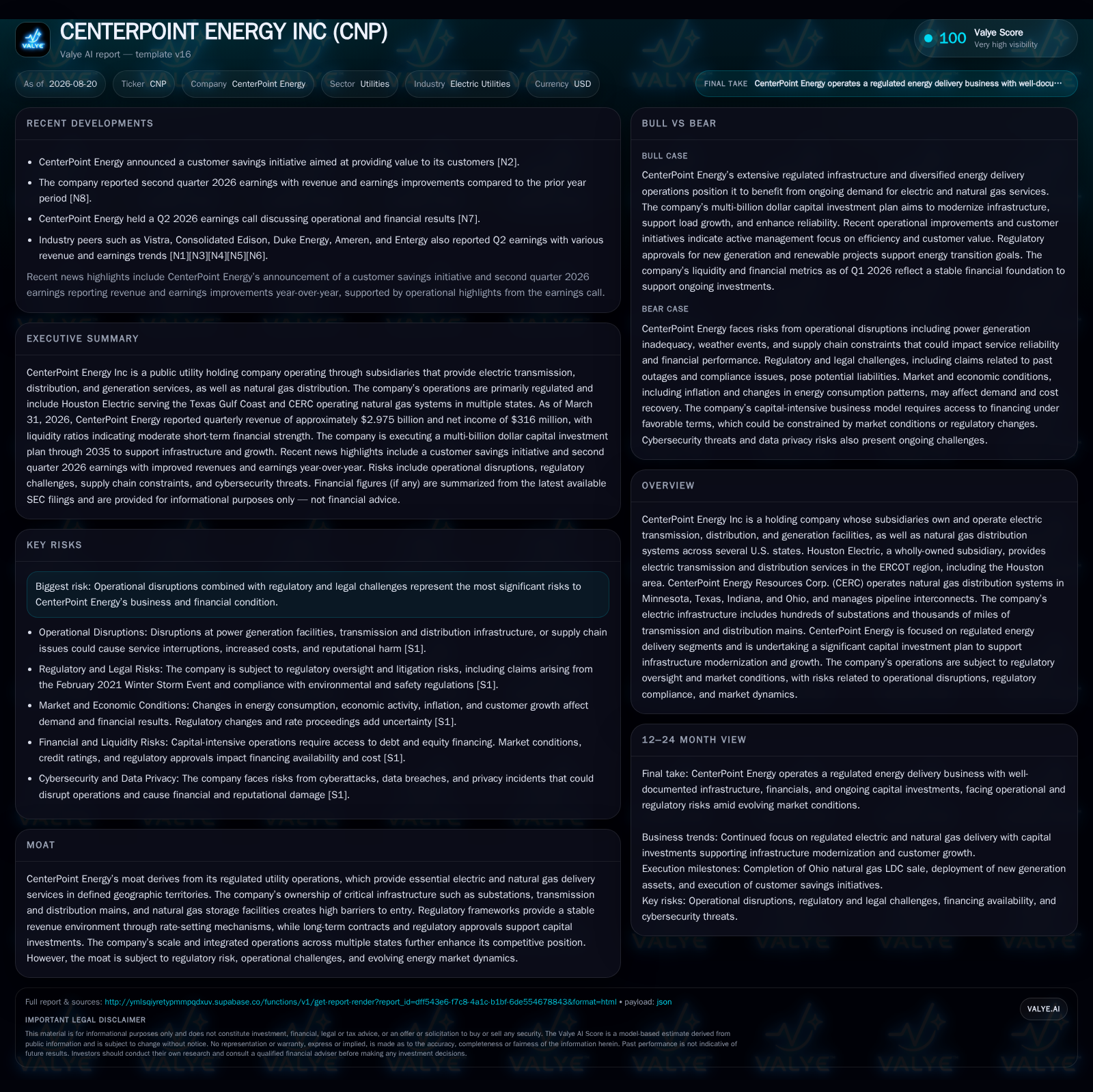
CenterPoint Energy's Q2 2026 operating results highlight continued capital investments in electric transmission, distribution, and generation infrastructure, including natural gas combustion turbines and solar assets commissioned in 2025. Regulatory developments, such as adjustments to the Texas Electric Emergency Equipment Fleet, affect operating costs and customer rates. The issuance of subordinated notes in July 2026 introduces dividend and capital allocation restrictions during Optional Deferral Periods, constraining near-term financial flexibility. These factors collectively influence the company's regulated utility economics, rate base growth, and dividend policy, shaping future earnings visibility and risk profile.
Q2 2026 Operating Performance and Capital Investments
CenterPoint Energy's Q2 2026 operating update reflects ongoing capital investments in its electric transmission, distribution, generation facilities, and natural gas distribution systems across multiple states [S2][S1]. These investments are part of a broader infrastructure modernization effort aimed at supporting long-term rate base growth and enhancing operational reliability. Notably, in 2025, the company completed and commissioned two natural gas combustion turbines totaling 460 MW, with 230 MW placed in service in both Q2 and Q3 of 2025, replacing portions of its coal-fired generation fleet [S1]. Additionally, the 191 MW Posey Solar project was acquired and placed in service in Q2 2025, contributing renewable generation capacity to the fleet [S1]. These projects align with regulatory approvals and are expected to enable cost recovery and provide a return on invested capital, underpinning future regulated earnings potential [S1][S2].
Regulatory Environment and Rate-setting Implications
CenterPoint Energy operates within a regulated utility framework where revenues are derived primarily from tariffs approved by state regulatory commissions. This structure provides revenue stability but also subjects the company to regulatory oversight that influences capital allocation and dividend policy [S1][S2]. A significant regulatory development involves Houston Electric's adjustments to its Texas Electric Emergency Equipment Fleet (TEEEF). Following legislation enacted after the February 2021 Winter Storm Event, Houston Electric leased 15 large and five medium TEEEF units to enhance emergency preparedness. In 2025 and early 2026, Houston Electric released its large and medium TEEEF units to ERCOT and CPS Energy, reducing fleet capacity and associated lease costs, which in turn affects operating expenses and customer rates [S1]. These regulatory adjustments demonstrate the dynamic nature of operating costs within the regulated framework and their impact on rate-setting outcomes.
Debt Issuance and Financial Flexibility Constraints
In July 2026, CenterPoint Energy issued subordinated notes that rank junior to existing senior indebtedness and mature in 2058 [S3]. These notes carry covenants that impose restrictions during any Optional Deferral Period, prohibiting the company and its majority-owned subsidiaries from declaring or paying dividends, repurchasing stock, or repaying junior indebtedness except under specified exceptions [S3]. This issuance enhances the company's financing capacity to support ongoing capital investments but introduces near-term constraints on financial flexibility, particularly regarding shareholder returns and capital management options. The dividend and capital allocation restrictions linked to these debt covenants are material considerations for investors assessing the company's capital structure and liquidity profile [S3].
Risks and Scenario Analysis
CenterPoint Energy faces several risks that could influence its operating and financial outlook. Regulatory risk remains prominent, with rate case outcomes and regulatory approvals directly affecting revenue growth and capital recovery. Operational risks include potential disruptions in power generation adequacy and compliance with directives issued by independent system operators ERCOT and MISO, which have historically required controlled outages and load shedding [S1]. Legal and operational challenges related to these directives could lead to claims or financial penalties.
From a financial perspective, the new subordinated notes introduce covenant-driven restrictions that could limit dividend payments and capital allocation during deferral periods, potentially depressing earnings visibility and shareholder returns if such periods are prolonged [S3].
The base scenario assumes successful execution of capital investments with stable regulatory approvals and manageable financial constraints, supporting steady earnings growth [S1][S2][S3]. Conversely, the bear case contemplates adverse regulatory rulings, operational disruptions, and extended debt covenant deferrals that constrain financial flexibility and depress earnings [S1][S3].
Business Economics and Watchpoints
CenterPoint Energy's business model centers on providing regulated electric transmission, distribution, generation services, and natural gas distribution to customers within defined geographic territories. Customers pay for these essential services under tariffs set by regulatory commissions, which allow the company to recover costs plus an authorized return on invested capital [S1][S2]. The company's margins and cash flows are influenced by regulatory rate-setting outcomes, the timing and scale of capital expenditures, and operational efficiency within the regulated framework.
Ongoing capital investments in generation and distribution infrastructure are critical drivers of rate base growth, which underpins future earnings potential. The commissioning of natural gas turbines and solar projects expands generation capacity and supports renewable integration, aligning with regulatory approvals that facilitate cost recovery [S1][S2]. Investors should closely monitor regulatory rate case outcomes, quarterly earnings and cash flow trends, operational reliability metrics, and any announcements related to debt covenant status or dividend deferral [S1][S2][S3]. These factors will provide insight into the company's ability to navigate regulatory constraints and operational challenges while maintaining financial flexibility.
Disclaimer: This is research-only, informational analysis and not investment advice. It may include AI-generated interpretation and general industry context. Always verify important details using primary sources.

Comments