
Clearwater Paper Q2 2026: Operating Stability Amid Cyclical Market Pressures
Clearwater Paper reports potential asset impairments and maintains liquidity amid cyclical challenges in the paperboard industry.
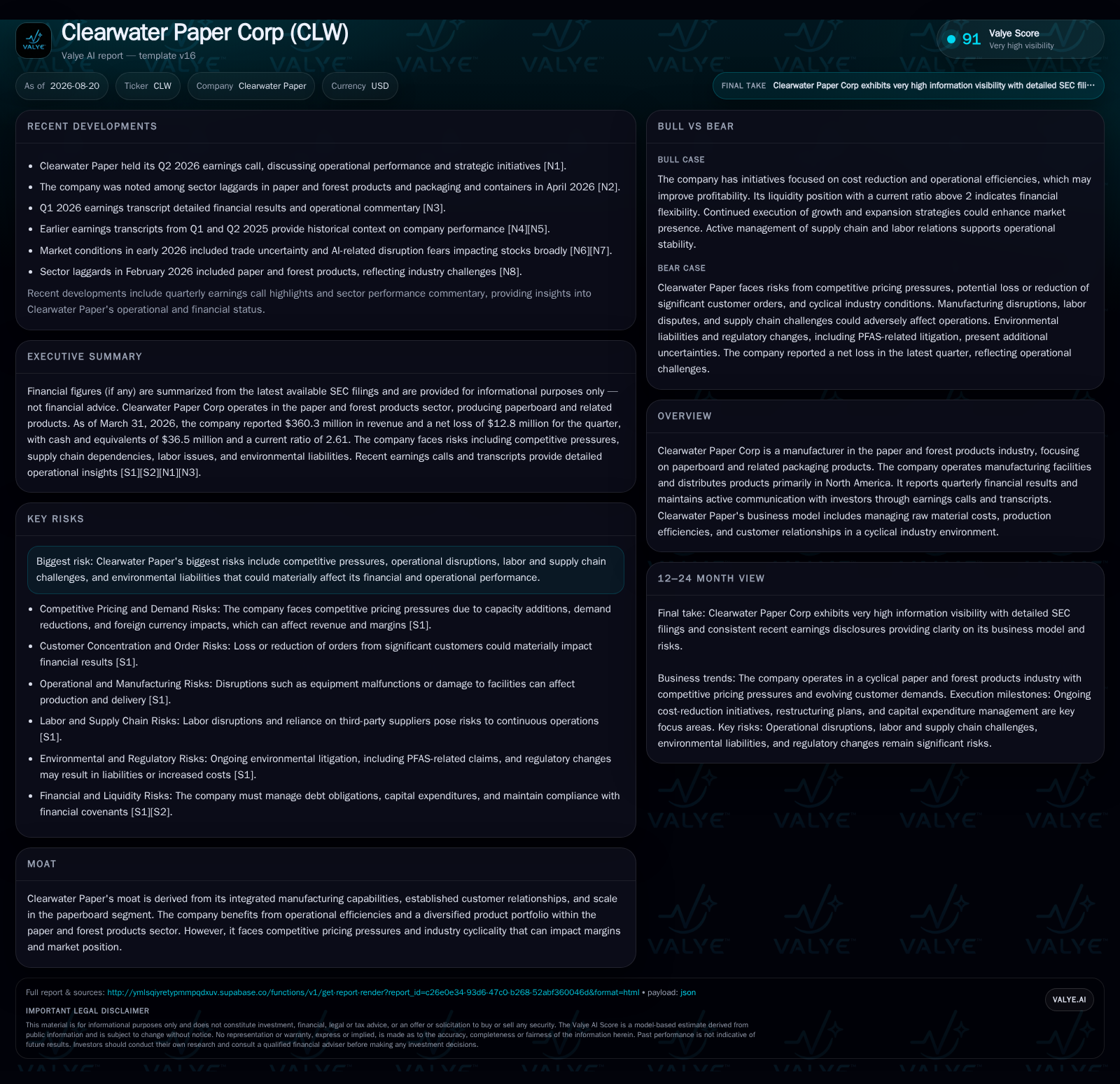
In Q2 2026, Clearwater Paper disclosed potential asset impairments reflecting ongoing cyclical pressures in the paperboard and packaging market. Despite these headwinds, the company maintained liquidity through cash, operational cash flow, and undrawn credit facilities, supporting operational continuity. The integrated manufacturing business model and established customer relationships underpin operational stability, though future earnings may face volatility depending on market conditions and impairment realizations.
Q2 2026 Operating and Financial Update
Clearwater Paper Corporation’s Q2 2026 10-Q filing reveals a cautious stance during cyclical pressures in the paperboard and packaging industry. The company disclosed potential asset impairments linked to assumptions about asset disposition or reorganization due to current and anticipated economic and industry conditions [S2]. These impairments arise from management’s need to estimate net sales proceeds that may be lower than prior expectations of undiscounted future net cash flows. Such disclosures often presage earnings volatility as asset values are reassessed in a challenging market environment.
As of June 30, 2026, the company’s principal liquidity sources include existing cash, operational cash flow, and borrowing capacity under credit facilities, notably a $259.3 million term revolver commitment with no outstanding balance [S2]. This undrawn credit facility, coupled with cash generated from operations, supports the company’s financial flexibility during cyclical uncertainty.
Accounts payable and accrued liabilities rose modestly to $231.6 million at quarter-end from $215.6 million at December 31, 2025, reflecting normal operational activity and including $13.3 million related to unpaid capital expenditures [S2]. This working capital movement aligns with ongoing manufacturing and supply chain requirements in the company’s operations.
Business Model and Industry Context
Clearwater Paper operates within the cyclical paperboard and packaging market, where profitability depends heavily on managing raw material costs, production efficiency, and pricing power. The company manufactures paperboard and related packaging products primarily for customers in North America [S1]. Its integrated manufacturing capabilities and established customer relationships provide scale advantages and operational efficiencies that are critical in a competitive industry marked by pricing pressures and demand volatility.
The paper and forest products manufacturing sector is capital intensive with significant fixed costs, making operational efficiency and capacity utilization key drivers of margin and cash flow stability. Raw material input costs such as pulp and recycled fiber prices fluctuate with market conditions, directly impacting margins. The absence of borrowings on the term revolver credit facility indicates available borrowing capacity, which, combined with operational cash flow, forms a buffer against potential cash flow variability [S2]. This financial flexibility is crucial given the uncertainty in cash flow generation over the next twelve months due to the competitive and cyclical nature of the markets served.
Working capital dynamics, including the modest increase in accounts payable and accrued liabilities, reflect ongoing operational needs without signaling financial stress [S2]. Capital expenditure liabilities embedded within these payables suggest continued investment in manufacturing capacity or maintenance, which is typical for a capital-intensive business model.
No new debt draws or changes in capital allocation were disclosed, although potential asset impairments could influence future capital deployment decisions. Investors should monitor subsequent filings for realized impairment charges and any shifts in liquidity or capital spending patterns.
Analytical Conclusions and Scenario Analysis
The disclosure of potential asset impairments represents a proactive management response to cyclical market pressures and strategic considerations regarding asset disposition or reorganization [S2]. This signals a risk of near-term earnings volatility as asset values are reassessed in light of weaker market conditions or changing strategic priorities. Confirming this scenario would involve observing impairment charges in future quarterly filings, while their absence alongside stable operational metrics would support a more stable earnings outlook.
Maintained liquidity through cash reserves, operational cash flow, and undrawn credit facilities provides Clearwater Paper with financial flexibility to navigate cyclical uncertainties [S2]. The lack of revolver borrowings and available credit lines underpin operational continuity and potential strategic actions. Evidence of liquidity deterioration or credit facility drawdowns would challenge this positive interpretation.
Two plausible scenarios emerge for investors. In the base case, Clearwater Paper manages cyclical headwinds with stable operations, no material impairments realized, and steady liquidity and earnings supported by its integrated manufacturing and customer relationships [S1][S2]. Confirmation would come from stable or improving margins, consistent cash flow, and no impairment charges.
In a bear case, intensified cyclical pressures could lead to realized asset impairments, margin compression, and liquidity strain, potentially necessitating debt drawdowns or capital raises [S2]. Confirmation would include impairment charges, credit facility drawdowns, and negative earnings surprises.
Watchpoints
Investors should closely monitor future quarterly filings for realized impairment charges, which will clarify the impact of cyclical pressures on Clearwater Paper’s asset base and earnings. Changes in liquidity, including any drawdowns on the revolver credit facility, will indicate financial flexibility under stress. Operational margin trends and raw material cost developments will provide insight into ongoing profitability challenges. Additionally, announcements related to capital expenditures and asset dispositions will shed light on the company’s strategic responses to market conditions.
Potential asset impairments introduce near-term earnings uncertainty, while the company’s integrated business model and financial resources form a foundation for navigating ongoing industry challenges.
Disclaimer: This is research-only, informational analysis and not investment advice. It may include AI-generated interpretation and general industry context. Always verify important details using primary sources.

Comments