
Giftify’s Acquisition-Fueled Growth Tests Profitability and Liquidity Amid Market Challenges
Giftify’s acquisitions of CardCash and Takeout7 have expanded its digital marketplace footprint, driving revenue growth but also persistent losses and liquidity pressures.
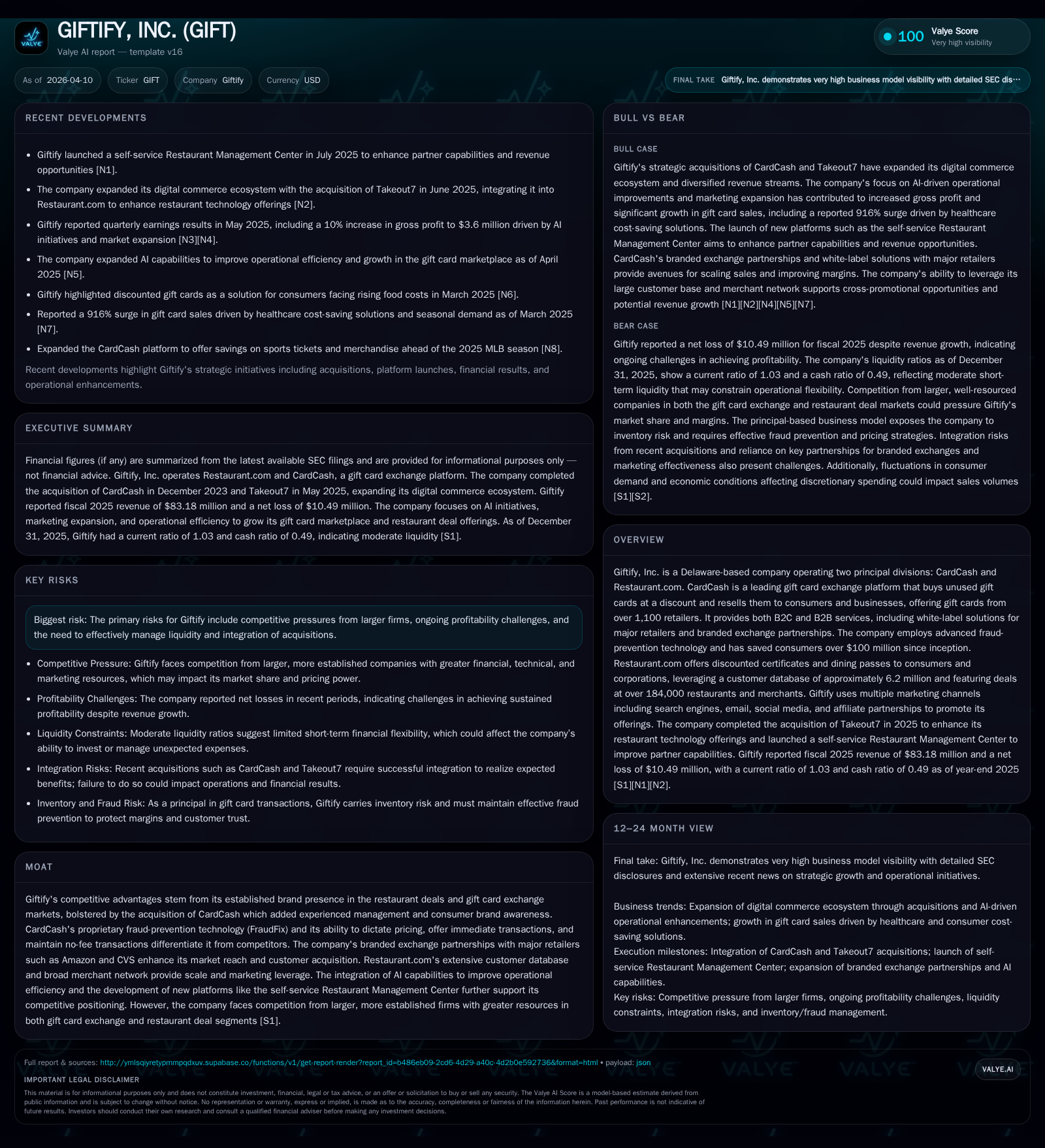
Giftify, Inc. transformed through acquisitions of CardCash in late 2023 and Takeout7 in mid-2025 into a diversified platform combining gift card exchange and restaurant deals. Revenue rose sharply post-acquisitions to $88.9M in 2024 before a 6.5% decline to $83.2M in 2025. Despite improved operating losses—narrowed by over 40% year-over-year—Giftify remains unprofitable with negative free cash flow and tight liquidity. The company relies on secured credit facilities and promissory notes for capital, while integrating new technologies and expanding sales channels. Ongoing Nasdaq listing risks highlight the need for operational leverage and capital discipline.
Company Overview
Giftify, Inc., a Delaware corporation, operates primarily across the United States through two main divisions: CardCash and Restaurant.com [S1][S6]. CardCash, acquired in December 2023, is a leading gift card exchange platform facilitating purchase and resale of unused gift cards from over 1,100 retailers including Target and Starbucks [S1]. It leverages proprietary fraud prevention software branded as FraudFix to mitigate risks associated with counterfeit or stolen cards [S1]. Restaurant.com provides discounted dining certificates redeemable at approximately 184,000 restaurants nationwide with an active customer base of about 6.2 million [S1]. The May 2025 acquisition of Takeout7 expanded Giftify’s digital offerings into AI-powered restaurant ordering and marketing solutions [S4].
Historical Growth & Financial Performance
Giftify’s revenue surged following the CardCash acquisition—from $0.48 million in FY 2023 to $88.9 million in FY 2024—before contracting by approximately 6.5% to $83.2 million in FY 2025 [F1]. This reflects integration effects as well as market conditions impacting gift card sales.
Profitability remains challenged despite improvements: operating losses narrowed from $18.4 million negative in FY 2024 to $10.4 million negative in FY 2025 (a nearly 44% improvement). Net losses followed this trend, reducing from $18.8 million negative to $10.5 million negative year-over-year [F1]. Operating cash flow was negative at approximately $1.59 million for FY 2025 but improved compared to prior periods; capital expenditures remained steady near $900,000 annually [F1].
Historical performance (annual)
| FY | Rev ($mm) | Net ($mm) | CFO ($mm) | OpInc ($mm) | Rev YoY | Net YoY |
|---|---|---|---|---|---|---|
| 2025 | 83 | -10 | -2 | -10 | -6.5% | +44.3% |
| 2024 | 89 | -19 | -3 | -18 | +18242.2% | -275.1% |
| 2023 | 0 | -5 | -1 | -5 | -292.6% | |
| 2022 | -1 | -1 | -2 |
Source: SEC companyfacts cache [F1].
Capital returns and efficiency (annual)
| FY | FCF ($mm) | ROE% |
|---|---|---|
| 2025 | -47.0 | |
| 2024 | -3 | -90.7 |
| 2023 | -1 | -20.6 |
| 2022 | 41.9 |
Source: SEC companyfacts cache [F1].
*Revenue surge largely attributable to acquisition consolidation; limited comparability.
Equity increased modestly to about $22.3 million by end-2025 from $20.8 million the previous year amid accumulated deficits nearing -$96 million [F1]. The current ratio stands near parity (~1.03), highlighting liquidity constraints [F1].
Strategic Drivers & Competitive Advantages
The CardCash acquisition significantly reshaped Giftify's business model by introducing a principal-based gift card exchange platform that controls inventory risk and pricing decisions [S1][S18]. Key competitive moats include:
- FraudFix Technology: Proprietary fraud detection reduces exposure to counterfeit or stolen gift cards—a significant risk factor in secondary markets [S1].
- Retail Partnerships: Collaborations with major retailers such as Amazon and CVS expand consumer reach and trust.
- Diverse Revenue Streams: Operations span both B2C consumers purchasing discounted cards/certificates and B2B white-label services.
- Restaurant.com Scale: A large consumer base combined with extensive merchant relationships supports cross-selling opportunities.
- Technology Expansion: Takeout7 acquisition adds AI-driven online ordering and digital marketing capabilities for restaurants enhancing service offerings [S4].
Risks & Industry Challenges
Despite scale gains and technological assets:
- Intense competition exists from e-commerce platforms entering the gift card space or offering restaurant promotions.
- Persistent operating losses raise concerns about sustainable profitability without substantial margin improvement [F1][S19].
- Liquidity depends heavily on access to debt capital; the company utilizes secured revolving credit lines ($2.7 million drawn as of Sept '25) and promissory notes with varying maturity profiles including related party debt retired during fiscal year [F1].
- Nasdaq delisting warning due to low stock price underlines investor pressure on corporate governance and capital strategy [S3].
Execution risks arise from integrating acquisitions effectively while managing cost structures amid competitive pressures.
Capital Structure & Cash Flow Analysis
As of fiscal year-end:
- Notes payable totaled approximately $2.58 million including accrued interest; related party secured notes were retired during FY25 reducing contingent obligations [S4][S14][F1].
- The revolving line of credit is secured by CardCash inventory/assets with interest rates around prime plus spread (~10%) reflecting prevailing market conditions [S5].
- Cash on hand was approximately $3.65 million providing limited runway given ongoing negative operating cash flows [F1].
- No dividends or share repurchases were reported as cash preservation remains a priority.
Return on equity remains deeply negative at approximately -47%, indicative of continuing net losses relative to equity base [F1].
Outlook & Monitoring Considerations
While explicit guidance is not provided publicly:
- Stabilizing or growing revenues through cross-selling between CardCash’s inventory platform and Restaurant.com’s consumer network is critical.
- Maintaining cost discipline especially around customer acquisition amid competitive digital advertising will impact margin trajectories.
- Successful integration and monetization of Takeout7’s AI-driven ordering/marketing tools could provide incremental growth avenues.
- Capital markets developments including potential equity raises or refinancing will influence financial flexibility.
- Addressing Nasdaq delisting concerns may necessitate strategic restructuring or enhanced investor outreach.
Monitoring continued reductions in net loss alongside extending operational runway will be key indicators of progress.
Conclusion
Giftify exemplifies how acquisitions can rapidly scale revenue but also introduce complex profitability challenges within dynamic markets like gift cards and restaurant deals. Its combination of fraud-prevention technology at CardCash with Restaurant.com's established consumer base creates differentiated offerings; however sustained success depends on effective capital management and operational execution amid liquidity constraints.
Investors should track quarterly performance for margin improvements and capital structure updates while assessing shifts driven by competitive forces or regulatory environments affecting secondary gift card exchanges.
This analysis is based solely on SEC filings ([F1],[S#]) without speculative forecasts or investment advice.
Disclaimer: This is research-only, informational analysis and not investment advice. It may include AI-generated interpretation and general industry context. Always verify important details using primary sources.

Comments