
Canadian Solar’s 2025 Financial Reset Highlights Supply Chain Risks and Strategic Pivot to Battery Storage
A significant drop in solar module sales amid rising battery energy storage growth drove Canadian Solar’s modest profit despite operational headwinds and high leverage.
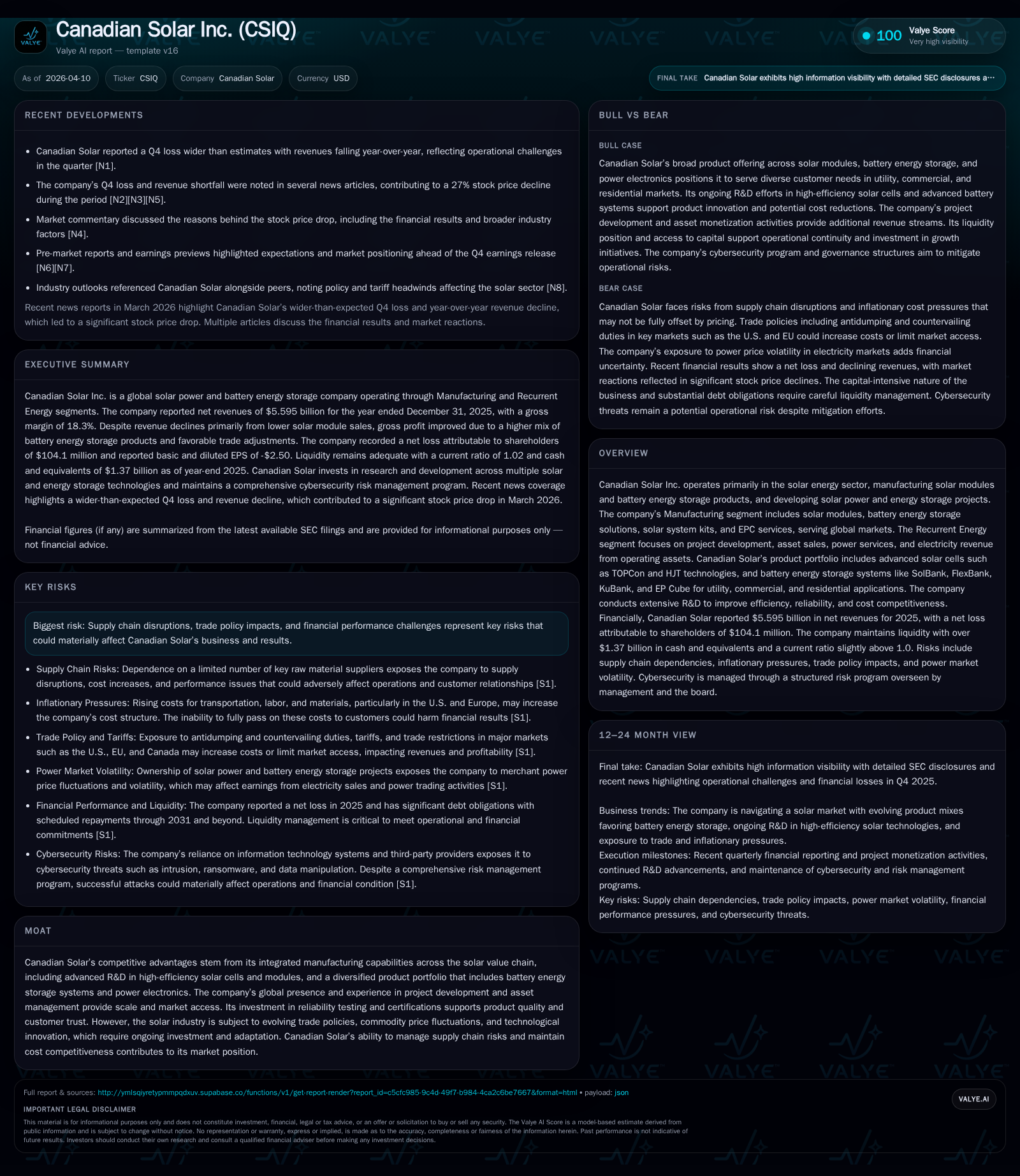
In 2025, Canadian Solar Inc. reported a net loss despite a rebound to positive operating income, reflecting persistent challenges in solar module volumes and pricing pressures offset partly by battery storage expansion. The company's integrated model spanning manufacturing and project development underpinned revenue growth of nearly 19%, yet negative free cash flow and elevated debt levels remain constraints. Capital allocation focused on heavy capex to expand manufacturing capacity with reduced R&D expenses signaling efficiency drive. Notable risks include trade disputes, supply chain dependency, and power market volatility, requiring vigilant management as the company scales its energy storage portfolio.
Historical Growth and Performance Drivers
Historical performance (annual)
| FY | CFO ($mm) | OpInc ($mm) |
|---|---|---|
| 2025 | -253 | 43 |
| 2024 | -885 | -30 |
| 2023 | 685 | 453 |
| 2022 | 917 | 356 |
Source: SEC companyfacts cache [F1].
Canadian Solar's topline rebounded strongly in 2025 with net revenues of approximately $5.6 billion, marking an 18.8% increase over the prior year [F1]. This growth primarily stems from a pronounced shift in product mix: while solar module shipments declined from 31.1 GW in 2024 to 24.3 GW in 2025, revenue from battery energy storage solutions surged ~70%, comprising 24.5% of total revenues compared to just 13.6% previously [S8]. This illustrates the firm's strategic pivot to diversify revenue streams beyond commoditized modules into higher value storage systems.
The company's revenue segmentation reflects the two main operating segments: Manufacturing (solar modules, battery systems, EPC services) accounting for approximately 96% of revenues, while Recurrent Energy (project development, asset sales, power services) contributed about 4% [S8]. Within Manufacturing, solar modules remain the largest chunk albeit shrinking proportionally due to softening volumes and ASP compression.
Despite top-line expansion, Canadian Solar recorded a net loss of $104 million for FY2025 after posting losses in the prior year too; however, operating income improved significantly from a $30 million loss in FY2024 to positive $43 million [F1]. Gross margins expanded modestly to 18.3% from 16.7%, helped by a greater share of battery energy storage which commands better margins than traditional modules. Additionally, adjustments related to U.S. antidumping and countervailing duty settlements provided some uplift [S12]. Nevertheless, heightened general & administrative expenses including impairments ($54 million charge related to manufacturing equipment) weighed on profitability [S16].
Operational cash flows remained weak with CFO at -$253 million translating into a sharp negative free cash flow when combined with nearly $1 billion of capital expenditures predominantly aimed at building out manufacturing plants [F1][S15][S16]. This capex ramp underscores management's commitment to expand capacity amid competitive pressures but also exacerbates liquidity strain.
| FY | Revenue ($B) | OpInc ($M) | Net Income ($M) | CFO ($M) | Capex ($M) | OpExp ($M) |
|---|---|---|---|---|---|---|
| 2025 | 5.60 | 43 | -104 | -253 | 962 | 983 |
| 2024 | 4.72 | -30 | -92 | -885 | 1,106 | 1029 |
| 2023 | n.a.* | 453 | n.a.* | 685 | 1,116 | n.a.* |
*not fully comparable data [F1]
Future Growth Prospects
The solar industry remains intensely competitive marked by oversupply particularly in polysilicon and wafers that depress module prices [S23][S20]. Canadian Solar’s vertical integration offers some cost advantage through control over ingot/wafer production innovations (CZ mono pulling technology, diamond wire sawing) improving efficiency and reducing material waste [S15]. Continued R&D focuses on next-gen N-type cells like TOPCon and HJT technologies designed for higher conversion efficiencies suitable for utility scale markets.
Battery energy storage is the focal point for future growth given rising global grid decentralization trends and renewable intermittency issues. Product families such as SolBank, FlexBank, KuBank target multiple market segments (utility/commercial/residential). Recurrent Energy segment benefits from monetizing utility-scale projects containing both solar power and storage assets contributing growing recurrent cash flows [S8][N10]. However, project execution risks tied to construction delays or contractual contingencies could impact returns [S1,S23].
Trade-related uncertainty—ongoing antidumping duties in key markets like U.S., EU—pose supply chain cost volatility risks [S4]. Also, inflationary pressures on labor/materials may constrain margin expansion unless offset by price renegotiations or efficiency gains [S9]. Power price fluctuations remain material exposure due to merchant elements in power trading activities connected with their asset fleet.
Forecasts, Milestones and What To Watch
While explicit forward guidance wasn’t provided recently [N2][N3], close attention should be paid to Q1/26 earnings results expected soon given Q4/25 operating loss shock that triggered notable stock price decline (~27%) [N1,N7,N9]. Market consensus expects continued margin pressure but potential stabilization in volume trends following aggressive capacity additions.
Key milestones include:
- Successful ramp-up of expanded manufacturing capacity without disruption or quality setbacks.
- Continued scaling of battery storage shipments exceeding ~18% volume growth experienced last year.
- Progress in monetizing Recurrent Energy projects advancing recurring revenue streams.
- Outcomes of pending trade policy reviews impacting cost structure.
Returns and Capital Allocation Review
Canadian Solar’s approximate ROE is negative ~-3.7% for FY2025 due largely to net losses despite positive operating income improvement [F1]. The cash flow profile is stressed with sustained negative CFO offset partly by sizable capex investments aimed at strategic expansion.
No dividend payments or meaningful buybacks were announced for recent years indicating prioritization of liquidity preservation amid debt servicing needs [F1][S17]. Debt load remains substantial: roughly $3.6 billion long-term plus $2.4 billion short-term borrowings on books at end-2025 with principal repayments beginning heavily in 2027 through subsequent years posing refinancing risks if market conditions deteriorate [S6,S20]. Interest expenses surged over prior periods contributing a worsening net interest burden exacerbated by variable rate exposure [S16,S24].
Share-based compensation plans continue incentivizing management alignment but do not currently alter capital return dynamics materially [S17,S22].
Industry Considerations
A nuanced dimension lies in Canadian Solar’s proactive enhancements within reliability testing accredited laboratories which reduce warranty costs long term while enabling premium pricing potential for innovative module designs deploying longer service life cells/modules [S15]. Achieving scale across both mature markets (U.S., Canada) and emerging regions diversifies geopolitical risk yet requires agility as trade barriers often evolve unpredictably affecting supply chains dominated by strategic raw materials such as polysilicon sourced globally.
Given evolving regulatory frameworks incentivizing decarbonization via subsidies or carbon credits globally but also subject to removal or revision as seen historically creates a volatile backdrop where Canadian Solar must continuously adapt its cost structure and project pipeline risk management techniques.[S23]
Summary
Canadian Solar Inc.’s FY2025 marks a transitional inflection confirming structural stress within traditional module sales offset by promising advances into energy storage systems both manufactured products and project assets monetization efforts creating new revenue vectors outside commoditized hardware sales alone. However, the firm grapples with negative profitability metrics driven by inventory impairments, increased operating expenses related mostly to project leases classification impacts, escalating interest load from its debt-heavy balance sheet demanding vigilant liquidity management. Technology leadership supported by expansive R&D into advanced cell types combined with vertically integrated wafer-to-module manufacturing scales form a defensive moat though exposed periodically to trade tariffs and commodity pricing swings. Future performance will hinge on execution of its diversification strategy into growing battery markets along with adept handling of geopolitical-trade policy complexities that shape cost competitiveness globally. Investors should watch early Q1/26 operational data closely alongside market signals regarding raw material prices and regulatory developments impacting incentive programs.
This analysis is prepared solely for informational purposes based on publicly available documents as of April 10, 2026; it does not constitute investment advice or recommendations.
Disclaimer: This is research-only, informational analysis and not investment advice. It may include AI-generated interpretation and general industry context. Always verify important details using primary sources.

Comments