
RBNE’s Strategic Fleet Expansion and Capital Deployment in 2025
Robin Energy’s 2025 operational growth, capital raises, and tanker segment spin-off position it for focused innovation and fleet diversification.
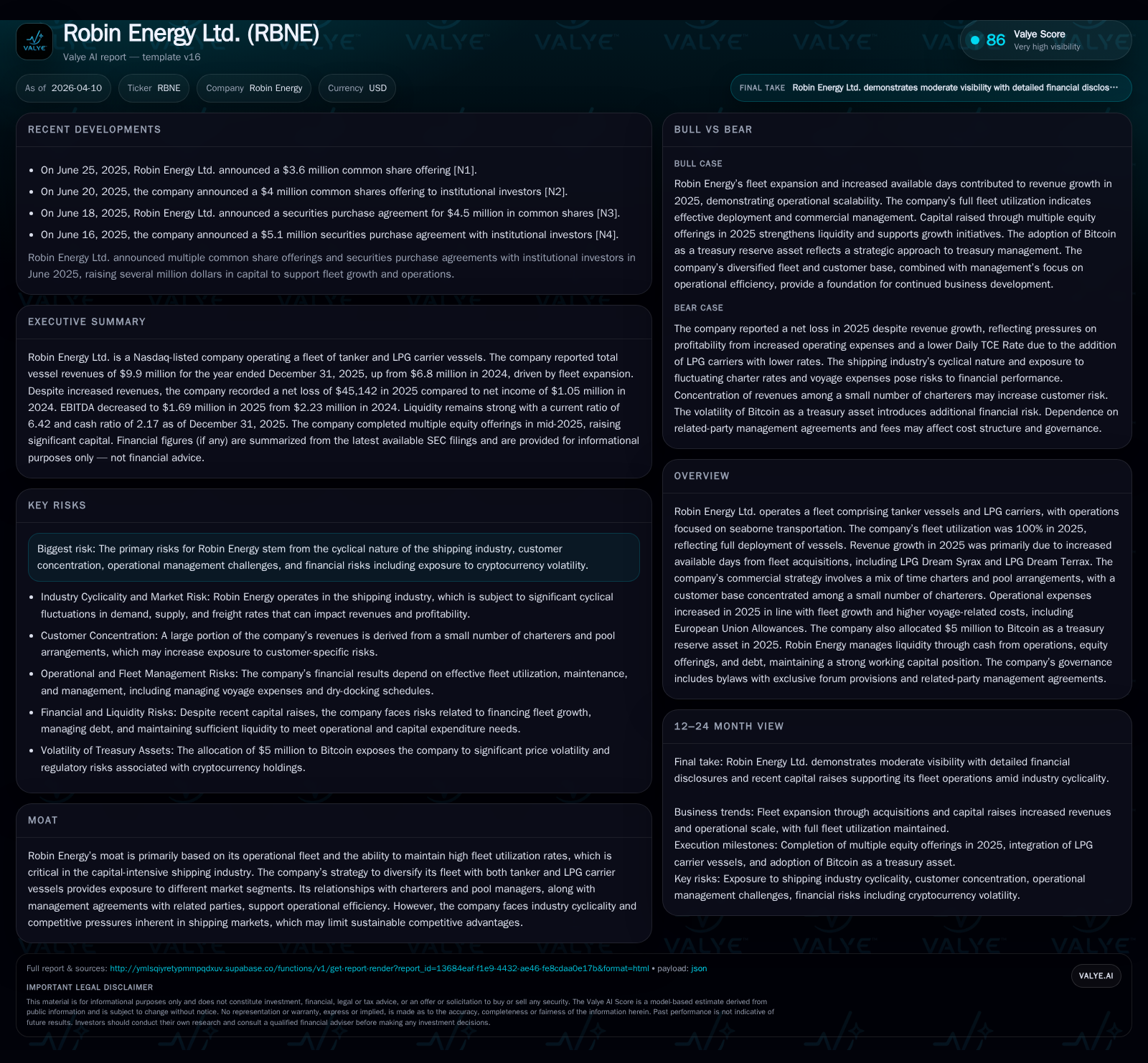
In 2025, Robin Energy Ltd. expanded its fleet by acquiring two LPG carriers, establishing dual reporting segments and achieving full fleet utilization with revenues nearing $10 million. The company announced a March 2026 spin-off of its tanker segment into AI OKTO Corp., an AI-enabled tanker operator. Capital raising efforts in late 2025 through early 2026 exceeded $30 million, supporting these strategic moves alongside a measured Bitcoin treasury allocation. Despite a modest net loss, robust operating cash flow and strong liquidity underpin RBNE’s financial flexibility amid shipping industry cyclicality and concentrated charterer relationships.
Fleet Expansion and Dual Segment Reporting in 2025
Historical performance (annual)
| FY | Rev ($mm) | Net ($) | CFO ($mm) | OpInc ($) |
|---|---|---|---|---|
| 2025 | 10 | -45142 | 10 | 721187 |
| 2024 | 0 | 0 | 0 | 0 |
Source: SEC companyfacts cache [F1].
Robin Energy Ltd. significantly evolved its operations in 2025 by acquiring two Liquefied Petroleum Gas (LPG) carrier vessels. This acquisition led to the establishment of two reportable segments — tankers and LPG carriers — reflecting distinct operational characteristics between refined petroleum product transport and liquefied petroleum gas carriage [S1]. The Chief Executive Officer acts as the Chief Operating Decision Maker (CODM), evaluating segment performance through key financial metrics such as revenues, operating expenses, operating income, and net income to guide capital allocation decisions [S1].
Utilization and Revenue Growth
The company achieved full fleet utilization (100%) during the year, with no off-hire days reported due to scheduled repairs or dry-docking [F1]. Revenue for the year ended December 31, 2025 reached approximately $9.9 million, a significant increase from zero revenue reported in the prior year due to fleet acquisitions commencing operations [F1]. This revenue growth was driven by increased Available Days from the expanded fleet combined with a mix of time charter contracts—where charterers bear voyage-related costs—and pooling arrangements [S1].
Tanker Segment Spin-Off: AI OKTO Corp.
In March 2026, Robin Energy announced a spin-off of its tanker segment comprising one tanker vessel and subsidiary Xavier Shipping Co., forming AI OKTO Corp., intended to operate as an independent entity focused on integrating artificial intelligence technology into tanker operations [S1]. This spin-off involves a distribution of approximately $15.5 million in cash alongside shares issued pro rata to Robin shareholders without requiring any exchange or payment [S1]. The initiative aims to leverage partnerships with data infrastructure providers and maritime technology firms to enhance efficiencies such as predictive maintenance and route optimization through AI-driven solutions [S1].
Capital Raising Activities
To support fleet growth and strategic initiatives including the spin-off, Robin Energy completed several equity offerings:
- Underwritten public offering on September 12, 2025 raising gross proceeds of about $8.6 million.
- Registered direct offering on October 27, 2025 generating roughly $7.0 million gross proceeds.
- At-The-Market (ATM) offering in Q1 2026 yielding approximately $14.8 million gross proceeds [S5][F1].
These transactions cumulatively provided over $30 million in gross funds.
Share Repurchases and Tender Offer
The Board authorized a share repurchase program up to $1 million starting December 16, 2025; approximately $0.1 million was used to repurchase shares before cancellation in January 2026 [S7]. Additionally, a tender offer commenced in March-April 2026 aims to acquire up to one million common shares at $3.00 per share funded from existing cash reserves [S7]. Dividends remain undeclared as the company prioritizes reinvestment [S6].
Liquidity Position
As of December 31, 2025, Robin Energy held cash and cash equivalents totaling approximately $5.6 million with current assets near $16.7 million against current liabilities of about $2.6 million resulting in a strong current ratio around 6.4 [F1][S4]. This liquidity supports working capital requirements including vessel maintenance compliance costs.
Treasury Reserve Innovation: Bitcoin Allocation
In September 2025, the company allocated $5 million into Bitcoin as part of an institutional-grade treasury framework targeting digital asset inclusion up to half its long-term cash reserves [S4]. This introduces novel balance sheet diversification but entails price volatility risks impacting earnings through fair value adjustments.
Operational Costs and Regulatory Impacts
Operating expenses rose with fleet expansion encompassing crewing, maintenance including dry-dockings amortized over survey cycles per accounting standards [S1]. Voyage expenses vary depending on charter contract types; vessels under voyage charters incur bunker fuel costs borne by RBNE whereas time charters shift these costs to charterers [S1]. Compliance with European Union Allowances (EUAs) for carbon emissions adds complexity particularly affecting bunker costs within regulated European waters [S1][F1].
Financial Performance Overview
For fiscal year ended December 31, 2025, operating income was positive at approximately $721,000 while net income slightly negative near -$45,000 reflecting elements including non-operational mark-to-market adjustments related to Bitcoin holdings [F1]. Return on equity approximates -0.1%, consistent with companies scaling asset bases amid investment phases. Operating cash flow stood at roughly $10.2 million underscoring strong cash generation capacity supporting capital expenditures without financing constraints [F1].
Risks Considerations
Robin Energy faces inherent risks from cyclical shipping markets where supply-demand imbalances impact freight rates contracted under diverse charter agreements [S1]. Customer concentration risk is notable given reliance on a limited number of charterers for substantial contract volumes [S1]. Operational risks include managing off-hire periods efficiently during maintenance while adhering to evolving environmental regulations adds complexity.
The Bitcoin treasury reserve introduces valuation variability distinct from core shipping activities necessitating vigilant risk monitoring against market volatility and regulatory developments affecting crypto assets [S4].
Outlook and Key Upcoming Developments
Key focus areas include:
- Completion of the AI OKTO Corp spin-off along with Nasdaq listing progress providing clarity on specialized AI-driven tanker operations’ performance trajectory [S1][S2].
- Post-spin-off resource allocation between LPG carriers continuing under Robin Energy versus autonomous tanker management inside AI OKTO.
- Execution under ATM equity facility potentially funding further vessel acquisitions or technology investments.
- Monitoring Bitcoin asset valuations impacting quarterly earnings.
- Dividend policy developments remain uncertain given reinvestment focus but require attention due to preferred stock dividend accruals [S6][S15].
Robin Energy’s trajectory reflects strategic fleet expansion combined with capital market activities positioning it for competitive differentiation amid volatile yet opportunity-rich shipping markets.
This summary is based on information disclosed by Robin Energy Ltd. through SEC filings as of April 10, 2026 ([F1], [S1]-[S7], [S4]). No investment advice is provided herein.
Disclaimer: This is research-only, informational analysis and not investment advice. It may include AI-generated interpretation and general industry context. Always verify important details using primary sources.

Comments