
Peakstone Realty Trust's Strategic Shift to Industrial Focus Pressures Revenue and Profitability
PKST is divesting office assets to concentrate on industrial outdoor storage amid challenging financial results.
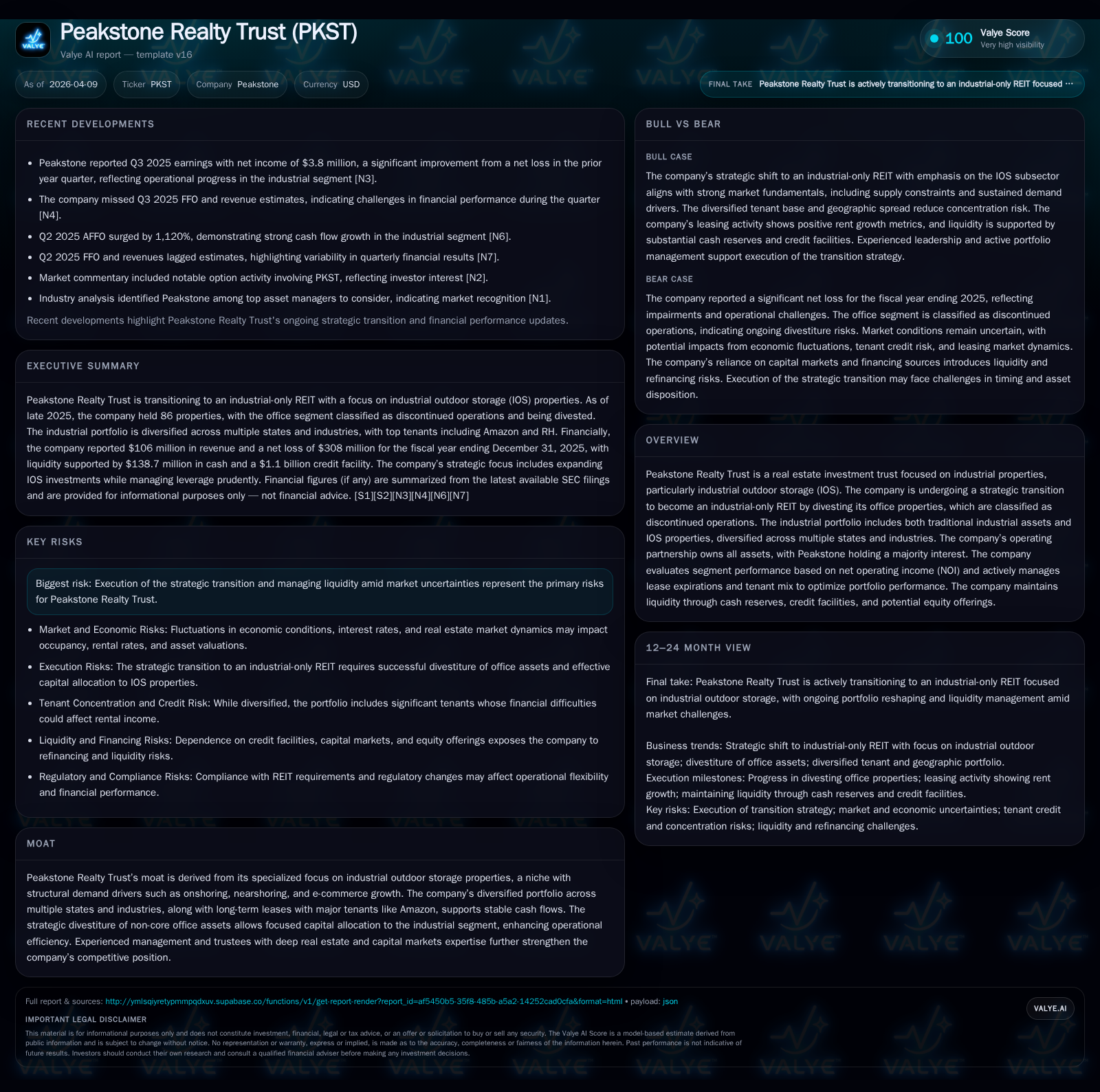
Peakstone Realty Trust has embarked on a deliberate transition to become an industrial-only REIT, primarily targeting growth in the industrial outdoor storage sector. This strategic pivot entails divesting its office properties, which are now categorized as discontinued operations, leading to a significant decline in reported revenues and net income in fiscal 2025 compared with prior years. Despite negative operating and net income, the company maintains solid operating cash flow supported by a diversified industrial portfolio with long-term leases. Key upcoming indicators include successful execution of office asset sales, stabilization of operating income in the industrial segment, and effective liquidity management amid debt maturities.
Company Overview and Strategic Shift
Peakstone Realty Trust (PKST) is executing a strategic transition to become an industrial-only real estate investment trust (REIT), focusing on growth in the industrial outdoor storage (IOS) sector. This repositioning involves actively divesting its office properties which have been classified as discontinued operations effective September 30, 2025 [S2][S26]. The Operating Partnership (PKST OP, L.P.), owned approximately 92.6% by Peakstone Realty Trust, holds all underlying assets providing consolidated control over the portfolio [S2].
Historical Performance Summary
The table below summarizes key annual financial metrics drawn from SEC filings and company facts [F1]:
Historical performance (annual)
| FY | Rev ($mm) | Net ($mm) | CFO ($mm) | OpInc ($mm) | Rev YoY | Net YoY |
|---|---|---|---|---|---|---|
| 2025 | 106 | -308 | 69 | -14 | -53.5% | -2851.6% |
| 2024 | 228 | -10 | 95 | -2 | -10.3% | +98.1% |
| 2023 | 254 | -558 | 89 | -364 | -38.9% | -35.4% |
| 2022 | 416 | -412 | 153 | -36 |
Source: SEC companyfacts cache [F1].
Capital returns and efficiency (annual)
| FY | Div ($mm) | Buybacks ($mm) | ROE% |
|---|---|---|---|
| 2025 | 29 | 0 | -41.3 |
| 2024 | 33 | 0 | -1.0 |
| 2023 | 41 | 4 | -50.2 |
| 2022 | 114 | 6 | -24.5 |
Source: SEC companyfacts cache [F1].
Significant observations include:
- The sharp revenue decline in FY2025 reflects the classification of office property revenues as discontinued operations amid ongoing divestitures [S2][F1].
- Operating losses widened relative to FY2024 but represent an improvement compared to prior years impacted by goodwill impairments [F1][S16].
- The net loss increase is largely attributable to impairment charges related to office property write-downs [F1][S16].
- Positive operating cash flow demonstrates continued cash generation from core industrial assets despite accounting losses [F1].
- Dividends have been reduced consistent with cautious capital allocation during this transition phase.
Portfolio Composition and Diversification
As of September 30, 2025, the Company’s portfolio comprised approximately 70 Industrial properties versus 16 Office properties classified as held for sale under discontinued operations [S2][S26]. The Industrial segment's Annualized Base Rent (ABR) is concentrated primarily in Georgia (15%), Florida (14%), Illinois (13%), Ohio (11%), California (10%), Pennsylvania (7%), Virginia (5%), Texas (5%), South Carolina (4%), and New Jersey (3%)—collectively representing over 87% of ABR [S26]. This geographic diversification reduces concentration risk while aligning capital allocation with high-demand IOS markets.
Debt Structure and Liquidity Position
As of September 30, 2025, Peakstone had approximately $1.05 billion in total consolidated debt comprising secured mortgage loans and unsecured term loans with average effective interest rates around mid-single digits after considering interest rate swaps [S11][S18][F1]. Key features include:
- A $1.1 billion credit facility with KeyBank including a $547 million revolving credit facility and multiple term loans maturing between April and October of upcoming years [S4][S5].
- Cash and cash equivalents totaling approximately $138.7 million at year-end provide liquidity support [F1].
- Scheduled principal repayments begin in April 2026 with a $150 million term loan maturity; additional lease obligations related to corporate headquarters also contribute to medium-term cash requirements [S11].
- The Company has actively managed revolver borrowings reducing drawn amounts during FY25 [S12][S16].
Capital Allocation Policies
Consistent with REIT requirements mandating distribution of at least 90% of taxable income annually, Peakstone has paid dividends totaling $29 million in FY25 down from $114 million in FY22 reflecting prudent capital deployment amid restructuring [F1][S9][S11]. No share repurchases occurred during FY25 following limited buybacks in prior years [F1], underscoring a focus on preserving liquidity during portfolio transformation.
Growth Outlook and Risks
Growth Drivers:
- Concentrated investment in IOS assets aligns with favorable structural trends such as supply chain reshoring and e-commerce expansion.
- Geographic diversification across multiple states enables selective capital deployment where market fundamentals promote occupancy gains.
- Potential redevelopment or acquisition opportunities within existing industrial holdings could enhance future cash flows.
Risks:
- Execution risk exists regarding timely disposition of remaining office assets which could impact near-term liquidity.
- Upcoming debt maturities require refinancing or repayment strategies amid volatile credit markets.
- Tenant credit quality and occupancy levels remain critical for sustaining cash flow stability.
- Macroeconomic factors may influence property valuations and operational performance.
No explicit forward guidance is provided; investors should monitor developments on office asset sales progress, quarterly industrial segment performance metrics such as NOI, leverage ratios post-debt maturities, and dividend policy updates for insights into capital return sustainability [S3][S25].
Conclusion
Peakstone Realty Trust’s financials reflect a company undergoing significant portfolio repositioning—exiting legacy office holdings while focusing on an industrial niche with growth potential but transitional challenges evidenced by revenue contraction and net losses for fiscal year ending December 31, 2025 [F1][S2]. Maintaining positive operating cash flow alongside substantial liquidity buffers provides some reassurance amid this strategic realignment. The successful execution of asset sales coupled with prudent leverage management will be critical factors shaping PKST’s path toward sustainable profitability within its refined business model.
This analysis summarizes publicly available information as of April 9, 2026 without extending any investment recommendations or forecasts.
Disclaimer: This is research-only, informational analysis and not investment advice. It may include AI-generated interpretation and general industry context. Always verify important details using primary sources.

Comments