
BlackBerry’s Steady Transition to Embedded Software and Secure Communications Sustains Profitability
BlackBerry LTD leverages its QNX platform and secure communications to navigate a competitive technology infrastructure market with recurring revenue.
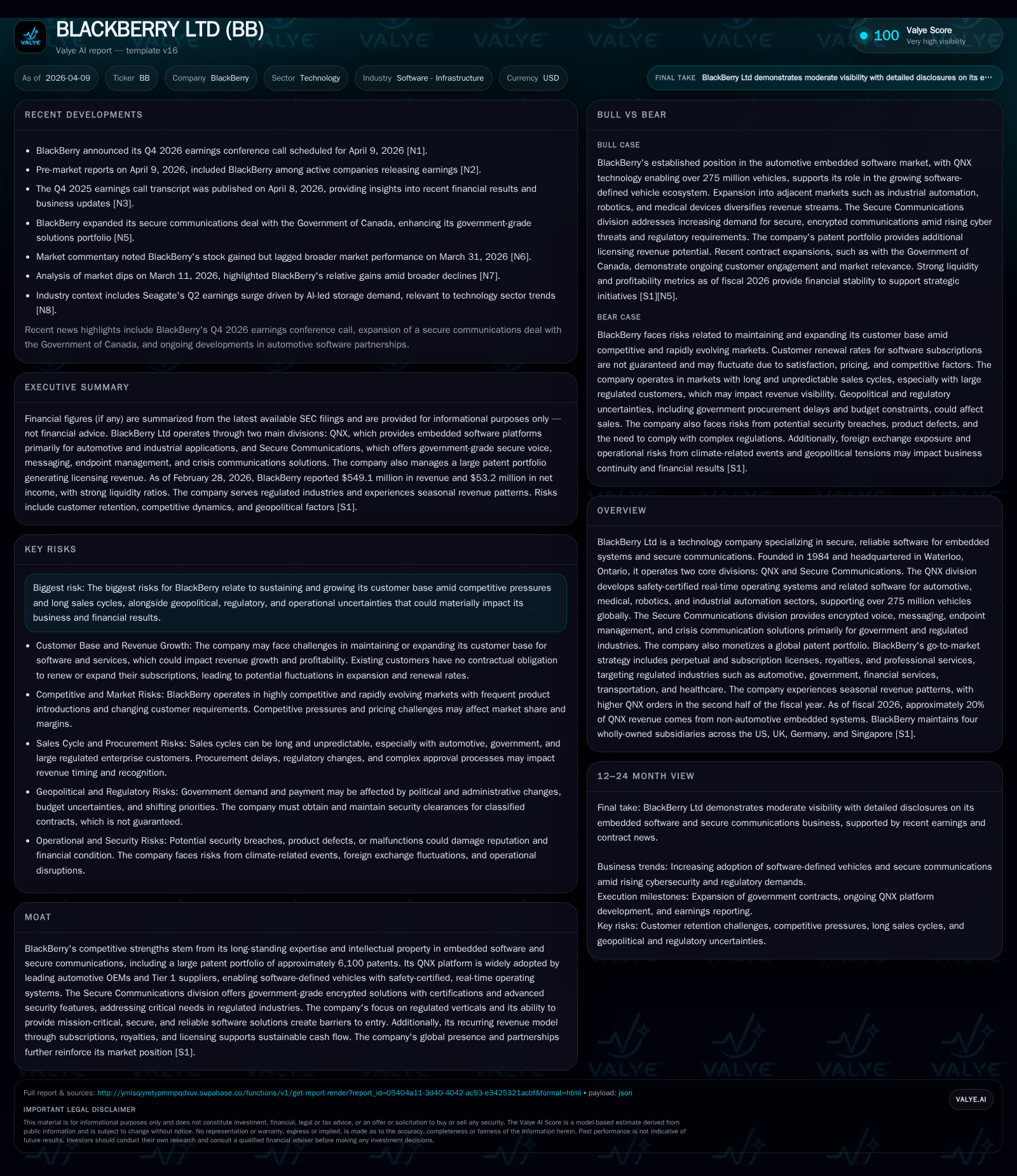
BlackBerry Limited has steadily repositioned itself from a legacy mobile device manufacturer into a software infrastructure player focused on embedded systems and secure communication solutions. Its QNX division, powering over 275 million vehicles worldwide, and Secure Communications unit serve industries requiring mission-critical reliability and security. The company has returned to profitability in fiscal 2026 after consecutive years of losses, driven by operational improvements and stable revenue growth amid fierce competition and long sales cycles. Going forward, BlackBerry faces risks from competitive pressures, lengthy government sales processes, and regulatory challenges but benefits from a large patent portfolio and diversified licensing revenues that undergird cash flow stability.
Company Overview
Founded in 1984, BlackBerry Limited has evolved dramatically from its early days as a pioneer in secure mobile devices into a specialized technology infrastructure provider focusing on embedded software systems and secure communications products [S4]. The company operates two synergistic divisions: the QNX division which develops safety-certified real-time operating systems (RTOS) widely deployed across automotive (powering over 275 million vehicles globally), medical devices, robotics, and industrial automation; and the Secure Communications segment that offers government-grade encrypted voice, messaging, endpoint management, and crisis communication solutions for regulated sectors such as government agencies, financial services, healthcare, and transportation [S4].
BlackBerry also monetizes an extensive patent portfolio comprising approximately 6,100 patents spanning OS technologies, cryptography, wireless communications, enterprise software, automotive subsystems among others [S22]. This intangible asset base supports licensing revenue streams critical for its financial stability.
Historical Performance
BlackBerry's recent financial trajectory reveals a company emerging from heavy restructuring predominantly completed by fiscal 2025 into a phase of profitable software-driven operations. Revenue growth was modest but positive in FY2026 at $549.1 million (a 2.7% increase from $534.9 million the prior year), following volatile revenue trends that included an anomalous spike then contraction seen particularly around FY2024 ($853 million) [F1].
Operating income recovered strongly to $48.3 million from essentially break-even results in FY2025; this followed significant losses of -$125 million in FY2024 reflecting the transformational investments underway [F1]. Net income turned positive at $53.2 million after several years of considerable net losses (-$79 million FY2025; -$130 million FY2024), indicative of stabilization post-restructuring [F1].
Operating cash flow improved markedly by over 200% YoY to $50.3 million despite low capital expenditures ($3.8 million), yielding an estimated free cash flow of $46.5 million supported by the recurring subscription/royalty licensing models characteristic of BlackBerry’s go-to-market approach [F1]. The company's financial position remains robust with cash balances of $274.7 million ensuring liquidity and a current ratio over 2.0 enabling working capital flexibility [F1].
Historical performance (annual)
| FY | Rev ($mm) | Net ($mm) | CFO ($mm) | OpInc ($mm) | Rev YoY | Net YoY |
|---|---|---|---|---|---|---|
| 2026 | 549 | 53 | 50 | 48 | +2.7% | +167.3% |
| 2025 | 535 | -79 | 17 | 1 | -37.3% | +39.2% |
| 2024 | 853 | -130 | -3 | -125 | +30.0% | +82.3% |
| 2023 | 656 | -734 | -263 | -725 |
Source: SEC companyfacts cache [F1].
Capital returns and efficiency (annual)
| FY | FCF ($mm) | ROE% |
|---|---|---|
| 2026 | 47 | 7.1 |
| 2025 | 13 | -11.0 |
| 2024 | -10 | -16.8 |
| 2023 | -270 | -85.6 |
Source: SEC companyfacts cache [F1].
Note: Operating income shows exceptional volatility due to transformation costs; buybacks resumed meaningfully only in FY2026.
Drivers Behind Historical Trends
The uneven revenue pattern through recent years reflects the company's complex transition from legacy mobile device sales toward higher-margin software solutions with longer sales cycles and customer adoption timelines [S1][S4]. The lift in operating income and return to net profitability signals that structural cost efficiencies paired with recurring license revenues have begun to materialize.
Growth was supported primarily by expansion in QNX licensing within automotive OEMs rolling out software-defined vehicle platforms as well as by increased adoption within adjacent industries embracing real-time operating systems on intelligent edge devices [S4]. Concurrently, BlackBerry's Secure Communications division expanded its footprint catering to governments’ rising demand for certified encrypted communications amidst escalating cyber threats globally [N5][S24].
Additionally, revitalized patent monetization through licensing deals helped stabilize income during periods when core software sales were softening [S22][F1]. Meanwhile ongoing investments into innovation including platforms like BlackBerry Radar asset tracking contributed incremental niche revenue.
Future Growth Prospects
BlackBerry identifies expansion opportunities based on accelerating intelligent edge computing trends across connected vehicles, IoT devices in industrial automation, robotics, medical systems as well as increasing governmental investment into secure communications infrastructure prompted by geopolitical instability [S4][N5]. Demand drivers include regulatory mandates for safety-certified software components in automotive/autonomous vehicles along with heightened compliance needs concerning data privacy/security in enterprise mobility.
The company aims to further grow recurring subscription/licensing revenue streams while extending professional engineering services linked to QNX integration projects [S4]. Expansion into new geographic regions through partnerships complements direct sales efforts worldwide.
However, growth is tempered by potentially protracted customer approval cycles especially within government contracts subject to budgetary constraints or shifting political priorities [S24]. Competition remains pronounced not only from entrenched large players but increasingly from open source solutions attractive for cost sensitive OEM customers developing internal platforms rather than licensing third-party RTOS software [S10][S16]. Technological advances like generative AI pose both enhancement opportunities for BlackBerry’s development efficiency but also risk accelerating competitor innovation cycles potentially compressing differentiation windows if not effectively leveraged [S10][S20].
Monitoring extensions or renewals of existing government contracts including expansions such as the recent Government of Canada deal will be critical near-term milestones to watch alongside indicators of new customer adoption within key verticals [N5][N3].
Guidance & Market Expectations
No formal forward-looking guidance or explicit milestone targets were provided in publicly available disclosures for fiscal years beyond February 28, 2026 [N3][S1]. However management commentary underscores focus on improving gross margins via product mix shifts favoring subscription/licensing models alongside disciplined operating expense management aimed at sustaining profitability gains achieved this fiscal year [N3][S1].
Analysts should track quarterly revenue cadence given seasonality patterns where QNX customer ordering tends to cluster in the second half of the fiscal year plus any updates on contract wins or patent monetization flows which can sway near-term performance variability [S4][N6]. Emerging geopolitical developments especially those affecting U.S.-Canada trade policies or international cybersecurity regulations may also influence future contract availability or investment pacing [S11][S26].
Returns & Capital Allocation
With net income turning positive at $53.2 million against equity of approximately $746 million at year-end FY2026 BlackBerry posted an approximate return on equity (ROE) of about 7.1%, indicating measured profitability reflective of ongoing strategic repositioning efforts yet room for further margin enhancements over time [F1]. Operating cash flow rose substantially boosting liquidity strength while capital expenditures remained modest at $3.8 million reflecting limited hardware investment needs consistent with software-platform centric business model economics [F1].
Notably BlackBerry resumed meaningful share repurchases within FY2026 totaling about $60.7 million after years without buybacks which signals management confidence in intrinsic valuation relative to deployment alternatives [F1]. Dividends are either minimal or not material relative to overall capital return though specific dividend policy details are absent from filings reviewed.
Intellectual property licensing royalties produce steady cash inflows supporting free cash flow generation enabling selective reinvestment plus returns through share repurchases while debt leverage remains conservative with limited reported outstanding convertible notes maturing beyond mid-decade horizons restricting financial risk exposure under current conditions [S19][F1].
Competitive Position & Risks
BlackBerry operates amidst intense competition from technology incumbents possessing larger R&D budgets and extensive sales/distribution channels alongside emerging agile startups exploiting rapid technology evolution especially around AI-enabled software development lifecycles that could erode time-to-market advantages it now possesses through QNX certification credentials or Secure Comm encryptions capabilities [S10][S20].
Customers regularly review alternative solutions including open source offerings perceived as lower cost risking erosion of license renewal rates or expansion orders particularly among automotive Tier-1 suppliers adopting internally developed platforms versus licensed software stacks from third-party vendors like BlackBerry [S10][S16].
Certain contracts notably with governments involve long sales cycles subject to shifting political priorities or funding uncertainties that could materially delay revenue recognition or depress order visibility despite pipeline strength currently reported including expansions of existing agreements such as the Canadian government secure comm deal announced recently [N5][N24].
Regulatory complexity spans export/import controls on encryption technologies that may hinder broader market access along with evolving AI governance frameworks creating compliance challenges related to certification/testing for safety-critical applications relying partially on AI-assisted development tools which BlackBerry employs internally but must tightly control risk exposure to avoid delays or denials of product approvals vital to customer market entry timelines [S11][S10][S20][S26].
Intellectual property infringement claims remain an inherent risk given extensive patent portfolio activities potentially triggering costly litigation defense even if BlackBerry believes its rights are sound; adverse judgments could require expensive licensing settlements or product modifications impacting financial results substantially if they arise unexpectedly given the industry’s litigious nature around technology patents [S9][S18][S19].
Environmental events/climate-related disruptions pose operational risks notably since corporate offices are located in geographies susceptible to extreme weather events impacting infrastructure continuity despite comprehensive disaster preparedness plans implemented by management [S6]. Additionally foreign currency exposure tied primarily to Canadian dollars, euros, British pounds against USD functional currency introduces earnings variability influenced by global macroeconomic factors beyond company control.
Sector Context Analysis
Embedded real-time operating systems form foundational layers enabling complex autonomous feature sets driving next-gen vehicle platforms characterized increasingly by domain controller architectures converging multiple functions onto centralized compute modules rather than distributed ECUs — a technological trend intensifying validation demands for certified RTOS vendors like BlackBerry’s QNX offering. Simultaneously secure communications solutions proliferate due to escalating cyber threats especially amongst governments requiring resilient networked crisis management capabilities integrated with unified endpoint controls reflective of converging enterprise security paradigms. Amid evolving AI regulation landscapes globally players embedding generative AI into safety-critical code development face balancing innovation velocity against certification rigor—anticipating regulatory requirements for explainability/human-in-the-loop safeguards affecting deployment timelines.
Conclusion
BlackBerry Ltd stands today as a leaner company rebuilt around high-value intellectual property assets focusing on sustainable growth niches within embedded software infrastructure for automotive/industrial markets and hardened secure communication products serving regulated institutions worldwide. Its financials reveal tangible progress returning to profitability fueled by recurring subscription & licensing revenues alongside disciplined capital management exemplified by significant buyback activity. Nevertheless substantial uncertainties persist including intensifying competitive dynamics propelled by open source alternatives and accelerated AI-driven innovation cycles requiring vigilant product evolution investments balanced against extended governmental procurement timelines fraught with budget unpredictability. Long-term value creation depends critically on maintaining differentiated technology leadership fortified by strong intellectual property defenses alongside penetrating emerging intelligent edge ecosystems powered increasingly by AI-enabled capabilities while navigating multi-jurisdictional regulatory complexities inherent to both encryption technology usage and artificial intelligence integration. Growth watchers will focus closest attention on renewal rates within major automotive OEM contracts tied to SDV rollouts combined with visible traction expanding secure communications deals globally amid shifting geopolitical landscapes influencing governmental spending decisions. Capital allocators observe steady positive cash flows enabling opportunistic repurchases yet await signs of scalable margin expansion aligned with elevated R&D investment absorbing efficiencies expected over medium term horizon.
This analysis is intended exclusively for informational purposes reflecting facts and disclosures available as of April 9, 2026 without constituting investment advice or recommendations.
Disclaimer: This is research-only, informational analysis and not investment advice. It may include AI-generated interpretation and general industry context. Always verify important details using primary sources.

Comments