
SolarWindow Technologies’ Financial Trajectory and Emerging Photovoltaic Innovations
An integration of SolarWindow’s financial evolution with technical progress in LiquidElectricity® Coatings highlights the pathway and hurdles toward commercial scalability.
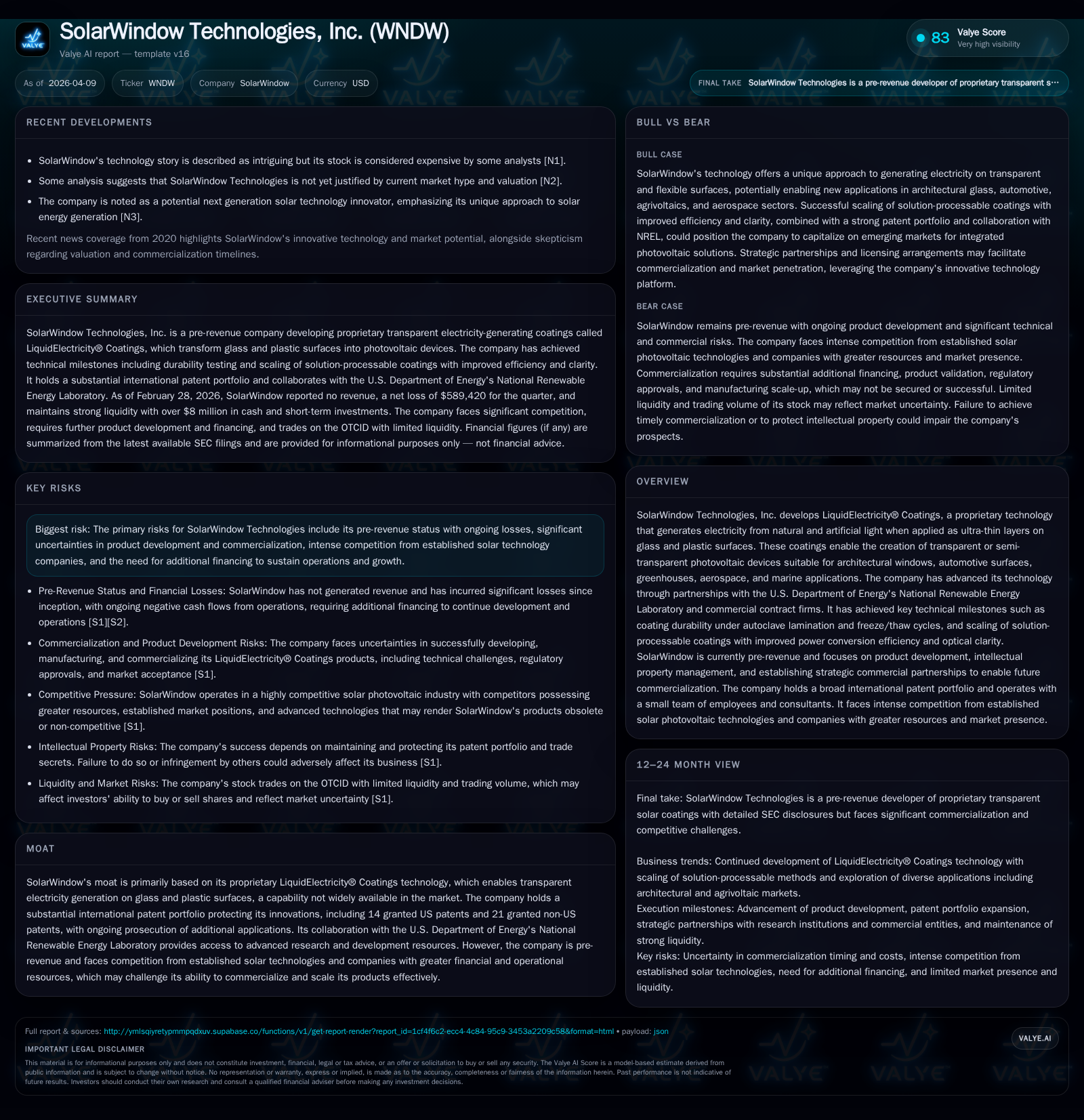
SolarWindow Technologies remains in a pre-revenue stage, advancing its proprietary LiquidElectricity® transparent photovoltaic coatings despite persistent operating losses. The company has steadily narrowed net losses and improved cash flow metrics over recent years while maintaining a strong liquidity position. Strategic collaboration with the U.S. Department of Energy's National Renewable Energy Laboratory underpins ongoing R&D progress, focusing on product durability and power conversion efficiency enhancements. Absent forecast guidance, watchpoints include demonstration milestones, funding sufficiency for commercialization efforts, and intellectual property protection amid competitive and regulatory headwinds.
Financial Performance Trends: Deepening Losses but Improving Cash Ratios
SolarWindow Technologies has consistently operated at a net loss through FY2022-FY2025 while remaining at an early product development stage with no revenues reported [F1]. The net losses narrowed from approximately -$4.95 million in FY2022 to -$2.26 million in FY2025, reflecting a 34.7% year-over-year reduction between FY2024 and FY2025 [F1]. Operating income and cash flow from operations similarly improved but remained negative throughout the period. Operating cash flow (CFO) usage decreased from -$3.64 million in FY2022 to -$1.50 million in FY2025, indicating moderation of operational cash burn [F1]. Capital expenditures have been modest but increased substantially to ~$37 thousand in FY2025 from negligible levels previously, consistent with incremental investments in technology assets [F1]. Liquidity remains strong; as of February 28, 2026, cash and equivalents totaled approximately $5.39 million with current assets far exceeding current liabilities (current ratio ~19.77), providing a comfortable runway for ongoing R&D activity despite zero revenue generation [F1]. This financial profile is characteristic of an innovation-stage technology developer dependent on equity capital inflows rather than operational cash flows.
Historical performance (annual)
| FY | Net ($mm) | CFO ($mm) | OpInc ($mm) | Capex ($) | Net YoY |
|---|---|---|---|---|---|
| 2025 | -2 | -2 | -2 | 37687 | +34.7% |
| 2024 | -3 | -2 | -3 | 1950 | -44.2% |
| 2023 | -2 | -2 | -2 | 0 | +51.6% |
| 2022 | -5 | -4 | -5 | 356966 |
Source: SEC companyfacts cache [F1].
Capital returns and efficiency (annual)
| FY | FCF ($mm) | ROE% |
|---|---|---|
| 2025 | -2 | -35.0 |
| 2024 | -2 | -73.8 |
| 2023 | -2 | -32.7 |
| 2022 | -4 | -51.7 |
Source: SEC companyfacts cache [F1].
Innovative Product Development: Decoding LiquidElectricity® Coatings
At the core of SolarWindow's endeavor is its proprietary LiquidElectricity® technology that utilizes ultra-thin organic photovoltaic coatings capable of generating electricity transparently when applied on glass or plastic substrates [S1]. These multi-layer coatings integrate functional chemical layers including hole transport layers (HTLs), active photovoltaic layers where photon absorption and exciton generation occur, electron transport layers (ETLs), and conductive contact points critical for efficient charge extraction [S1]. The design optimizes trade-offs between optical clarity—important for architectural and automotive window applications—and power conversion efficiency to maximize electricity output without impairing substrate transparency [S1]. The technology’s flexibility allows adaptation across diverse off-grid sectors such as architectural glass windows (both new build and retrofit), automotive surfaces like sunroofs or windows, agrivoltaic greenhouses benefiting from light transmission while harvesting energy, aerospace and marine applications demanding lightweight photovoltaics [S1]. This layered approach represents an area of cutting-edge organic photovoltaics seeking to balance manufacturability at scale with material stability under environmental stresses.
Partnerships Driving Technology Advancement and Validation
A crucial element enabling SolarWindow’s technological progress is its collaborative framework with the U.S. Department of Energy’s National Renewable Energy Laboratory (NREL) through Cooperative Research and Development Agreements (CRADA) initiated since March 2011 [S1][S4]. NREL provides access to sophisticated research infrastructure essential for validating key performance parameters such as coating durability against autoclave lamination processes common in double-pane windows and resilience under freeze/thaw cycling reflective of real-world temperature variations [S4]. This partnership involves sharing proprietary intellectual property and leveraging NREL's background IP for advanced coating formulations [S4]. Commercial contract firms supplement expertise in chemistry refinement and manufacturing scalability optimization supporting transition from lab-scale prototypes toward pilot production capabilities [S1][S4]. Such cooperative arrangements are less common among smaller PV innovators given the high costs and regulatory barriers inherent in these validation steps.
Competitive Differentiation amidst Established Solar Market Rivals
SolarWindow’s moat largely hinges on its ability to produce transparent electricity-generating coatings—a capability still rare compared to dominant crystalline silicon photovoltaic modules dominating global markets [S14]. The extensive patent portfolio encompassing fourteen granted U.S. patents and over twenty non-U.S. patents further fortifies proprietary claims around unique chemical compositions and fabrication methods extending through mid-to-late decade expirations depending on filings [S17][S19]. However, competition is fierce; well-funded incumbents benefit from mature supply chains optimized for cost-effective mass manufacturing of opaque solar panels that have driven down prices sharply [S14]. Transparent photovoltaics face the dual challenge of maintaining attractiveness as visually unobtrusive additions to building envelopes while achieving sufficiently competitive power conversion efficiencies at scale—a hurdle compounded by materials longevity concerns under prolonged exposure to solar irradiance and weathering cycles [S14]. While SolarWindow garners technological differentiation via patented multi-layer organics adaptable beyond traditional silicon panels into flexible plastics for varied applications—the path from innovation to commercial volume production remains arduous.
Capital Structure and Liquidity Positioned for Near-Term R&D
SolarWindow does not employ debt financing; capital is principally derived from equity issuance complemented by liquid short-term investments [F1][S5][S25]. Notably, a June 2025 private placement generated approximately $3.9 million via sale of units priced at $0.31 each [S5], bolstering cash reserves alongside accrued investment maturities helping increase total liquid resources to over $6.5 million by August 31, 2025 [F1][S5]. Operational cash burn moderation combined with this liquidity positions the company favorably toward sustaining R&D activities through at least twelve months post-report date absent significant unforeseen expenditures [S15]. Existing equity capital supports progression through advanced research stages including scalability demonstrations though management acknowledges further capital will be needed to finance full commercialization scaling beyond this phase—given unknowns around timeframes for market entry and customer adoption cycles [S13][S15][S23]. No share repurchase programs or dividend distributions exist; return measures remain negative driven by ongoing developmental expenses without revenue inflows [F1][S25].
Regulatory, Litigation, and Operational Risks Influencing Growth
SolarWindow confronts typical legal-risk profiles associated with emerging technology firms operating in regulated sectors encompassing electrical safety codes (e.g., OSHA regulations; ANSI/NFPA-70 certification requirements), product liability exposure risks which must be mitigated through insurance coverage anticipated at standard industry levels though uncertainties persist about sufficiency or availability under evolving regulatory regimes [S3][S4][S6][S21]. The company reports no material pending litigation currently but acknowledges unpredictable court or regulatory outcomes could impose costly penalties or operational constraints interfering with commercialization timetable [S10][S11][S12]. Moreover supply chain interruptions linked to geopolitical tensions such as the Russia-Ukraine conflict could imperil procurement of requisite raw materials elevating costs temporarily or causing delivery delays impacting prototypes or pilot production phases [S4]. Internal controls related challenges including fraud prevention limitations inherent in early stage companies are identified without specific incidents yet underscoring need for continuous governance vigilance [S6][S16]. Intellectual property enforcement represents another risk vector given potential infringement claims from other entities or inability to secure licenses necessary for continued development—highlighted by ongoing patent prosecutions aiming at broadening claim scope via continuation filings as defensive strategy against design-arounds by competitors [S17][S18][S19][S20][S22].
Path to Revenue: Commercialization Milestones and Licensing Prospects
SolarWindow foresees initial commercial products deriving primarily from application of LiquidElectricity® coatings to glass surfaces forming electricity-generating windows intended for integration into architectural projects—both new construction skylights—as well as retrofit solutions plus niche markets including recreational vehicle marine vessel skylights noted explicitly as near-term focuses [S1][S4]. The company anticipates leveraging licensing or joint venture agreements involving third-party manufacturers possessing requisite scale rather than direct internal fabrication reflecting a strategic choice aligned with its operational resource base currently focused on innovation rather than mass production capability development [S1][S15]. Technical milestones rest upon successful demonstration of coating robustness through fabrication processes like autoclave lamination common in insulated glazing units plus freeze/thaw testing simulating climatic stressors coupled with incremental gains in power conversion efficiencies balanced against optical transparency criteria maintained throughout development cycles at DOE’s NREL facilities corroborated by commercial contractors collaborating on coating process optimization—a nexus crucial for achieving market-ready status pending alignment on manufacturing cost targets inclusive of durability assurances required by end users ranging from building developers to automotive OEMs [S1][S4].
Forecast Watchpoints: Operational Metrics and Financing Needs Ahead
Absent explicit financial forecasts or revenue guidance within SEC reports pertinent metrics signaling transition toward commercialization include progressive enhancements in power conversion efficiency quantifications demonstrated by NREL collaborations; completion of durability testing passing stringent industrial norms; expansion of intellectual property portfolio protecting newly developed variants; timely execution of licensing deals or partnerships enabling scale manufacturing capacity deployment; maintenance or extension of positive cash runway balancing operating expense trends predominantly related to personnel costs alongside materials procurement efficiency improvements[S1][S2][S15].
Financially prudent management anticipates future capital rounds will be imperative given extended time horizons expected before meaningful revenue generation—as research advances necessitate capital-intensive scale-up equipment acquisition beyond current holdings flagged modestly via capex uplift YOY albeit still minor relative to total cash disbursement volumes[F1][S9][S15]. Equity dilution implications remain salient considerations influencing shareholder value trajectories contingent on broader market conditions affecting availability terms.[S13][S23] Monitoring increasingly stringent regulatory developments governing electrical devices safety compliance may also impact timing and scope upward adjustments related expense budgeting.[S21]
In sum, SolarWindow Technologies’ interplay between a promising yet nascent organic photovoltaic innovation platform centered on LiquidElectricity® transparent coatings intertwined with a cautious financial management approach characterizes a firm working deliberately within sector constraints toward eventual commercial market penetration amidst competitive pressures inherent within the solar technologies landscape.
This analysis reflects information available up to April 9th, 2026 based on SEC filings and company disclosures without incorporating any unverified data or forward-looking speculation beyond documented evidence provided herein.
Disclaimer: This is research-only, informational analysis and not investment advice. It may include AI-generated interpretation and general industry context. Always verify important details using primary sources.

Comments