
Byrna Technologies’ Turnaround: From Operating Losses to Sustainable Profitability
Byrna Technologies shifted from persistent losses to positive net income in FY2025, propelled by leadership revamps and innovation in the personal security device sector.
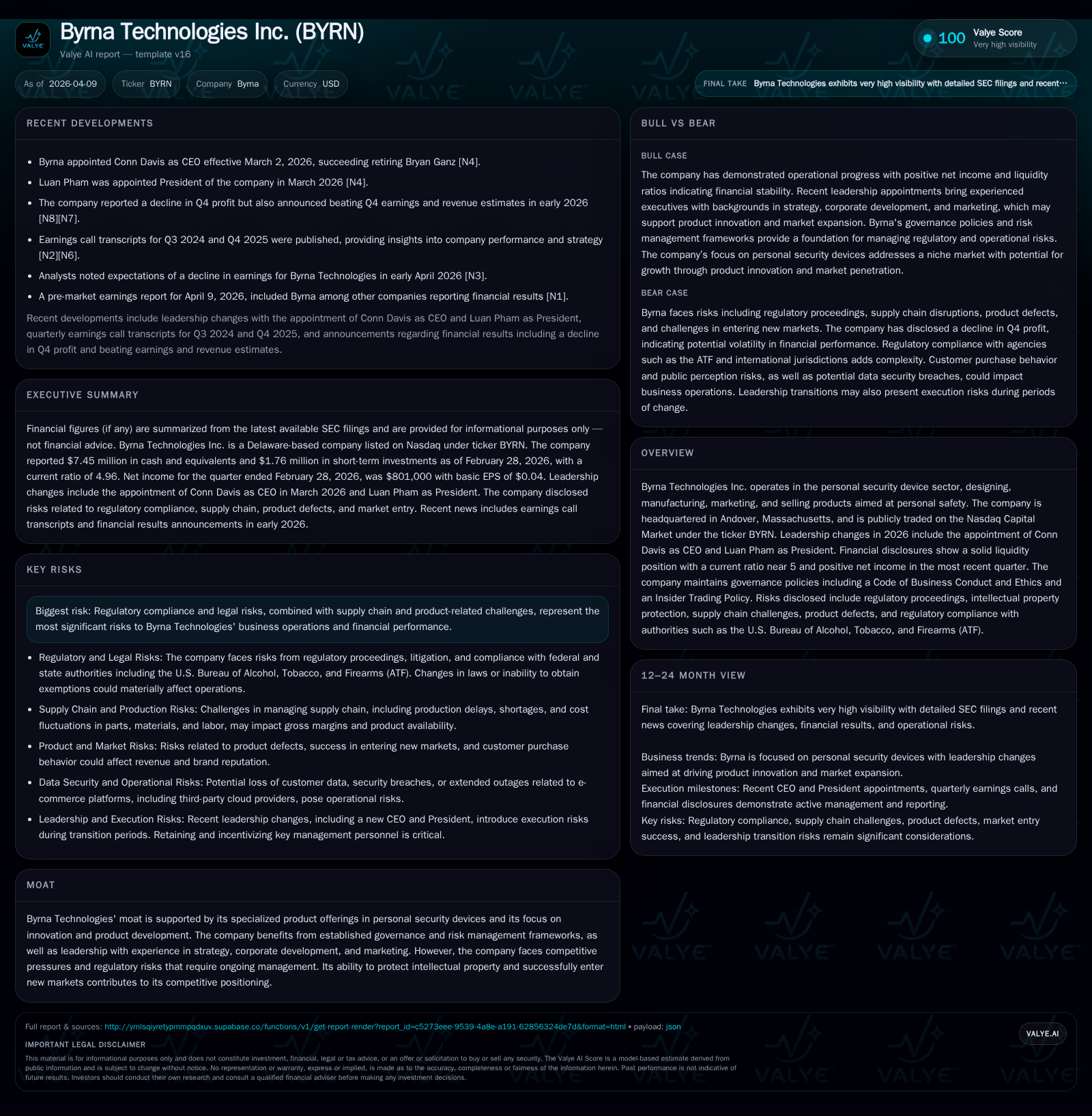
Byrna Technologies Inc. has navigated a remarkable financial transformation, evolving from multi-year operating and net losses into a profitable enterprise by fiscal year 2025. This turnaround coincided with strategic leadership changes and intensified focus on product innovation within a regulated environment dominated by personal security devices. Despite strong revenue growth and improved operating margins, risks remain elevated due to regulatory compliance demands and supply chain complexities. The company's solid liquidity position and capital allocation choices, including significant capex investments and moderated share buybacks, now set the stage for future market expansion under new executive leadership.
From Large Losses to Profitable Operations: BYRN’s Historical Performance Trajectory
Byrna Technologies Inc.'s financial evolution exemplifies a sharp pivot from sustained operating losses to robust profitability over recent fiscal years. Starting from a modest revenue base of approximately USD 0.9 million in fiscal year (FY) 2019, the company achieved explosive top-line growth that catapulted revenues beyond USD 16.5 million by FY2020 [F1]. This growth surge marked the beginning of an operational scale-up phase amid industry challenges.
Yet Byrna had yet to translate revenue advances into profits at that stage; the company posted deep net losses ranging around USD -7.9 million in FY2023 reflecting heavy investments and market development costs [F1]. Operating income mirrored this trend with losses near -USD 7.7 million that same year.
A turning point materialized by FY2024 when Byrna began generating positive operating income ($6.7 million), followed by an acceleration of profitability culminating in an operating income of USD 11.8 million and net income nearing USD 9.7 million in FY2025 [F1]. The trajectory indicates disciplined cost management accompanied by enhanced product sales volume or pricing power.
The table below summarizes key historical financial metrics across this transition period:
Historical performance (annual)
| FY | Net ($mm) | CFO ($mm) | OpInc ($mm) | Capex ($mm) | Net YoY |
|---|---|---|---|---|---|
| 2025 | 10 | -2 | 12 | 8 | -24.3% |
| 2024 | 13 | 12 | 7 | 2 | +256.2% |
| 2023 | -8 | 4 | -8 | 1 | -3.9% |
| 2022 | -8 | -14 | -7 | 3 |
Source: SEC companyfacts cache [F1].
Capital returns and efficiency (annual)
| FY | Buybacks ($mm) | FCF ($mm) | ROE% |
|---|---|---|---|
| 2025 | 1 | -9 | 14.7 |
| 2024 | 4 | 9 | 23.5 |
| 2023 | 3 | -19.4 | |
| 2022 | 18 | -17 | -17.1 |
Source: SEC companyfacts cache [F1].
*YoY percentages for FY24 vs FY23 calculated where possible; missing revenue data limits completeness.
The operating cash flow (CFO) picture remained volatile; while CFO peaked positively around USD +11.7M in FY2024 alongside rising operating income, it swung negative again in FY2025 to approximately -USD 1.57M due primarily to a surge in capital expenditures (CapEx escalated to USD 7.6M) [F1]. This elevated capex intensity underscores Byrna's reinvestment into product development or capacity expansion.
Key Drivers Behind Byrna’s Profit Recovery and Emerging Market Position
Byrna's pivot toward profitability owes much to its concerted push on product innovation tailored for the personal security device market—a sector marked by heightened consumer demand yet complicated by federal regulatory oversight from authorities such as the U.S. Bureau of Alcohol, Tobacco, and Firearms (ATF) [S4][S5][N1].
An established moat emerges from proprietary product designs specifically engineered for non-lethal self-defense solutions leveraging patent protections and brand differentiation strategies . Enhancements in intellectual property safeguarding fortified competitive barriers amidst evolving consumer needs.
Operational refinements including supply chain management adaptations helped mitigate production delays and materials cost volatility—a necessity given widespread sector-wide bottlenecks exacerbated by geopolitical tensions and pandemic ripple effects [S4][N1]. The company's governance framework further strengthens risk oversight through dedicated committees addressing product safety compliance and recalls, which are vital given the tight regulation of devices adjacent to firearms technology [S12][S13].
Continued strategic emphasis on research & development aims at refreshing the product pipeline while navigating shifting regulatory landscapes—both domestic and international—with marked attention to export controls especially relevant to markets like South Africa [S4][S5]. The cross-functional approach combining risk management with innovation underpins Byrna’s recent earnings uplift.
Leadership Changes Steering Strategic Innovation and Market Expansion
March 2026 witnessed pivotal leadership transitions as Conn Davis assumed CEO duties succeeding Bryan Ganz, who retired per contractual terms without disputes [N5][S3]. Alongside this, Luan Pham elevated to President bringing marketing strategy acumen accrued through prior roles within the company’s ranks [S16].
Davis's background includes robust experience in corporate strategy and growth initiatives, setting the tone for expanded market penetration and operational scaling efforts [N5]. Pham’s leadership complements these moves via amplified customer outreach campaigns aimed at broadening brand footprint within core demographics.
These appointments coincided with board realignments emphasizing expertise in technology commercialization, public safety advocacy, and consumer engagement—factors critical for modernization ([S15], [S16]). Investors should consider this refresh as key enablers propelling Byrna toward sustainable growth beyond its recent financial turnaround.
Regulatory and Operational Risks: Managing Compliance in Personal Security Devices
Byrna operates within a regulatory thicket shaped significantly by ATF scrutiny due to its proximity to firearm-adjacent technologies [S4][S5]. Primary risks stem from ongoing litigation possibilities pertaining to regulatory approvals or procedural compliance failures that could disrupt production or sales license renewals.
Additional headwinds include potential product defects triggering recalls which not only incur direct costs but pose reputational damage risks—governance emphasis on consumer safety committees reflects efforts to preempt such issues [S12][S13].
Supply chain fragilities remain pertinent given global sourcing challenges that directly affect inventory flows and manufacturing timelines—a critical factor influencing gross margin sustainability [N1][S4]. Incomplete mitigation could impair delivery promises undermining customer trust.
Cumulatively, these regulatory and operational dimensions necessitate vigilant monitoring as they bear material consequences on Byrna's business continuity and capital deployment decisions.
Current Financial Health: Liquidity, Leverage, and Capital Structure Analysis
As of February-end Q1 fiscal year 2026 data show Byrna holding USD 7.45 million in cash and cash equivalents supported by current assets totaling roughly USD 59 million against current liabilities near USD 12 million yielding an enviable current ratio approaching five times [F1][S10].
This substantial liquidity buffer provides Byrna with financial flexibility essential for meeting short-term obligations while enabling investment in growth initiatives without immediate debt dependence . Total shareholders’ equity swelled dramatically reaching USD ~65.8 million marking a fortified capital base versus previous years.
No indication exists of material leverage concerns or reliance on significant borrowings based on SEC filings up to Q1-26 confirming a conservative balance sheet posture suitable for navigating anticipated sector volatility.
Capital Allocation Focus: Dividends, Buybacks, CapEx, and Return on Equity
Byrna has not instituted dividend payments as per latest disclosures but engaged strategically timed share repurchases peaking at around USD 17.5 million bought back in FY2022 before tapering off markedly thereafter—FY2025 buybacks moderated to just over USD 1 million reflecting recalibrated capital priorities [F1].
Meanwhile CapEx outlays spiked substantially by approximately +225% YoY in FY25 totaling USD ~7.6 million underscoring accelerated reinvestment into facilities or technology platforms consistent with high-growth phase demands.
Return on equity (ROE), approximated at nearly 15% for FY25 by dividing net income (USD9.7m) over average shareholders’ equity (USD65m), signals improved profitability translating effectively into shareholder value creation absent excessive financial leverage [F1].
Free cash flow trends diverged negatively due predominantly to heavy capex consumption resulting in roughly USD -9.2 million FCF suggesting reinvestment takes precedence over immediate cash returns—typical for firms balancing scale with margin progression.
Outlook and What Investors Should Watch: Growth Catalysts and Headwinds
Recent Q1 fiscal year 2026 earnings release revealed a decline in net income which sparked stock price drops exceeding fifteen percent pre-market reflecting heightened sensitivity toward quarterly swings despite overarching profit trajectory gains [N6][N4][N3].
Key forward-looking drivers include potential uplifts from new product launches leveraging fresh innovations aimed at expanding addressable market segments within personal defense devices—a domain where branding combined with technical differentiation matters intensely.
Regulatory developments remain critical given ATF’s ongoing jurisdictional impact; any shifts imposing tighter controls or requirements warrant close investor attention due to operational cost implications presently embedded within governance frameworks.
Supply chain steadiness post-pandemic constraints will also dictate near-term margin sustainability; disruptions here could offset incremental sales gains achieved through marketing initiatives steered by new leadership teams.
Finally, successful execution under Conn Davis's strategic guidance alongside Luan Pham's marketing stewardship is pivotal—their effectiveness will influence Byrna’s ability to convert enhanced R&D pipeline potential into enduring commercial outcomes absent magnified risk exposures.
Disclaimer: This analysis is based exclusively on publicly available information as of early April 2026 including SEC filings [F1], company disclosures [S#], and reported news articles [N#]. It does not constitute investment advice or recommendations.
Disclaimer: This is research-only, informational analysis and not investment advice. It may include AI-generated interpretation and general industry context. Always verify important details using primary sources.

Comments