
Webull Corp's Revenue Turnaround and Capital Strategy in 2025
Webull Corp reversed its prior losses in 2025 through platform growth, strategic equity financing, and enhanced cash flow generation.
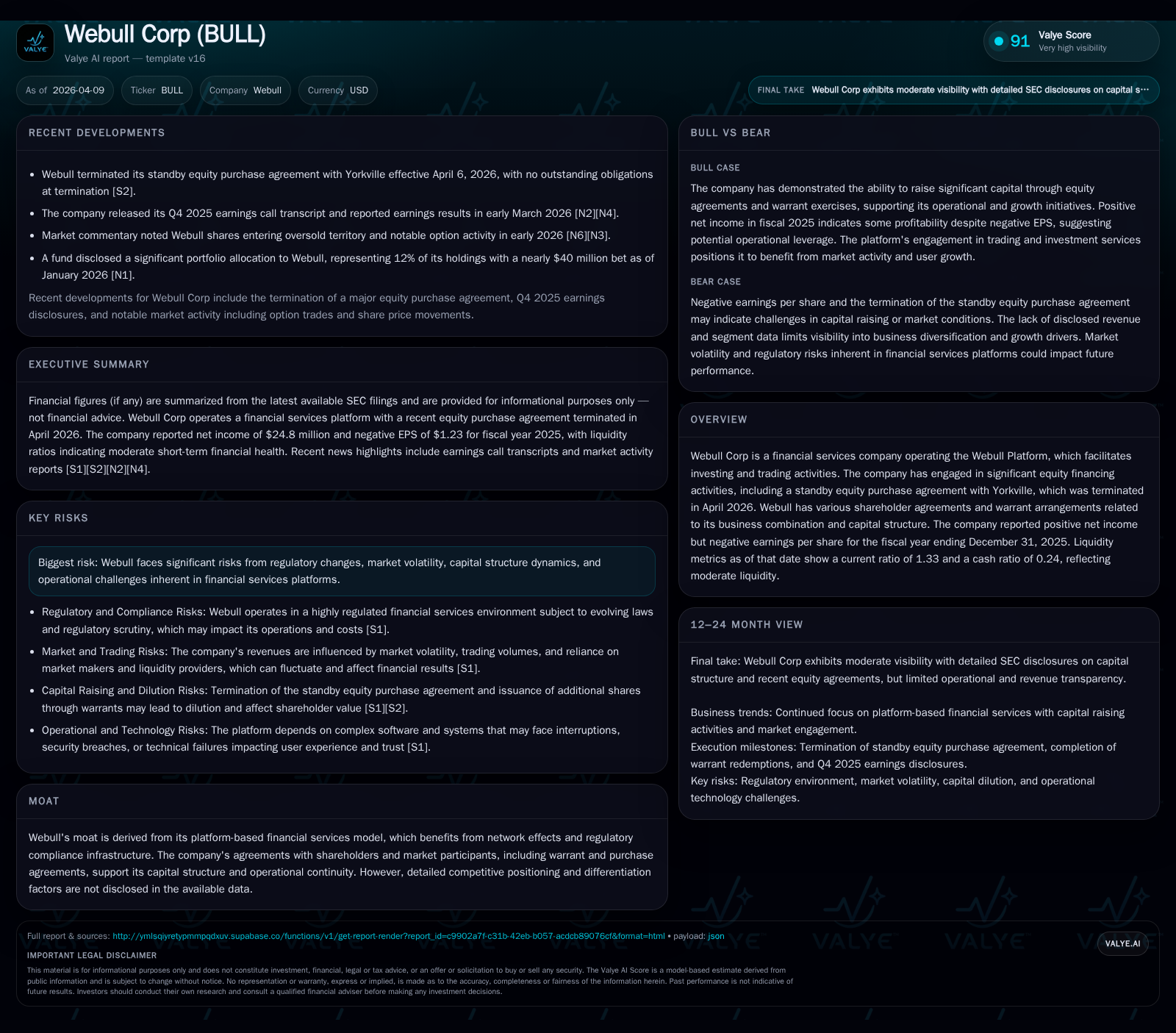
In 2025, Webull Corp marked a significant financial turnaround, shifting from a net loss in 2024 to generating positive net income driven by increased transaction activity and user engagement. The company expanded its registered user base and funded accounts, capitalizing on the appeal to millennial and Gen Z investors. Operational cash flow more than doubled year-over-year while capital expenditures grew moderately, supporting technological enhancements and platform scalability. Webull also executed key capital structure maneuvers, including a standby equity purchase agreement with Yorkville that was fully utilized and later terminated, reflecting disciplined capital management amid regulatory and market challenges.
From Loss to Profit: Webull’s FY2025 Growth Trajectory
Webull Corp’s financial turnaround in fiscal year 2025 was remarkable. The company reported positive net income of approximately $24.8 million compared to a net loss of $22.7 million in fiscal year 2024 — an improvement of over 209% year-over-year according to consolidated SEC filings [F1]. This pivot was underpinned by a surge in operating cash flow that more than tripled from $185.2 million to $566.4 million YoY (+205%), signaling improved operational efficiency and robust revenue conversion [F1]. Concurrently, capital expenditures increased modestly to just under $4.9 million (+103%), reflecting sustained investment into technology infrastructure critical for scaling and global deployment [F1][S6][S7]. Equity on the balance sheet shifted dramatically from negative $2.25 billion at end-2024 (a legacy effect of prior business combination adjustments) to positive equity exceeding $1 billion by December 31, 2025, affirming improved capitalization post-Business Combination closing on April 10, 2025 [F1][S1]. These results collectively indicate not only profitability but also strengthened financial footing.
Historical performance (annual)
| FY | Net ($mm) | CFO ($mm) | Capex ($mm) | Net YoY |
|---|---|---|---|---|
| 2025 | 25 | 566 | 5 | +209.2% |
| 2024 | -23 | 185 | 2 |
Source: SEC companyfacts cache [F1].
Capital returns and efficiency (annual)
| FY | FCF ($mm) | ROE% |
|---|---|---|
| 2025 | 562 | 2.4 |
| 2024 | 183 | 1.0 |
Source: SEC companyfacts cache [F1].
Note: All figures sourced from audited company filings [F1].
User Base and Platform Engagement: Driving Forces Behind the Numbers
Webull’s growth is inseparable from its expanding user base and platform stickiness among digitally savvy young investors. Registered users grew steadily through each quarter of 2025 — from roughly 24.1 million at Q1 to about 26.8 million by year-end; meanwhile funded accounts increased from approximately 4.7 million to over 5.3 million during the same period [S1]. These increments underscore effective user acquisition strategies that blend a mobile-first interface with community-driven investing tools.
Targeting millennials and Gen Z investors who demand accessible real-time market data without paywalls has endowed Webull with strong network effects within the self-directed retail trading segment. The Webull Community enables social exchange around investment theses that resembles virtual equivalents of traditional trading floors such as Wall Street or Canary Wharf sectors — an innovative approach leveraging social media paradigms effectively embedded in its platform design [S1][N1]. This strategy differentiates Webull as both an educational resource for novice investors and a professional-grade toolset preferred by experienced traders.
Revenue Mix and Trading Activity Evolution
Revenue streams are primarily driven by transaction-based trading activities including equities and options order flow rebates alongside interest income from margin financing and securities lending services [S1]. In fiscal year ended December 31 2025 revenues notably increased as market engagement improved amid expanding customer base.
Options trading revenues benefited from higher volumes although inherent volatility impacts transaction counts; interest income linked to stock lending reflected steady balances of margin loans consistent with rising funded accounts [N2][S1]. Notwithstanding general market headwinds affecting trade volumes industry-wide during volatile periods, Webull managed revenue mix stability adapting via product diversification such as cash sweep accounts and wealth management services introduced recently.
Capital Structure and Equity Financing Moves
A pivotal element behind Webull’s liquidity management was the standby equity purchase agreement executed on July 1 2025 with YA II PN Ltd., known as Yorkville[S1][S2]. The agreement authorized up to $1 billion share purchases at Webull’s discretion over three years subject to contractual parameters.
Between inception date through December 31 2025, the company utilized this facility by issuing approximately 11.66 million Class A Ordinary Shares yielding gross proceeds of $173.2 million under this variable pricing arrangement which included an approximate discount of 2.5% off market prices at issuance times[S1]. Notably on April 6 2026 Webull delivered termination notice correspondingly closing this arrangement with no remaining obligations or shares pending issuance.[S2] This termination signals prudent capital discipline likely enabled by improved operational cash flows reducing dependency on external equity issuances.
Operating Cash Flow Surge Amid Strategic Investments
Webull’s operating cash flows support optimistic sustainability prospects given their magnitude relative to capex spend.[F1] With CFO growing to $566 million for fiscal year ending December 31 2025 (+206%) against capex rising modestly just beyond $4.8 million (+103%), free cash flow approximates $561 million — providing ample reinvestment capacity.[F1] This reflects strong operating leverage where additional revenues scale disproportionately faster than fixed or expanding costs related to systems development and platform stability improvements necessary for retaining competitive advantage globally.[S6][S7]
Investments targeted toward maintaining proprietary infrastructure underpinning seamless fast order processing across multiple geographies enable scalable expansion as referenced in management commentary.[S6]
Risk Factors and Regulatory Challenges Ahead
Despite momentum gains major risk factors persist which could constrain future performance.[S17],[S21],[S27] Regulatory scrutiny remains elevated especially given reliance on order flow revenues—payment-for-order-flow practices face increasing legislative risk potentially curtailing material revenue components.[S20] Additionally operational complexities arise from global footprint expansion requiring compliance across multiple jurisdictions’ regulatory regimes imposing capital adequacy rules (e.g., Rule 15c3-1 SEC for broker-dealers).[S4],[S9]
Exposure also exists regarding dependence upon limited liquidity providers: losing any could disrupt market-making functions impacting spreads.[S17] Cybersecurity threats remain material given sensitive customer data handled by platform; failure here carries reputational damage risk that could reduce customer trust.[S21]
Macrofinancial environment volatility influencing investor sentiment directly affects trade volumes hence transactional revenue variability remains a perennial challenge.[S20]
Forward Outlook: Growth Prospects and Operational Levers
Management underscores focus on deepening engagement with millennial/Gen Z cohorts which compose the majority of its active users emphasizing ongoing enhancements such as launching simplified app versions like 'Webull Lite' for new investors plus expanding passive wealth management offerings.[N1][S1]
Expansion into new global markets leverages modular scalable technology architecture promising marginal incremental cost increases relative to user acquisition potential aiding sustainable top-line growth.[S6]
While official guidance is unavailable,[N3] monitoring user registration growth rates alongside progression in funded account metrics as well as adoption trends for margin products will be critical near-to-mid term milestones indicative of organic traction.
Capital Deployment: Navigating Returns, Dividends, and Buybacks
Return metrics reflect early-stage growth investing posture: Return on Equity approximated at modest ~2.4% based on fiscal year net income divided by shareholders’ equity at December 31 2025.[F1] In line with fintech brokerage norms targeting scale over shareholder payouts currently no dividends have been declared or are expected.[S8]
Similarly share repurchases remain absent aligned with prioritization of reinvestment funds toward technology development and liquidity buffers vital amidst regulatory capital maintenance requirements enforced across diverse subsidiaries worldwide.[S8]
This restrained allocation strategy coheres with sustaining platform innovation capabilities while ensuring compliance liquidity safeguards essential for continued operation under multi-jurisdictional broker-dealer regulations.
This analysis synthesizes available filings through April 9 2026 reflecting historical performance coupled with strategic initiatives positioning Webull Corp within competitive digital brokerage landscapes dominated by evolving retail investor preferences and regulatory environments. Readers should note forward-looking statements rely upon management disclosures subject to numerous uncertainties including macroeconomic trends beyond company control. The information herein is provided solely for analytical purposes without investment recommendation or valuation judgments.
Disclaimer: This is research-only, informational analysis and not investment advice. It may include AI-generated interpretation and general industry context. Always verify important details using primary sources.

Comments