
AEHR Test Systems Reports Revenue Decline and Operating Losses Amid Equity Financing Initiative
AEHR Test Systems experienced a decline in revenue and operating income for fiscal 2025, while entering an equity distribution agreement to support liquidity and fund strategic investments.
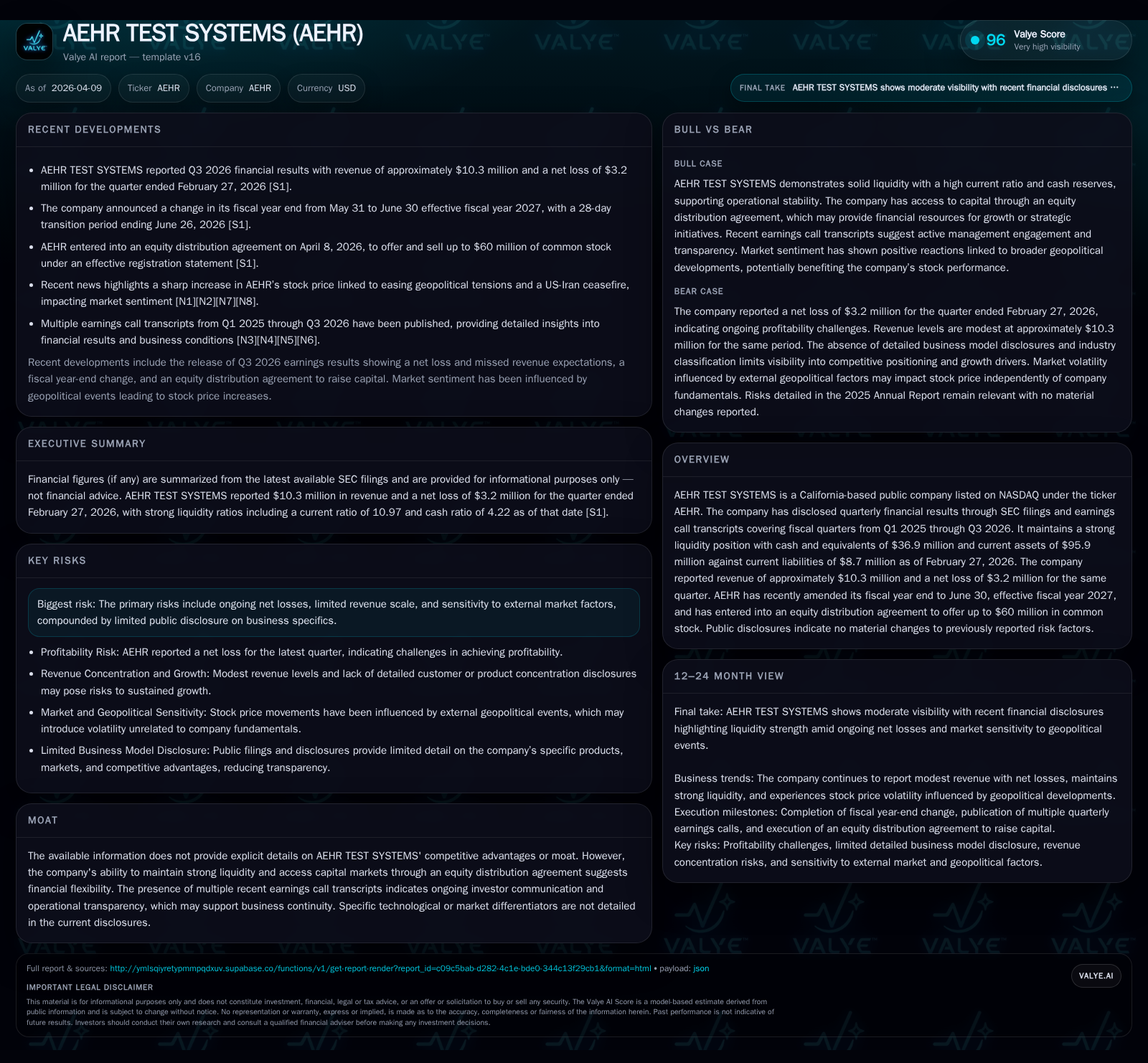
AEHR Test Systems, a Nasdaq-listed semiconductor test equipment provider, reported a 9.2% year-over-year revenue decline to $58.97 million for fiscal 2025, reversing prior growth trends. Operating income turned negative at -$5.68 million and net income was -$3.91 million, reflecting increased expenses and investments. Operating cash flow also turned sharply negative at -$7.4 million, pressured further by capital expenditures rising to nearly $5 million. The company maintains strong liquidity with $36.9 million in cash and equivalents as of February 2026 and a current ratio near 11x. In April 2026, AEHR entered an equity distribution agreement to sell up to $60 million in common stock through agents William Blair & Co. and Craig-Hallum Capital Group, enhancing financial flexibility amid ongoing losses. The fiscal year-end shift to June 30 starting in fiscal 2027 introduces a transition period aligning reporting with operational cycles. Capital allocation remains focused on reinvestment without dividends or buybacks. AEHR faces competitive pressures without explicit moat disclosures in filings.
Historical Performance
AEHR Test Systems demonstrated rapid growth from fiscal year 2021 through fiscal year 2023, with revenue increasing from $7.64 million in FY21 to nearly $65 million in FY23 [F1]. This expansion coincided with rising profitability; operating income grew from $7.8 million (FY22) to $13.38 million (FY23), while net income increased from $5.79 million to $14.56 million over the same period.
However, fiscal year 2025 marked a reversal with revenue declining approximately 9.2% year-over-year to about $58.97 million [F1]. Operating income swung into a loss of $5.68 million and net income turned negative at approximately -$3.91 million, reflecting increased operating costs including research and development investments [F1][N1][N2].
Operating cash flow also deteriorated substantially, turning negative at -$7.4 million compared to positive inflows in prior years [F1]. Capital expenditures rose sharply to nearly $5 million—more than five times the prior year's level—likely representing investments aimed at product development or capacity expansion but exerting pressure on free cash flow which is estimated near -$12.4 million (operating cash flow minus capex) [F1].
Historical performance (annual)
| FY | Rev ($mm) | Net ($mm) | CFO ($mm) | OpInc ($mm) | Rev YoY | Net YoY |
|---|---|---|---|---|---|---|
| 2025 | 59 | -4 | -7 | -6 | -111.8% | |
| 2024 | 33 | 2 | 10 | +127.8% | ||
| 2023 | 65 | 15 | 10 | 13 | +220.2% | +151.2% |
| 2022 | 20 | 6 | 2 | 8 | +165.6% |
Source: SEC companyfacts cache [F1].
Capital returns and efficiency (annual)
| FY | FCF ($mm) | ROE% |
|---|---|---|
| 2025 | -12 | -3.2 |
| 2024 | 1 | 29.7 |
| 2023 | 9 | 19.3 |
| 2022 | 1 | 11.4 |
Source: SEC companyfacts cache [F1].
Note: Revenue for FY2024 is not explicitly available; comparisons focus on years with reported data.
Liquidity and Capital Structure
Despite operating losses, AEHR maintains strong liquidity as of February 27, 2026, with cash and equivalents totaling approximately $36.9 million and current assets of about $95.9 million against current liabilities near $8.7 million—resulting in a current ratio close to eleven times [F1]. This robust liquidity position provides significant operational flexibility.
The company’s capital structure is predominantly equity-based with no material debt reported across recent filings [S8][S9][S10]. On April 8, 2026, AEHR entered into an equity distribution agreement allowing the sale of up to $60 million in common stock through agents William Blair & Company, L.L.C., and Craig-Hallum Capital Group LLC [S12][S16]. This arrangement facilitates opportunistic capital raising aligned with market conditions rather than fixed offerings.
No dividends or share repurchase programs are currently active; capital allocation focuses on supporting operations and strategic investments via equity issuance rather than returning capital to shareholders [S7][S11][S17]. Additionally, shareholder approval was obtained during the October-2025 annual meeting for amendments increasing shares reserved under employee stock incentive plans, highlighting emphasis on incentivization over direct shareholder returns [S7][S11][S17].
Strategic Developments and Outlook
Effective fiscal year starting June 27, 2026 (fiscal year 2027), AEHR will shift its fiscal year-end from the Friday nearest May 31 to the Friday nearest June 30, resulting in a one-time transitional reporting period that may better align financial reporting with operational cycles or customer demand patterns [S22].
While specific guidance or outlook statements are not detailed publicly for calendar year ’26 as per earnings call transcripts and SEC filings [N1][N2], the significant increase in capital expenditure suggests strategic investments possibly aimed at new product development or capacity expansion intended to restore revenue growth.
Ongoing net losses alongside shrinking revenues since peak levels raise questions about market positioning strength amid competitive pressures inherent in the semiconductor test equipment industry [S2][S4][S5]. Public disclosures do not highlight distinct technological moats or dominant customer relationships that would underpin sustainable margin improvements.
Monitoring quarterly results under the new fiscal calendar will be important to assess whether invested capital translates into renewed top-line growth or improved profitability.
Returns and Capital Allocation Analysis
Based on latest full fiscal data ending May 30, 2025, AEHR's return on equity stands at approximately -3%, reflecting net losses relative to shareholders’ equity exceeding $120 million [F1]. The sharp decline in operating cash flow combined with elevated capital expenditures resulted in significantly negative free cash flow estimated near -$12.4 million (operating cash flow minus capex) during this period [F1].
The absence of dividends or share buybacks indicates management’s focus on reinvesting available resources into operations and growth initiatives amid ongoing earnings challenges rather than distributing cash back to shareholders [S7][S11][S17]. The recently executed equity distribution agreement further underscores reliance on external financing sources during this phase.
Industry Context
AEHR operates within the highly cyclical semiconductor test equipment sector characterized by rapid technological change and significant capital intensity.
Competitors often include larger firms investing heavily in automated testing platforms geared toward next-generation semiconductor nodes and packaging technologies.
Success requires balancing innovation cadence with capital efficiency while maintaining close OEM partnerships—a challenging endeavor especially given recent geopolitical supply chain uncertainties impacting the industry broadly.
Summary
AEHR Test Systems’ recent financial performance reflects slowing revenue growth turning modestly negative accompanied by operating losses after several years of strong gains; nevertheless, solid liquidity metrics provide meaningful runway as the company pursues strategic investments supported by enhanced equity financing capacity.
The substantial increase in R&D-related capital expenditure signals attempts at repositioning for long-term growth despite absent clear evidence yet of reaccelerated earnings power or sustainable competitive advantages disclosed publicly.
Investors should closely watch upcoming quarterly results under the new fiscal calendar for signs that invested capital drives sales growth or margin improvement while remaining mindful of ongoing execution risks noted consistently since late-2024 filings.
Disclaimer: This analysis is based solely on publicly disclosed company filings and news sources cited herein; it does not constitute investment advice.
Disclaimer: This is research-only, informational analysis and not investment advice. It may include AI-generated interpretation and general industry context. Always verify important details using primary sources.

Comments