
Grupo Cibest’s 2025 Performance and Strategic Capital Allocation in Latin American Finance
An analysis of Grupo Cibest’s 2025 financial results, regional diversification, and capital allocation amidst evolving macroeconomic and regulatory dynamics in Latin America.
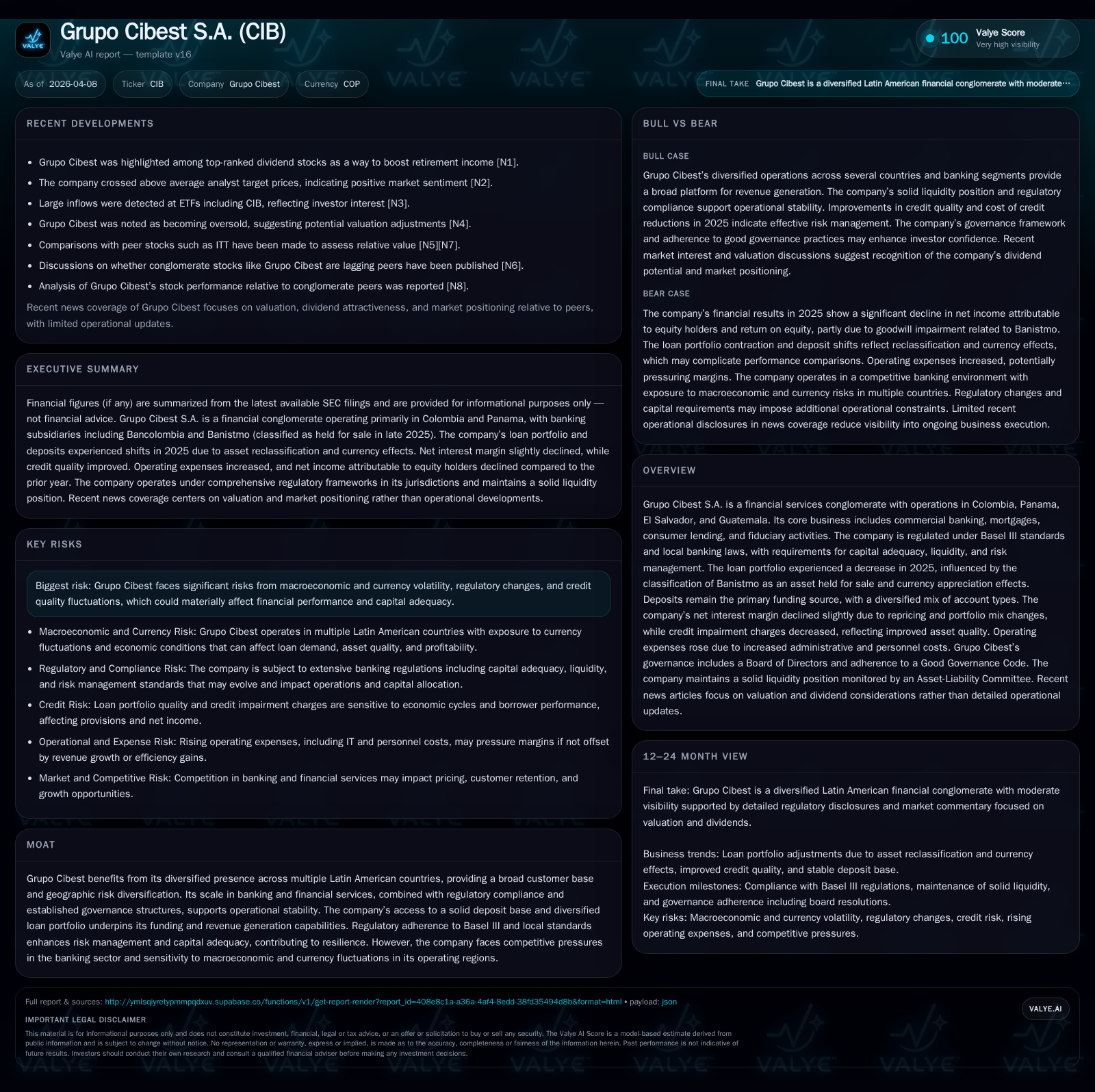
Grupo Cibest demonstrated resilience in 2025 with a modest increase in net interest income despite pressure from currency appreciation and portfolio reclassification effects related to Banistmo. The company maintained regulatory capital adequacy under Basel III while navigating shifts in deposit funding mix and credit quality improvements that reduced impairment charges. A new share buyback program launched in early 2026 underscores commitment to shareholder returns amid ongoing macroeconomic and regulatory challenges across its diversified Latin American footprint.
2025 Financial Overview: Trends and Turning Points
Grupo Cibest's fiscal year 2025 exhibited mixed dynamics shaped by strategic repositioning and external macroeconomic factors. Net interest income (NII) rose modestly by 1.35% to COP 19,426 billion despite the net interest margin (NIM) contracting by 26 basis points to 6.13% [S5]. This margin compression was influenced by loan repricing pressures amid a higher share of lower-yielding assets along with the reclassification of the Panama-based Banistmo unit as held for sale, which removed certain higher-yielding assets from continuing operations [S1][S7].
Total deposits declined about 5.25%, primarily driven by decreases in U.S. dollar-denominated deposits tied directly to the Banistmo divestiture [S8][S15]. Notably, operating expenses fell by approximately 7.39%, largely due to reduced professional fees related to IT projects offsetting increased bonus payments [S7].
Credit impairment charges decreased over 11% year-over-year to COP 4,430 billion reflecting strengthening asset quality via selective origination policies and enhanced portfolio risk management frameworks [S14]. The allowance for loan losses covered approximately 134% of loans overdue beyond thirty days at year-end compared to about 112% previously, signaling conservative provisioning consistent with IFRS expected loss models incorporating forward-looking macro assumptions [S14][S11].
Macroeconomic and Regulatory Impacts on Operational Results
Colombia’s economic environment strongly influenced Grupo Cibest’s operations in 2025. Real GDP growth improved to 2.6%, supported by private consumption growth of 3.9% and public spending increases of 7.5%, underpinning credit demand [S1]. The Central Bank’s benchmark repo rate ended the year at 9.25%, following a single reduction during April; inflation remained stable near 5.1%, exerting upward pressure on wages and key cost components such as shelter and transportation [S1]. The Colombian peso appreciated roughly 15% against the U.S. dollar during the year impacting translation of dollar-denominated assets and liabilities as well as competitive positioning [S1].
Regulatory compliance under Basel III remains foundational for Grupo Cibest’s capital strategy with Tier 1 capital ratios above regulatory minima [S4][S18]. Liquidity coverage ratios meet supervisory standards across its markets including Panama where Basel III implementation has progressively stabilized liquidity norms since late 2022 [S18]. New exposure limits on large counterparties and related party transactions are set ahead of May 2026 enforcement under Colombian decree regulations [S6].
Geographic Diversification and Segment Contributions
Grupo Cibest operates primarily across Colombia, Panama (via Banistmo), El Salvador, and Guatemala—each contributing variably to overall performance [S10][S14]. Colombia remains the core market with commercial banking activities encompassing retail consumer lending, mortgages, fiduciary services, and SME segments [S12][S14]. Post-divestiture Panama experienced contraction in its loan book partially due to cautious underwriting amid fiscal uncertainties [S22]. El Salvador and Guatemala showed more supportive credit environments aligned with demand recovery.
Cross-border synergies arise through shared technology platforms and treasury operations optimizing liquidity management regionally while distributing risk exposures geographically. Mortgage originations faced constraints particularly in Panama due to government subsidy delays and tighter credit policies [S22][S14], whereas consumer lending continued credit metric improvements evidencing effective risk selection.
Capital Structure, Share Buybacks, and Dividend Policy
A significant shareholder return initiative was the March 2026 approval of a COP 1.35 trillion share repurchase program with a three-year execution period funded partly through reallocation from legal reserves [S3]. This program supersedes the previous buyback scheme formally terminated concurrently.
Grupo Cibest maintains strong operating cash flow generation with reported cash flows from operations reaching COP 12.26 trillion in 2025 while investing primarily in debt securities totaling approximately COP 2 trillion [S17]. Dividend distributions have been steady though explicit yield targets or guidance were not detailed recently; inclusion in dividend-focused analyst listings suggests ongoing investor appetite for returns [N1]. Capital allocation balances growth funding needs against Basel III capital constraints and shareholder returns objectives [S20].
Asset Quality, Credit Impairment Trends, and Liquidity Management
The allowance for loan losses increased coverage relative to past-due loans supporting conservative provisioning aligned with IFRS expected loss methodologies incorporating GDP growth forecasts and inflation expectations [S14][S11]. Stage-specific impairment modeling employs probability-of-default curves enabling targeted risk monitoring.
Liquidity levels remain robust with total liquid assets rising over COP 2.68 trillion driven mainly by increased holdings of high-quality liquid securities eligible for repo operations under regulatory criteria [S4][S7]. Funding remains predominantly deposit-based accounting for about 78% of total liabilities despite USD deposit attrition linked to Banistmo classification changes [S15][S8]. Liability tenor adjustments have enhanced repricing responsiveness helping control interest expense levels relative to historical benchmarks.
Forward-Looking Growth Prospects and Risk Factors
Management expresses moderate optimism regarding regional economic recovery supported by strengthening labor markets (notably Colombia), elevated remittance inflows reducing external vulnerabilities, stable political institutions fostering policy predictability, alongside anticipated monetary easing as inflation moderates [S1]. However, private investment remains subdued potentially limiting medium-term credit expansion.
Key risks include sensitivity to foreign exchange volatility given significant USD exposures affecting consolidated earnings translation; ongoing regulatory compliance demands; political uncertainties especially in peripheral markets; plus cyclical credit risks intensified by inflationary pressures constraining consumer spending power [S20]. Comprehensive risk management frameworks are applied to mitigate systemic vulnerabilities.
Key Financial Metrics and Historical Performance Table
| Fiscal Year | Net Interest Income (COP Billion) | Credit Impairment Charges (COP Billion) | Operating Expenses Change (%) | Cash Flow from Operations (COP Trillion) |
|---|---|---|---|---|
| 2025 | 19,426 | 4,430 | -7.39 | 12.26 |
| 2024 | N/A | N/A | N/A | 0.435 |
| Note: Exact revenue figures not explicitly available; metrics drawn from SEC filings narrative sections [F1], [S1], supplemented context. |
Monitoring Milestones: What Investors Should Watch
Investor focus will monitor execution progress of the new share buyback program alongside dividend sustainability within tight regulatory capital parameters [N2][N1][S3]. ETF inflows into Grupo Cibest-linked instruments indicate growing market interest albeit amid volatility risks tied to geopolitical sensitivities affecting Latin America broadly [N3][N4]. Key operational milestones include quarterly asset quality indicators such as nonperforming loan ratio trends post-pandemic normalization; stabilization or growth of loan portfolios particularly within Colombia; shifts in deposit composition targeting cost optimization; plus regulatory guideline developments especially large exposure limits effective May 2026 [S20][S6]. Currency fluctuations will remain material given their impact on consolidated financials.
In summary, Grupo Cibest is positioned on solid footing via geographic diversification across core Latin American markets; diversified commercial banking product lines; disciplined credit risk management aligned with Basel III standards; alongside proactive capital return strategies balancing shareholder interests with balance sheet prudence amidst evolving macroeconomic challenges.
This analysis is based solely on information available as of April 8, 2026 provided through SEC filings, company announcements, financial data repositories, and publicly reported news items without projecting future investment outcomes.
Disclaimer: This is research-only, informational analysis and not investment advice. It may include AI-generated interpretation and general industry context. Always verify important details using primary sources.

Comments