
Beasley Broadcast Group's Earnings Collapse Highlights Industry Pressures
A dramatic operating loss reversal exposes the challenges facing Beasley's cluster-driven radio business amid regulatory and digital transformation hurdles.
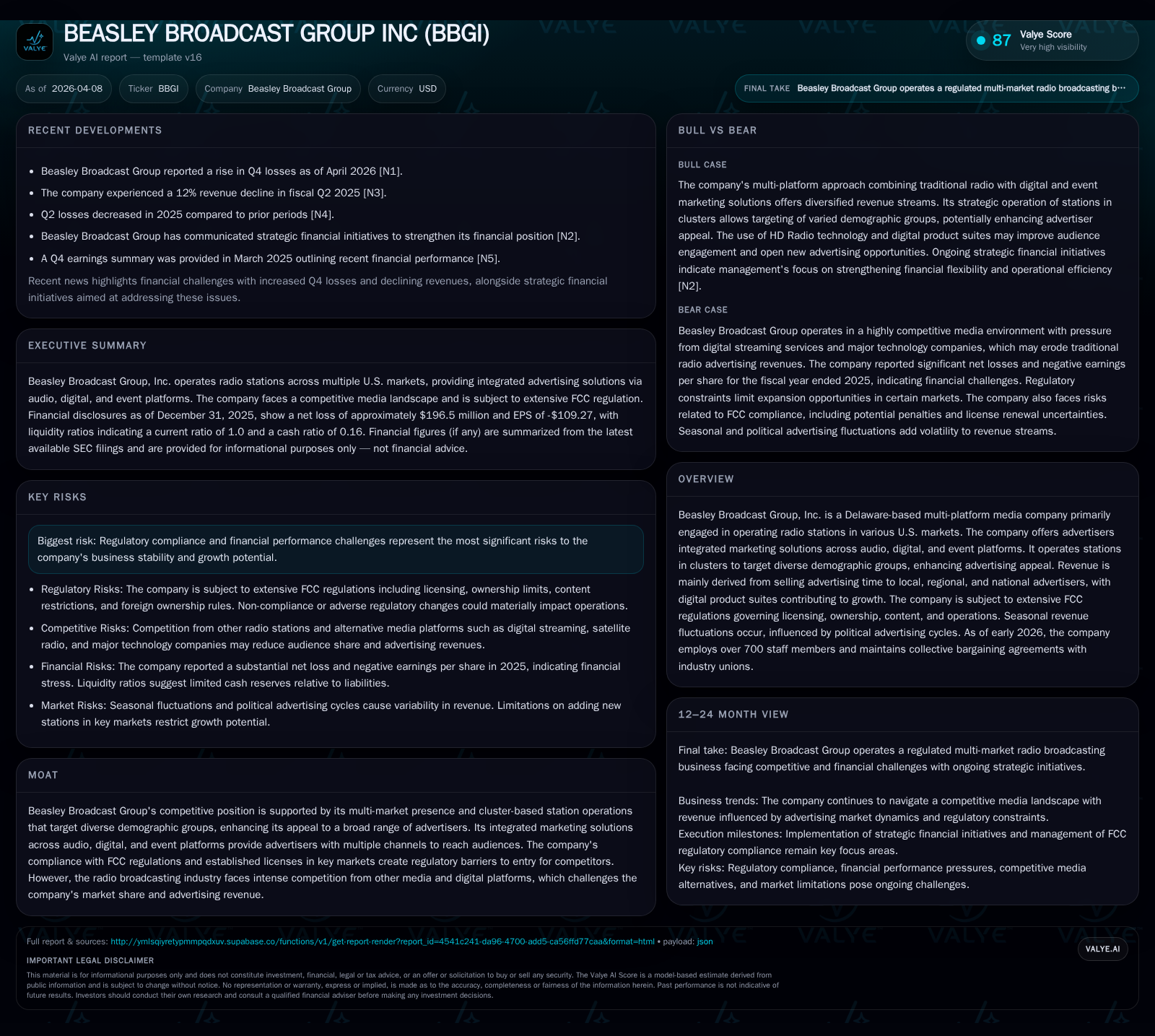
Beasley Broadcast Group, Inc.'s fiscal history reveals a steep drop from modestly positive operating income in 2024 to a severe loss in 2025 despite solid revenue growth nearing 70% year-over-year [F1]. Its cluster strategy fosters market-specific audience targeting but constrains expansion under FCC ownership limits [S1][S10]. Meanwhile, digital and integrated marketing offerings are increasingly important growth engines, aiming to offset traditional radio advertising pressures [S1][F1]. The company faces significant regulatory challenges including FCC licensing constraints, evolving royalty obligations, and political advertising seasonality [S4][S9][S14]. Capital allocation balances strained cash flows and limited buybacks, with equity turning negative in 2025 reflecting balance sheet stress [F1][S13]. Key upcoming monitoring points include effectiveness of digital initiatives, regulatory shifts especially FCC license flexibility, and quarterly earnings recovery attempts post-2025 losses [N1][N2].
From Expansion to Erosion: A Review of Recent Financial Performance
Beasley Broadcast Group has experienced a striking financial turnaround in recent years. Revenue climbed steadily from $58.7 million in FY2014 to $232.2 million in FY2017 ([F1]). However, the last three fiscal years leading into FY2025 show increased volatility. Revenues grew sharply by approximately 69.9% year-over-year from FY2024 to FY2025 ([F1]), reflecting factors such as increased political advertising spend typical in even-numbered election years ([S14]). Despite this top-line growth, operating income plunged from a positive $13.1 million in FY2024 to a negative $229.7 million in FY2025 ([F1]). Net income followed this trend, reaching -$196.5 million in FY2025.
Operating cash flow deteriorated further into negative territory at -$8.47 million against capital expenditures of $4.84 million ([F1]). This negative free cash flow underscores challenges converting revenue gains into profitability amid competitive pressures.
Historical performance (annual)
| FY | Net ($mm) | CFO ($mm) | OpInc ($mm) | Capex ($mm) | Net YoY |
|---|---|---|---|---|---|
| 2025 | -197 | -8 | -230 | 5 | -3238.6% |
| 2024 | -6 | -4 | 13 | 3 | +92.2% |
| 2023 | -75 | -5 | -82 | 4 | -78.6% |
| 2022 | -42 | 11 | -34 | 13 |
Source: SEC companyfacts cache [F1].
Capital returns and efficiency (annual)
| FY | Buybacks ($) | FCF ($mm) | ROE% |
|---|---|---|---|
| 2025 | 29531 | -13 | 398.4 |
| 2024 | 98701 | -7 | -4.0 |
| 2023 | 83879 | -9 | -50.4 |
| 2022 | 133940 | -2 | -18.8 |
Source: SEC companyfacts cache [F1].
Table: Selected annual financial highlights showing recent earnings collapse alongside robust revenue growth ([F1]).
Cluster Strategy and FCC Constraints: Local Leadership in Key Markets
Beasley operates its radio stations grouped as "market clusters" across markets such as Boston, Philadelphia, Las Vegas, among others ([S1],[S10]). This strategy targets multiple demographic groups simultaneously within each market cluster to attract diverse advertisers.
However, Federal Communications Commission (FCC) ownership limits restrict adding new AM or FM stations within certain clusters including Philadelphia and Boston ([S1],[S10]). These regulations aim to prevent excessive media concentration but limit Beasley's ability to expand organically within these key markets.
The company's competitive position depends heavily on audience ratings and local content differentiation ([S11]). Navigating FCC licensing rules regarding signal coverage and adjacent market overlaps adds complexity to cluster operations ([S27]).
Digital Products and Integrated Marketing Solutions as Growth Drivers
While traditional advertising remains the primary revenue source through local sales teams selling commercial airtime, Beasley increasingly emphasizes station-related digital product suites ([S1],[S10]). These offer enhanced audience interaction via integrated digital advertising solutions across audio streaming platforms.
Such digital offerings provide incremental revenue opportunities that partially offset declines or flat trends in conventional radio advertising revenues amid competition from streaming services and major technology companies ([S11],[F1]). The scale of these revenues is still emerging but represents an important strategic focus.
Regulatory Landscape and Competitive Pressures
The regulatory environment includes several factors impacting Beasley's operations:
- Ownership Limits: FCC enforces multiple ownership rules limiting the number of stations held per market ([S15],[S22],[S27]).
- Content Compliance: Stations must comply with programming obligations and sponsorship identification rules; violations can lead to significant fines ([S26],[S27]).
- Royalties: Payments are made to performing rights organizations and Sound Exchange for music broadcast licenses; audits may increase payments ([S12],[S14]).
- Political Advertising Seasonality: Advertising revenues fluctuate seasonally with spikes during even-year election cycles ([S14]).
- Competition: Beyond intra-radio competition, Beasley faces pressure from satellite radio, streaming platforms, video providers, social media ad inventories ([S11],[S10]).
- Emerging Regulations: New rules on AI-generated political ad disclosures and limitations on certain ad categories may increase compliance costs or constrain operations starting mid-2026 ([S8],[S16],[S26]).
Capital Allocation Trends: Cash Flows, Dividends, and Buybacks
Capital deployment reflects tightening liquidity:
- Dividends were paid through FY2020-21 but have ceased due to weak profitability ([F1]).
- Share repurchases have been minimal recently ($29k in FY2025), indicating constrained capital availability ([F1]).
- Negative operating cash flow alongside sustained capital expenditures results in free cash flow deficits nearing $13 million in FY2025 ([F1]).
- Equity turned negative at approximately -$49 million at fiscal year-end 2025 indicating balance sheet stress that could affect financing options ([F1]).
- The company is engaged in debt restructuring discussions aimed at improving financial flexibility ([N1],[S13],[S18]-[S19]).
Outlook Amid Uncertainty: What Investors Should Monitor Next
Key near-term considerations include:
- Quarterly earnings updates following Q4 FY25 losses that highlight cost control efforts and digital growth strategies ([N2],[N1]).
- Regulatory developments around FCC local radio ownership rules under review that could alter expansion capabilities or require divestitures ([S22],[S27]).
- Changes affecting political advertising rates or disclosure requirements for AI-generated content impacting seasonal revenue patterns ([S9],[S14],[S26]).
- Progress on digital product sales growth as a diversification away from traditional spot ads ([N1],[F1]).
- Stability of employee relations via collective bargaining agreements supporting operational continuity amid industry changes ([S14]).
This analysis is based on publicly available data as of April 2026 and aims to outline structural themes shaping Beasley Broadcast Group’s financials and strategic environment.
Disclaimer: This is research-only, informational analysis and not investment advice. It may include AI-generated interpretation and general industry context. Always verify important details using primary sources.

Comments