
Jabil Inc: Balancing Scale, Capital Moves, and Margin Pressures in Manufacturing
Jabil leverages its vast manufacturing footprint and financial flexibility to sustain growth amid intense margin pressures and competitive dynamics.
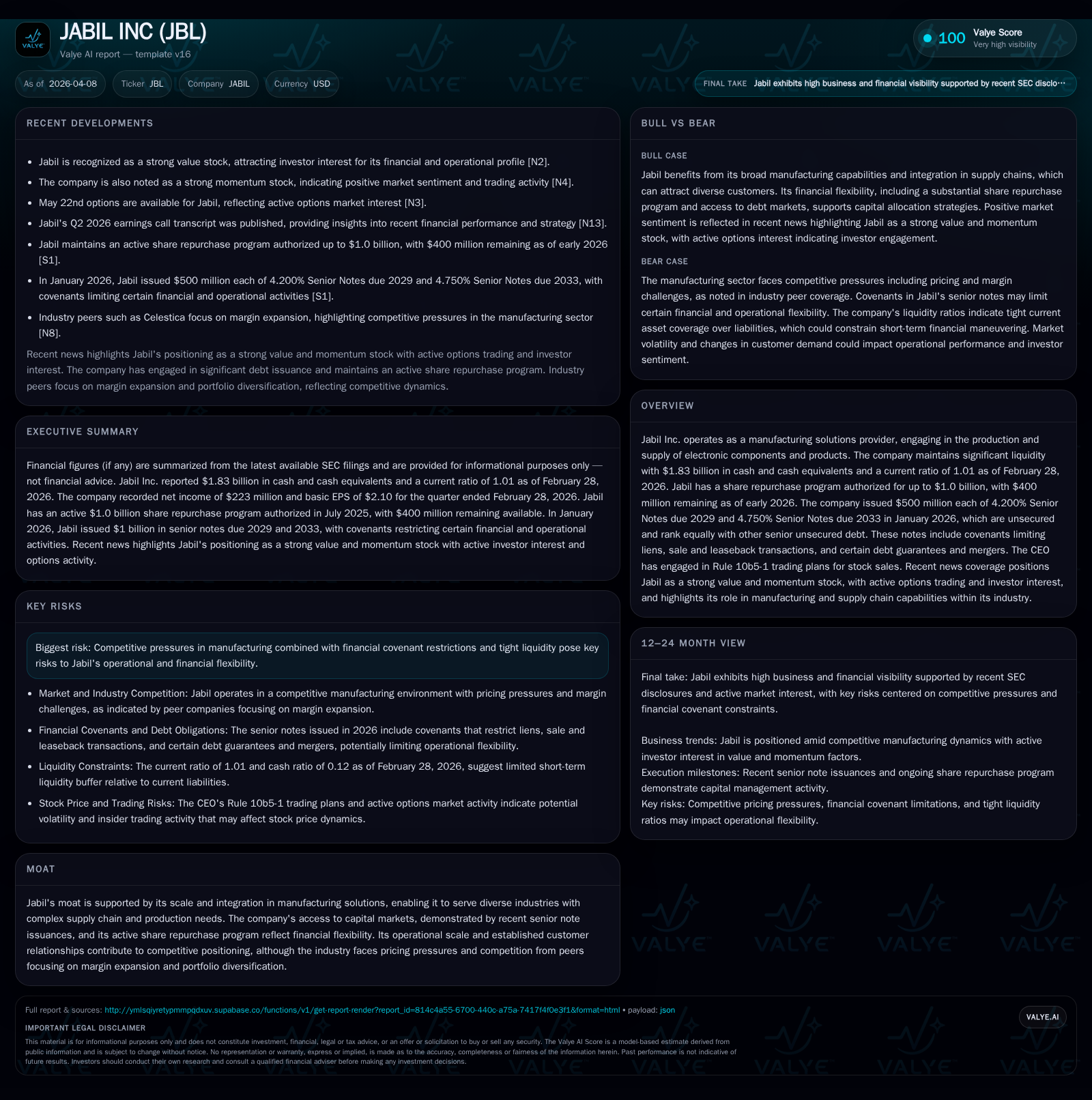
Jabil Inc. demonstrated strong revenue growth driven by scale and integration within complex manufacturing supply chains, achieving a 14.4% increase in FY2025 revenue. However, operating income declined by 41.3% in the same period, reflecting margin compression from pricing pressures and elevated costs. The company maintains solid liquidity with $1.83 billion in cash against current liabilities and enhanced its capital structure through $1 billion in senior notes issued in January 2026. Capital returns focus on share repurchases under a $1 billion program authorized in mid-2025, with dividends representing a smaller portion of distributions. Managing cost pressures, operational efficiencies, and covenant compliance remain critical for sustaining financial flexibility amid competitive challenges.
Recent Performance Trends and Historical Growth Drivers
Jabil Inc.'s FY2025 financial results illustrate robust revenue growth alongside significant profitability headwinds. The company reported approximately $25.3 billion in revenue for FY2025, up 14.4% compared to the prior fiscal year—a reflection of its expansive manufacturing scale and effective integration within complex global supply chains serving diversified electronics markets ([F1]).
Despite top-line gains, operating income declined sharply by 41.3% year-over-year to about $1.18 billion from $2.01 billion in FY2024 ([F1]). This contraction points to margin pressures driven by competitive pricing environments and increased cost bases common in large-scale contract manufacturing.
Net income also contracted significantly by 52.7% to roughly $657 million in FY2025 ([F1]), indicating that fixed costs and overhead are exerting substantial pressure on bottom-line profitability despite volume growth.
Operating cash flow remained relatively stable but decreased by approximately 4.4% to $1.64 billion ([F1]), supporting continued capital investments and shareholder return activities.
Historical performance (annual)
| FY | Net ($mm) | CFO ($mm) | OpInc ($bn) | Capex ($mm) | Net YoY |
|---|---|---|---|---|---|
| 2025 | 657 | 1640 | 1.2 | 468 | -52.7% |
| 2024 | 1388 | 1716 | 2.0 | 784 | +69.7% |
| 2023 | 818 | 1734 | 1.5 | 1030 | -17.9% |
| 2022 | 996 | 1651 | 1.4 | 1385 |
Source: SEC companyfacts cache [F1].
Capital returns and efficiency (annual)
| FY | Div ($mm) | Buybacks ($bn) | FCF ($mm) |
|---|---|---|---|
| 2025 | 36 | 1.0 | 1172 |
| 2024 | 42 | 2.5 | 932 |
| 2023 | 45 | 0.5 | 704 |
| 2022 | 48 | 0.7 | 266 |
Source: SEC companyfacts cache [F1].
Table summarizes key financial metrics highlighting revenue growth alongside margin compression.
Profitability Challenges Despite Revenue Expansion
The divergence between growing revenues and shrinking profits exemplifies sector-wide challenges faced by contract manufacturers like Jabil. Managing complex supply chains amid global component shortages, labor cost inflation, and stringent customer demands has intensified cost pressures.
Additionally, fierce price competition among industry peers pursuing portfolio diversification often dilutes higher-margin product mixes with lower-margin services (). This dynamic constrains sustainable margin improvements despite scale advantages.
Industry commentary points to the difficulty of achieving lasting margin expansion without vertical integration or innovation-driven differentiation (,[N1],[N14]).
Liquidity Position and Capital Structure Enhancements
As of February 28, 2026, Jabil held approximately $1.83 billion in cash and equivalents against nearly $14.8 billion in current liabilities, resulting in a current ratio of about 1.01—indicative of tight working capital management but limited liquidity buffer ([F1],[S5]).
In January 2026, the company issued two tranches of unsecured senior notes totaling $1 billion: $500 million due February 2029 at a coupon of 4.2%, and another $500 million due February 2033 at a coupon of 4.75% ([S15],[S8],[S9]). These issuances reinforce access to fixed-rate financing amid prevailing market conditions.
The debt instruments include covenants restricting liens creation, sale-leaseback transactions, guarantees on restricted subsidiaries’ debt, as well as limitations on mergers or asset transfers ([S11],[S15]). These provisions help safeguard creditor interests but require careful capital management.
Capital Allocation Priorities: Share Repurchases versus Dividends
Capital allocation focuses predominantly on share repurchases under a board-authorized program of up to $1 billion initiated in July 2025 ([S4],[S6]). By early calendar year 2026, approximately $400 million remained available for repurchases.
Dividend payments totaled around $36 million in FY2025—a modest decrease from prior years—indicating a preference for buybacks as the primary shareholder return mechanism ([F1]). This approach allows flexible capital deployment aimed at enhancing earnings per share while managing payout levels prudently.
Return on equity stood near an elevated level around 43%, reflecting leverage combined with net income contributions despite profit declines ([F1]). Insider transactions via Rule 10b5-1 plans further align management interests with market conditions ([S12]).
Industry Context: Manufacturing Solutions under Pricing and Competitive Pressure
Jabil operates within a highly competitive contract manufacturing sector where scale and integration across design-to-delivery supply chains create core competitive moats (). Nonetheless, pervasive pricing pressure continues to challenge margins across the industry (,[N1],[N14]).
Peers’ portfolio diversification efforts may improve category-specific margins but often increase complexity and cost structures (,[N14]). Some competitors pursue vertical integration as a margin lever though this entails substantial capital investment ([N4],[N14]).
Jabil balances broad offerings with targeted margin management initiatives amid OEM demands for cost control coupled with service innovation.
Outlook: Navigating Cost Pressures and Operational Efficiencies
Looking ahead, Jabil’s ability to manage ongoing cost inflation while driving operational efficiencies will be critical as outlined during recent earnings discussions ([N2]). Demand outlook reflects mixed signals with softness expected in certain electronic segments offset by emerging technology areas like AI infrastructure ([N3]).
Key monitoring areas include working capital trends given tight liquidity ratios; adherence to debt covenants under expanded borrowings; utilization pace of share repurchase authorization; and free cash flow sustainability excluding capex outlays ([S2],[F1]).
Risks include intensified competition or macroeconomic disruptions potentially compressing margins further or restricting balance sheet flexibility given covenant constraints ([S2],). Client retention and supply chain resilience remain pivotal for medium-term stability.
Investor Sentiment Evident Through Options Activity and Trading Patterns
Active options markets around Jabil shares reflect investor engagement combining directional bets with hedging strategies consistent with momentum stock characterization ([N5],[N6],[N7],[N9],[N11],[N12],[N13]).
Market narratives oscillate between recognition of Jabil’s scale-driven advantages versus caution regarding near-term margin sustainability—creating nuanced trading dynamics typical within manufacturing sector equities.
Disclaimer: This analysis is based solely on publicly available financial data, regulatory filings, and reported news without any forward-looking investment recommendations.
Disclaimer: This is research-only, informational analysis and not investment advice. It may include AI-generated interpretation and general industry context. Always verify important details using primary sources.

Comments