
PLAYSTUDIOS’ Financial Balancing Act Amid Persistent Losses and Market Pressures
PLAYSTUDIOS combines innovation in social casino gaming with rigorous cost control while confronting Nasdaq listing pressures and sustained net losses.
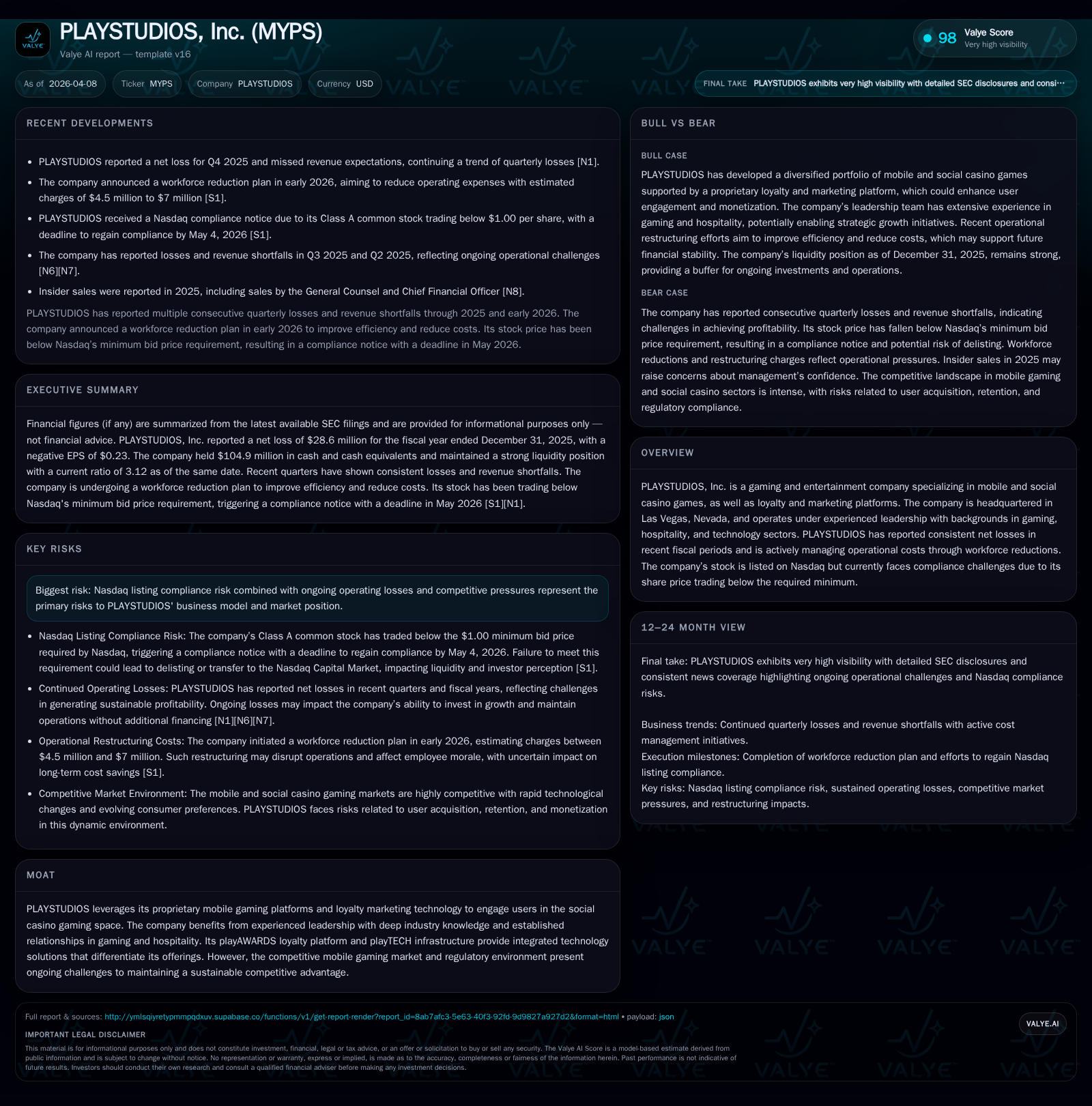
PLAYSTUDIOS has carved a niche with proprietary mobile gaming platforms and loyalty technologies within an intensely competitive social casino market. Despite improving operating losses by over 27% from 2024 to 2025, net losses have remained largely flat, reflecting ongoing profitability challenges. The company faces critical Nasdaq minimum bid price compliance deadlines, heightening uncertainty around future capital market access. Management is actively cutting costs through workforce reductions, while operating cash flows turned positive in 2025, supporting a cautiously optimized capital allocation approach with sharply curtailed share repurchases.
Financial Performance Trends: Year-Over-Year Dynamics
PLAYSTUDIOS’ financial trajectory over the last four fiscal years illustrates the persistent challenge of generating profits despite operational improvements. The company's operating income improved significantly by approximately 27% from a loss of $32.9 million in FY2024 to a narrower loss of $23.9 million in FY2025 [F1]. However, net income remained essentially flat at about -$28.7 million (FY2024) versus -$28.6 million (FY2025), indicating continued bottom-line pressure perhaps from non-operating costs or tax effects.
Operating cash flow (CFO), an important liquidity indicator in a loss-making tech/gaming business, declined by over 42% compared to prior year yet remained robustly positive at $26.3 million for FY2025 [F1]. The firm’s aggressive capex reduction—dropping from nearly $4 million in FY2024 to just below $1 million in FY2025—signals cautious capital expenditure discipline during operational tightening [F1]. Equity diminished steadily from above $302 million in 2022 down to roughly $228 million by the end of 2025, reflecting cumulative net losses and shareholder dilution factors [F1]. Share repurchase activity was sharply curtailed, falling from $31.2 million in buybacks during FY2024 to only $3.5 million in FY2025 [F1], underscoring a strategic pivot toward capital conservation.
This section’s table consolidates these key metrics:
Historical performance (annual)
| FY | Net ($mm) | CFO ($mm) | OpInc ($mm) | Capex ($mm) | Net YoY |
|---|---|---|---|---|---|
| 2025 | -29 | 26 | -24 | 1 | +0.2% |
| 2024 | -29 | 46 | -33 | 4 | -47.9% |
| 2023 | -19 | 52 | -10 | 6 | -9.1% |
| 2022 | -18 | 33 | -28 | 12 |
Source: SEC companyfacts cache [F1].
Capital returns and efficiency (annual)
| FY | Buybacks ($mm) | FCF ($mm) | ROE% |
|---|---|---|---|
| 2025 | 3 | 25 | -12.6 |
| 2024 | 31 | 42 | -11.7 |
| 2023 | 15 | 45 | -6.7 |
| 2022 | 4 | 21 | -5.9 |
Source: SEC companyfacts cache [F1].
The firm’s approximate return on equity remains negative near -12.6%, confirming profitability hurdles persisting despite operational gains [F1]. The healthy current ratio of over 3 signals strong liquidity as CASH & equivalents stood at about $105 million as of December 31st, 2025 [F1].
Core Business Drivers and Market Positioning
PLAYSTUDIOS operates within the highly competitive mobile and social casino gaming sector leveraging proprietary platforms that integrate entertainment with loyalty solutions. Its flagship technologies include playAWARDS—a loyalty marketing program designed to enhance player incentives—and playTECH—the underlying technological framework enabling seamless player experiences . This integration fosters user engagement metrics critical in gaming such as DAUs (daily active users) and high ARPU (average revenue per user), which are typical performance indicators for this vertical.
Company leadership brings seasoned expertise intersecting gaming development and hospitality sectors which underpins strategic partnerships enabling brand collaborations that drive player retention and growth [N1]. Yet the environment remains intensely competitive given market saturation by other mobile game developers alongside shifting regulatory scrutiny affecting social casino operations nationally and internationally.
The sustained focus on retaining core active users while optimizing loyalty program monetization differentiates PLAYSTUDIOS’ value proposition but also mandates continuous product launches and platform enhancements to maintain engagement amidst these pressures.
Navigating Nasdaq Compliance Risks and Regulatory Environment
A key challenge confronting PLAYSTUDIOS is its recent notification from Nasdaq regarding non-compliance with Listing Rule 5450(a)(1), tied specifically to the closing bid price dropping below the mandated minimum of $1 per share for over thirty consecutive trading days as of November 5th, 2025 [S14]. This triggers a formal compliance period expiring May 4th, 2026 during which the company must achieve a consecutive ten-day close above this threshold or face potential delisting.
Failure to comply could lead to transfer onto the Nasdaq Capital Market where the minimum bid price rule is relaxed but other listing standards apply or eventual delisting altogether [S14][S15]. From an investor perspective this weighing of options heightens uncertainty around equity liquidity and stock valuation dynamics.
Additionally regulatory considerations extend beyond capital markets into jurisdictional licensing requirements pertinent to PLAYSTUDIOS’ social casino offerings—a segment susceptible to evolving gambling statutes that may impose operational constraints or necessitate costly compliance measures [S6]. These multifaceted risks underscore management’s imperative need for both financial stabilization and proactive strategic communication.
Operational Efficiencies and Cost-Management Measures
Responding directly to earnings pressures compounded by Nasdaq listing constraints and broader market challenges,公司 enacted a major internal reorganization beginning Q1 of fiscal year 2026 involving a global workforce reduction of approximately 27%, targeted for completion within the first half of the year [S13].
This headcount rationalization aligns with industry trends where gaming firms facing revenue headwinds streamline cost bases by adjusting R&D intensity and marketing spend linked directly with customer acquisition/retention campaigns [N1]. Expected charges estimated between $4.5 million and $7 million predominantly reflect severance packages plus ancillary facility-related exit costs incurred early during restructuring rollout [S13].
Such measures aim at enhancing operational leverage although may trade-off short-term innovation cycle velocity particularly around new game development launches crucial for sustaining user engagement momentum.
Capital Allocation Strategy: Cash Flow, Buybacks, and Equity Trends
Despite continual net losses reported each year since at least FY2022 through FY2025 (-$17.8M shrinking slightly to -$28.6M range) PLAYSTUDIOS converted substantial operating cash flows into free cash flow territory supporting near-term liquidity needs without dependence on external financing [F1]. For example free cash flow approximated $25.3 million in FY2025 after accounting for minimal capex spend (~$968k) compared with larger historical expenditures reflective of tightening investment discipline [F1].
A notable shift has occurred around share repurchase programs which slowed drastically from aggressive buybacks peaking above $31 million in FY24 down to modest ~$3.5 million levels last fiscal year providing a cushion preserving cash while maintaining shareholder value prudently [F1][S14][S15]. Dividend payments were not disclosed suggesting capital returns remain focused on managing leverage rather than distributions.
The equity base contracted over four years from roughly $302 million end-2022 down to approximately $228 million as of December 31st 2025 consistent with accumulated deficits reducing book value alongside possible share issuances or cancellations implied from disclosures [F1]. The strong reported current ratio exceeding three further reinforces liquidity resilience despite earnings shortfalls [F1].
Assessing Future Growth Opportunities and Constraints
PLAYSTUDIOS' ability to grow hinges on its success increasing the scale of active users interacting across its portfolio of social casino titles alongside deepening monetization via its loyalty platforms such as playAWARDS which blend free-to-play engagement with marketing analytics capabilities [N1][S2]. Reported guidance remains limited but investors should monitor metrics including DAU trends and ARPU evolution as proxies for underlying demand strength given limited top-line disclosure.[N1]
Constraints arise principally from intensifying competition within mobile gaming featuring rapid innovation cycles from well-capitalized peers competing aggressively on content quality and customer acquisition spend alongside regulatory headwinds imposing limitations on game mechanics or geographic reach[S6]. Furthermore capital allocation decisions balancing reinvestment against restructuring costs will materially impact execution cadence over upcoming quarters.
What to Watch: Upcoming Catalysts and Key Milestones
Investor focus should prioritize forthcoming quarterly earnings releases tracing sequential progress on operating cash flow trends post-headcount reduction implementation alongside any updates surrounding Nasdaq's determination on compliance status after May 4th deadline [N1][S3].
Additional disclosures regarding new game launches or platform expansions would signal strategic momentum essential for reversing profitability challenges whereas announcements of further cost containment reflect sustained caution.
Finally clarity surrounding potential reverse stock splits or transfer applications towards Nasdaq Capital Market would generate material share price catalysts impacting liquidity profiles directly tied to listing security.[S14][S15]
Disclaimer: This analysis is based solely on publicly available filings and news reports up to April 8th 2026 without any forward-looking projections or investment recommendations.
Disclaimer: This is research-only, informational analysis and not investment advice. It may include AI-generated interpretation and general industry context. Always verify important details using primary sources.

Comments