
Cintas Corp’s Resilient Margins and Strategic Expansion in Specialty Business Services
Cintas leverages its extensive route servicing network and diversified segments to sustain growth, improve margins, and execute disciplined capital allocation.
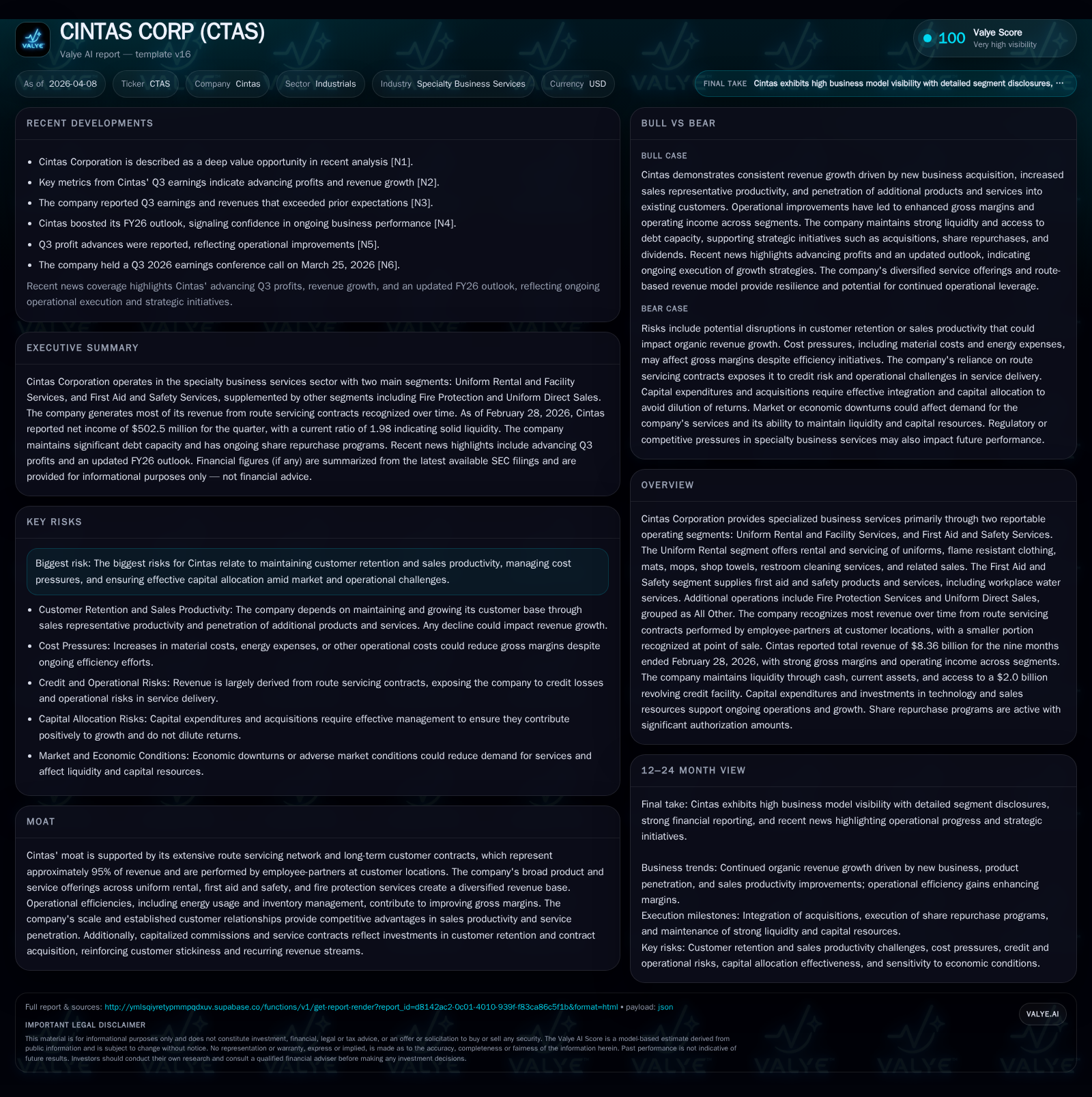
Cintas Corporation has demonstrated robust revenue growth and margin expansion driven predominantly by its Uniform Rental and Facility Services segment. The company’s entrenched route servicing contracts, executed by employee-partners, form a durable moat supporting recurring revenues and operational efficiencies. Capital allocation balances ongoing share repurchases with steady dividend increases, underpinned by strong free cash flow generation. Looking forward, retention of customers amid rising cost pressures alongside operational leverage will be pivotal to sustaining performance.
Historical Revenue and Margin Trajectory: Engines of Past Growth
Cintas has exhibited steady top-line expansion anchored by its Uniform Rental and Facility Services segment. Fiscal 2025 revenue reached approximately $10.3 billion USD, reflecting an organic increase of about 8%, primarily driven by volume gains rather than acquisitions or currency effects [S1]. This segment accounted for roughly 77% of total revenue, underscoring its core role.
Gross margins expanded to 50.0% in fiscal 2025 from 48.8% the prior year due to operational efficiencies including energy management and inventory control improvements [S1]. Operating income grew faster at +14.1% year-over-year to $2.36 billion USD benefiting from cost discipline [F1]. The First Aid and Safety Services segment holds higher gross margins (57%) relative to Uniform Rental (49%), enhancing margin profile through diversification [S1].
Historical performance (annual)
| FY | Net ($mm) | CFO ($bn) | OpInc ($bn) | Capex ($mm) | Net YoY |
|---|---|---|---|---|---|
| 2025 | 1812 | 2.2 | 2.4 | 409 | +15.3% |
| 2024 | 1572 | 2.1 | 2.1 | 409 | +16.6% |
| 2023 | 1348 | 1.6 | 1.8 | 331 | +9.1% |
| 2022 | 1236 | 1.5 | 1.6 | 241 |
Source: SEC companyfacts cache [F1].
Capital returns and efficiency (annual)
| FY | Div ($mm) | Buybacks ($mm) | FCF ($mm) |
|---|---|---|---|
| 2025 | 612 | 935 | 1757 |
| 2024 | 531 | 700 | 1670 |
| 2023 | 450 | 399 | 1267 |
| 2022 | 375 | 1526 | 1297 |
Source: SEC companyfacts cache [F1].
The above table summarizes key financials illustrating Cintas’ growth trajectory [F1].
Operational Structure: Unlocking Synergies Across Service Segments
Cintas operates two primary reportable segments: Uniform Rental & Facility Services and First Aid & Safety Services, along with smaller All Other operations including Fire Protection Services and Uniform Direct Sales [S7][S14].
The Uniform Rental segment generates about three-quarters of revenues through route servicing contracts for uniforms, mats, mops, restroom supplies, and related rental services performed monthly by employee-partners at client sites under long-term agreements recognized over time [S9].
First Aid & Safety Services represent roughly 12% of revenues with higher gross margins (~57%) due to product mix focused on safety supplies and workplace water services [S1][S9]. This segment complements uniform rental via cross-selling opportunities.
The delivery model featuring employee-partners performing onsite services drives deep client relationships reinforced by capitalized commissions—investments made to secure durable route servicing contracts that support customer retention [S12]. This integrated approach mitigates segment volatility.
Capital Allocation Strategy: Balancing Buybacks, Dividends, and Investment
Since mid-2022, Cintas has pursued an assertive but disciplined share repurchase strategy with nearly $3 billion authorized across multiple programs executed or ongoing as of Q3 FY26 [S4][S6]. Approximately $934.8 million was repurchased in FY2025 alone at an average price near $185 per share through September 2025 [S4]. These programs lack expiration dates providing flexibility.
Dividend payments have grown steadily aligned with earnings strength: FY25 dividends totaled about $612 million compared to $531 million in FY24 reflecting prudent payout policy alongside rising net income levels [F1][S20][S21].
Free cash flow remains robust; operating cash flow comfortably covers capex needs with estimated FY25 free cash flow near $1.75 billion after capital expenditures averaging around $409 million annually [F1], enabling balanced returns without excessive leverage dependence.
Current Financial Health: Liquidity, Leverage, and Cash Flow Profile
Cintas maintains solid liquidity with a current ratio near two (approximately $3.6 billion current assets versus $1.8 billion current liabilities as of February 28, 2026) providing ample coverage for short-term obligations [F1].
The company secured a new $2 billion revolving credit facility maturing March 2031 featuring customary covenants including a leverage ratio capped at about 3.5x debt-to-EBITDA [S5][S15][S18].
Debt includes roughly $230 million commercial paper outstanding at a weighted average interest rate around 3.81%, complemented by senior notes spanning maturities through the next decade plus interest rate hedges that smooth borrowing costs amidst treasury rate fluctuations [S10][S16][S22].
Operating cash flows have shown modest growth or stability recently; for the nine months ended February in Q3 FY26 period operating cash flow exceeded capital expenditure requirements supporting organic growth investments while funding shareholder returns sustainably [F1][S13].
Market Position and Risks Impacting Future Growth
Cintas’ moat rests on extensive route servicing contracts performed onsite predominantly by employee-partners under long-term agreements comprising approximately 95% of revenue recognition—this fosters significant customer stickiness enhanced by capitalized commissions allocated to retain clients effectively [S12][S19]. The broad portfolio spanning uniform rental, safety products, fire protection services, and direct sales diversifies revenue sources.
Challenges include maintaining high customer retention amid wage inflation pressures impacting service economics as well as supply chain issues that could compress margins if unmanaged effectively [N11][S1]. Sustaining sales productivity remains critical given industry fragmentation.
Capital allocation decisions must balance reinvestment with shareholder returns prudently amidst evolving macroeconomic conditions.
Analyst Commentary & Recent Earnings Highlights
Q3 FY26 earnings releases reported beats on EPS and revenues fueled by accelerating organic growth primarily via volume gains across service lines [N2][N13]. Analysts noted margin improvement fueled by operational leverage from fixed cost absorption due to higher utilization on existing routes [N1][N12].
Broker reports highlight confidence in sustained sales productivity aided by digital routing tools and enhanced cross-selling within installed bases underpinning resilient revenue despite inflationary headwinds [N11][N5].
Key Metrics for Monitoring Near-Term Performance
With no explicit forward guidance disclosed beyond recent commentary ([N12]), investors should focus on:
- Organic sales volume trends especially within Uniform Rental segment versus pricing dynamics,
- Gross margin stability amid input cost inflation,
- Share repurchase pace relative to valuations,
- Customer contract renewal rates reflecting retention strength,
- Working capital changes signaling operational stress or margin pressure. Tracking these indicators will inform on Cintas’ ability to sustain profitable growth alongside disciplined capital return strategies.
This analysis draws from SEC filings ([S1]-[S29]), validated financial facts ([F1]), and recent credible news sources ([N1]-[N13]). It presents a data-driven perspective without speculative forecasts or investment advice.
Disclaimer: This is research-only, informational analysis and not investment advice. It may include AI-generated interpretation and general industry context. Always verify important details using primary sources.

Comments