
MDxHealth SA’s Growth Trajectory Hinges on Expanded Urologic Diagnostics Portfolio and Reimbursement Dynamics
The company’s recent acquisitions and robust revenue growth underscore potential but are tempered by persistent losses and capital structure challenges.
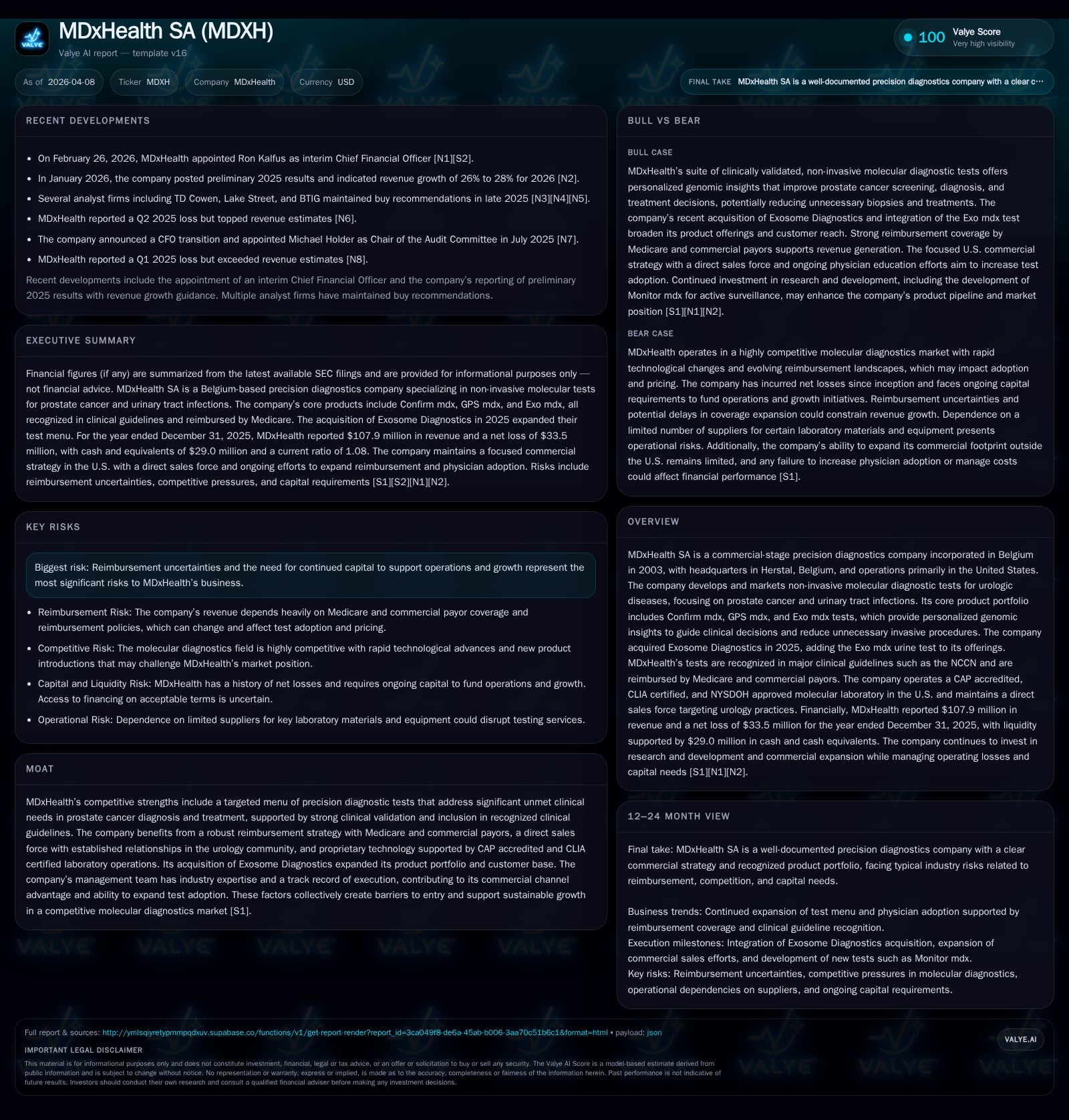
MDxHealth SA has demonstrated strong topline growth, increasing revenues by nearly 20% year-over-year to $108 million in 2025 through the enhancement of its precision diagnostic test offerings for urologic diseases. This expansion is notably driven by acquisitions such as Exosome Diagnostics, which broadened its product portfolio with non-invasive assays like Exo mdx. Despite increasing sales and inclusion in clinical guidelines, MDxHealth remains unprofitable with a substantial accumulated deficit and ongoing cash burn. The company’s capital position is supported by recent equity raises and a $100 million loan facility, though repayment terms hinge on meeting revenue milestones. Watch for developments in reimbursement policies and successful integration of acquisitions as key determinants of MDxHealth’s path to sustainable profitability.
Company Overview and Historical Performance
Founded in Belgium in 2003, MDxHealth SA operates as a commercial-stage precision diagnostics company focused on urologic diseases — chiefly prostate cancer and complicated urinary tract infections. Headquartered in Herstal, Belgium, the company's operational core is its U.S.-based CAP-accredited and CLIA-certified molecular laboratory, from which it markets a portfolio of molecular diagnostic tests that provide personalized genomic insights guiding physicians [S1][S18].
MDxHealth’s flagship tests — Confirm mdx, GPS mdx (acquired from Exact Sciences in August 2022), and Exo mdx (acquired through the September 2025 acquisition of Exosome Diagnostics) — cover different clinical pathways: from initial risk stratification of men suspected of prostate cancer (Confirm mdx), through personalized treatment decision support post-diagnosis (GPS mdx), to non-invasive urine testing (Exo mdx). These tests collectively form a targeted menu allowing MDxHealth to address multiple unmet clinical needs across diagnosis and management paradigms [S1][S3][S18].
The company has achieved steady revenue growth over recent years evidenced by figures rising from $37.1 million in 2022 to $70.2 million in 2023 (+89%), then climbing further to $90.0 million in 2024 (+28%) and $107.9 million (+19.8%) in 2025 [F1]. This growth largely stems from increased volumes of tissue-based tests (Confirm & GPS mdx) comprising approximately 80% of total revenues as of 2024, complemented by the addition of the Exo mdx test post-acquisition [S18].
Historical performance (annual)
| FY | Rev ($mm) | Net ($mm) | Rev YoY | Net YoY |
|---|---|---|---|---|
| 2025 | 108 | -34 | +19.8% | +12.0% |
| 2024 | 90 | -38 | +28.3% | +11.7% |
| 2023 | 70 | -43 | +89.4% | +2.1% |
| 2022 | 37 | -44 |
Source: SEC companyfacts cache [F1].
Capital returns and efficiency (annual)
| FY | ROE% |
|---|---|
| 2025 | 277.2 |
| 2024 | -256.5 |
| 2023 | -597.9 |
| 2022 | -472.8 |
Source: SEC companyfacts cache [F1].
Despite revenue gains, MDxHealth continues to report net losses stemming from ongoing investment into its commercial infrastructure, research and development efforts, acquisition-related costs, plus interest expenses associated with debt financing [F1][S13]. The net loss narrowed modestly from $43.1 million in 2023 to $33.5 million in FY25 [F1]. Equity turned negative at year-end 2025 reflecting accumulated deficits [F1].
Product Portfolio Expansion & Commercial Strategy
MDxHealth solidified its leadership position through strategic acquisitions:
GPS mdx Acquisition (August 2022): Acquiring Genomic Prostate Score testing business from Exact Sciences for up to $100 million expanded tissue-based testing offerings addressing treatment decision-making post-localized prostate cancer diagnosis [S1][S3].
Exosome Diagnostics Acquisition (September 2025): The addition of Exo mdx introduced a proprietary urine-based assay modality leveraging exosomal RNA for early detection of high-grade prostate cancer outside invasive biopsies; this also included acquiring a CLIA-certified lab facilitating service continuity and scalability [S1][S3].
Both acquisitions enhanced MDxHealth's direct-to-urologist commercial engagement model, which now encompasses coverage by Medicare and major commercial payors—driving improved test adoption within clinical guidelines such as those established by NCCN [S18]. Over 7,000 urologists have utilized MDxHealth’s tests cumulatively as part of this outreach strategy [S18].
Marketing efforts focus on targeted physician education programs supported by managed care and payer reimbursement expertise — critical given that Medicare reimbursement is a linchpin for market penetration within the fragmented U.S. molecular diagnostics landscape.
Financial Position & Capital Allocation
The company sustains operations funded primarily through equity raises totaling upwards of $83 million since early-2023 via multiple public offerings priced between $2-4 per share [S1][S17], complemented by a five-year senior secured credit facility secured against intellectual property assets with OrbiMed Advisors LLC providing up to $100 million [S4][S5]. Drawdowns against this facility occurred progressively with tranches totaling $100 million drawn between May ’24 and March ’26.
Interest terms under this loan are approximately SOFR plus margins resulting in an effective rate around ~11-13%, with covenant triggers linked directly to net revenue milestones—failure to meet these could accelerate repayment or impose liquidity constraints [S4][S5]. Minimum cash balance requirements further impose operational discipline.
Operating cash flows remain negative; however, management anticipates sufficient liquidity from existing sources for at least the coming twelve months [S21]. Capital expenditures stay relatively modest (~$1.2 million annually primarily for lab equipment) while R&D costs approximate $10 million annually aimed at pipeline expansion including assay improvements and workflow automation [S6][S8].
No dividends or share repurchases have been declared due to ongoing losses and reinvestment priorities [S19][S20].
Operational Performance & Margins
Gross margin improved notably from approximately 61% in FY24 to around 64.5% in FY25 due largely to scaling benefits—improved fixed cost absorption combined with pricing optimization amid expanded commercial coverage [S7][S13]. Cost of sales includes labor charges related to sample processing but excludes intangible amortization tied mostly to acquired IP brands such as GPS mdx [S13].
Operating expenses rose moderately due partly to expenses related to the Exo mdx acquisition—selling & marketing costs increased along with headcount supporting new product launches whereas R&D stabilized after ramping prior years’ clinical study activities [S13][S14]. General administrative costs also increased reflecting transaction costs plus support for Nasdaq listing operations.
The amortization charge relating primarily to intangibles acquired during prior deals remains significant at over $5 million annually but is excluded from gross margin computations [S13][S14].
Industry Context & Competitive Environment
MDxHealth competes within the growing precision urologic diagnostics market where non-invasive assays targeting prostate cancer risk assessment are increasingly preferred over traditional biopsy approaches due to patient safety considerations.
Key competitors include Labcorp's acquisition-backed OPKO Health's FDA-cleared blood-based “4Kscore” test and Beckman Coulter's Prostate Health Index urine assay—both enjoy broader resources, greater scale salesforces, and marketing budgets than MDxHealth which constrains competitive dynamics long-term [S15]. Emerging players like Lynx Dx’s MyProstateScore offer similarly positioned urine biomarkers challenging Exo mdx’s share.
MDxHealth differentiates through integrated multi-platform genomic insights spanning DNA methylation markers (Confirm mdx), gene expression risk scores (GPS mdx), and exosomal RNA (Exo mdx), delivered via vertically integrated lab services supporting CLIA compliance—regulatory certifications that amplify trust among clinicians and payors alike [S15][S18].
Reimbursement landscape volatility persists within molecular diagnostics broadly; sustained favorable Medicare coverage status remains critical while commercial payor negotiations necessitate ongoing vigilance [S16]. Furthermore, compliance mandates such as anti-kickback statutes and FCPA enforcement require robust governance infrastructures given healthcare industry sensitivities.
Future Prospects & Risks
Growth Drivers:
- Continued Test Adoption: Scaling usage among community urology practices (>7k current users) leveraging reimbursed diagnostics recognized by NCCN guidelines supports predictable volume growth.
- Portfolio Expansion: Focused R&D investments aim at developing next-gen biomarkers for other urologic indications beyond prostate cancer including complicated UTIs via Resolve mdx enhancing addressable markets.
- Integration Synergies: Leveraging Exosome Diagnostics’ lab infrastructure facilitates new test deployments potentially improving turnaround times / customer satisfaction.
- Reimbursement Strategy: Maintaining Medicare coverage coupled with expanding contracts with commercial insurers can underpin average selling price improvements observed recently.
Constraints:
- Persistent Operating Losses: Despite progress narrowing losses ($33.5M net loss FY25), deployment scale must materially exceed cost base before achieving profitability; reliant on continual capital access presently.
- Debt Obligations: Loan covenants pegged to revenue or cash balances place tangible constraints on financial flexibility bringing refinancing risk if growth stalls or macro conditions deteriorate.
- Competitive Pressures: Larger incumbents could intensify pricing competition or leverage superior marketing budgets constraining pricing power or market share gains.
- Regulatory & Compliance Complexity: Evolving rules governing laboratory-developed tests internationally may elevate compliance costs or delay market entry outside U.S.
- Reliance on U.S Market: While based in Belgium, >95% revenues stem from U.S., posing geographic concentration risk dependent on U.S healthcare policy dynamics.
Milestones / Catalysts To Watch:
- Quarterly Revenue Trends: Meeting or exceeding loan facility benchmarks will be critical to avoid accelerated repayments or covenant breaches.
- Integration Effectiveness: Demonstrating synergy capture post Exosome Diagnostics acquisition will signal operational execution capability.
- Reimbursement Updates: Any changes or expansions affecting Medicare billing codes relevant for Confirm mdx / GPS mdx / Exo mdx impact revenue visibility significantly.
- Pipeline Advances: Progression of new product candidates into clinical validation phases can diversify future revenue streams beyond current portfolio.
Conclusion
MDxHealth SA occupies a specialized niche within precision molecular diagnostics for urologic cancers supported by validated genomic technologies aligned with prominent clinical guidelines—a formidable basis for sustained growth evidenced by consistent topline gains nearing $108 million ARR in FY25 driven both organically and via accretive acquisitions like Exosome Diagnostics.
However, this promising top-line trajectory coexists with ongoing operating losses fueled by continued investment into commercialization infrastructure and R&D coupled with elevated debt burdens implying constrained financial flexibility pending achievement of positive operating leverage.
Going forward, execution risks center on effective integration of acquired assets, securing durable reimbursement amid complex healthcare payor dynamics, fending off well-resourced competitors entrenched across diagnostic channels, all while navigating evolving regulatory landscapes domestically and internationally.
Investors tracking MDXH should vigilantly monitor quarterly performance against loan covenants alongside clinical adoption trends given their outsized influence on liquidity profiles over the near term.
This report is based solely on publicly available information as cited without incorporating any non-public material data or insider insights about MDxHealth SA or its affiliates. It does not constitute investment advice or recommendations regarding securities transactions but aims solely to provide an analytical overview grounded in verified disclosures.
Disclaimer: This is research-only, informational analysis and not investment advice. It may include AI-generated interpretation and general industry context. Always verify important details using primary sources.

Comments