
Totaligent’s Dramatic Revenue Retreat and Strategic Turn Toward AI-Driven Growth
Totaligent faces a precipitous revenue collapse and mounting losses, prompting a strategic pivot toward AI integration and diversified acquisitions to revive growth.
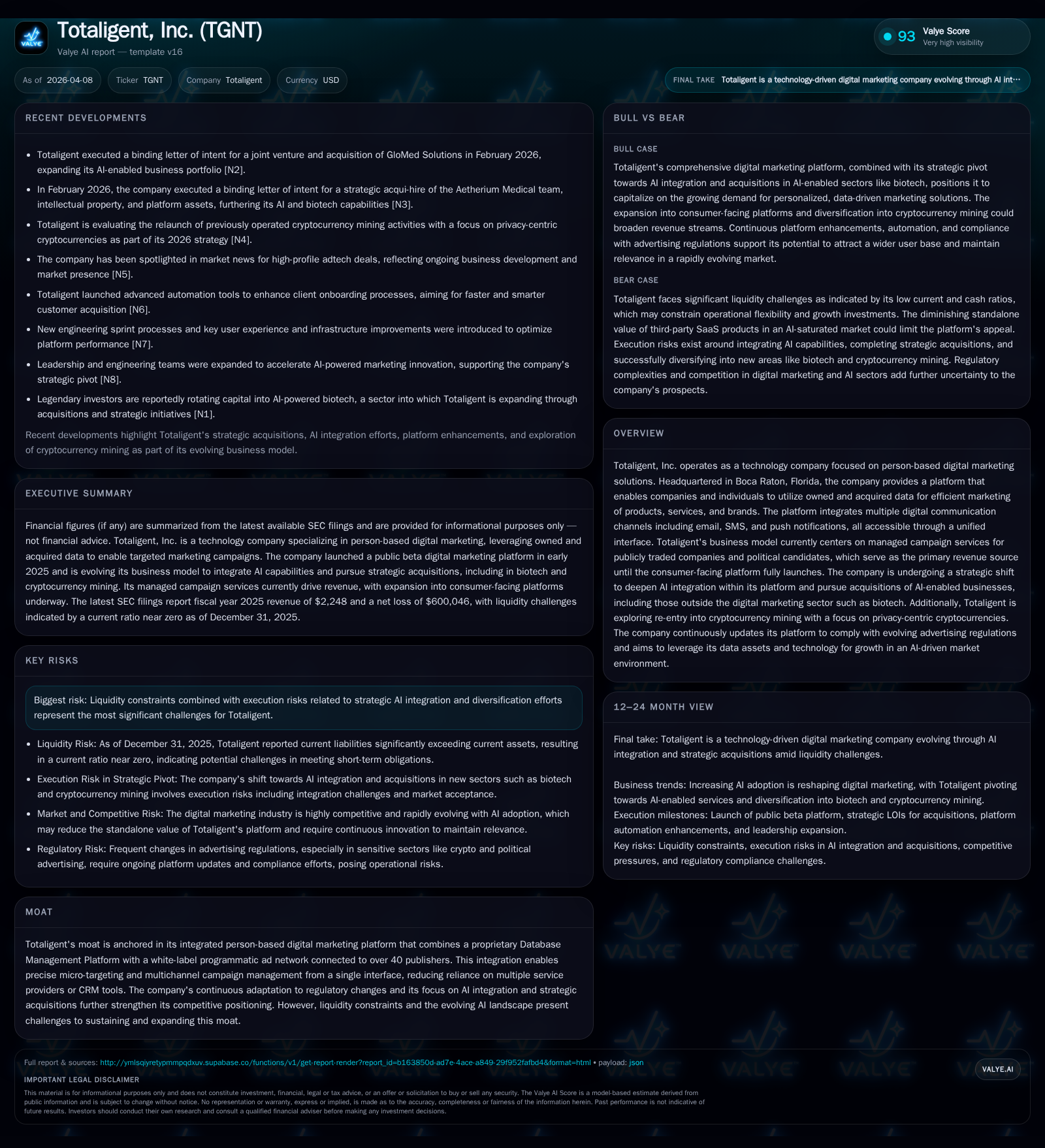
Totaligent’s top-line revenue plummeted by over 99% from $444.5K in 2024 to approximately $2.2K in 2025 while operating losses remain substantial at nearly $455K. This dramatic fall stems from the transition away from managed campaigns, which previously generated steady income, toward the consumer-facing person-based digital marketing platform still in its beta stage. The company is aggressively shifting strategy to embed AI capabilities within its platform and pursuing acquisitions in AI-enabled sectors including biotech, aiming to leverage its proprietary Database Management Platform and white-label ad network. Cash constraints pose severe risks as working capital remains deeply negative, and going concern doubts underpin urgent financing needs. Key upcoming milestones include platform maturation, joint venture developments, and traction in newly targeted verticals, which will be crucial barometers of Totaligent’s ability to stem losses and restore viability.
Historical Revenue Collapse and Its Immediate Drivers
Totaligent’s financial performance trajectory faced an unprecedented reversal in FY2025 marked by a precipitous revenue collapse from $444,529 in FY2024 to merely $2,248—a decline of approximately 99.5% [F1]. This dramatic drop reflects the cessation of its primary revenue stream from managed campaign services targeting publicly traded companies and political candidates as the company transitioned focus toward its newly launched consumer-facing digital marketing platform. The beta release of this integrated person-based marketing solution occurred in Q1 2025 [S1], but its commercial adoption remains nascent.
Such an abrupt decline underscores the inherent risk linked to overlapping business models operating during transitional phases within tech firms reliant on platform rollouts. Revenue erosion outpaced cost savings, pushing operating losses down only moderately from -$884,681 in FY2024 to -$454,992 in FY2025 [F1]. The company still bore substantial fixed infrastructure and development expenses tied to platform refinement despite evaporating sales volume.
Within digital marketing ecosystems, leveraging owned and acquired data assets through an integrated interface usually provides scale economies; however, until critical mass adoption occurs on the new platform, cash burn remains elevated.
Historical performance (annual)
| FY | Rev ($) | Net ($) | CFO ($) | OpInc ($) | Rev YoY | Net YoY |
|---|---|---|---|---|---|---|
| 2025 | 2248 | -600046 | -265041 | -454992 | -99.5% | +36.7% |
| 2024 | 444529 | -947236 | -199790 | -884681 | -39.2% | -135.5% |
| 2023 | 731679 | -402170 | -29476 | -353958 | ||
| 2016 | -516176 | -96326 | -511557 |
Source: SEC companyfacts cache [F1].
Capital returns and efficiency (annual)
| FY | ROE% |
|---|---|
| 2025 | 27.7 |
| 2024 | 54.5 |
| 2023 | 44.2 |
| 2016 | 161.6 |
Source: SEC companyfacts cache [F1].
Table shows sharp revenue contraction coinciding with sustained losses reflective of scaling challenges across multiple years [F1].
The Business Model Transition: Managed Campaigns to AI-Centric Platform Expansion
Totaligent’s strategic pivot revolves around evolving from purely offering managed digital campaigns—a traditional service model—towards embedding advanced artificial intelligence capabilities into its person-based marketing platform [N1][S1]. This move attempts to capitalize on industry-wide trends favoring AI-driven analytics and automated personalization over standalone third-party SaaS products whose value has eroded amid market saturation.
Central to this shift is Totaligent’s proprietary Database Management Platform coupled with a white-label programmatic ad network connected via APIs to over 40 publishers [S1]. These assets enable seamless multichannel campaign orchestration across email, SMS, push notifications among other formats through a unified dashboard—a feature highly valued by marketers aiming for micro-segmentation efficiency.
The integration of AI functionalities promises enhanced predictive targeting models utilizing first-, second-, and third-party data pools democratized through the public beta platform launched March 2025 [S1]. This combination may result in superior customer lifetime value optimization for end-users by automating audience segmentation while maintaining compliance amidst evolving privacy regulations.
However, delayed monetization indicates time lags typical when transitioning SaaS platforms towards fully autonomous AI-assisted operations under stringent data governance frameworks.
Strategic Acquisitions and Diversification Beyond Core Digital Marketing
Confronted with diminishing returns solely within digital advertising services amidst rapid AI market evolution, Totaligent has embarked on an acquisitive growth path targeting AI-enabled enterprises beyond traditional verticals [N1][N2][S3]. Notably, the company recently executed a binding letter of intent for a joint venture plus acquisition involving GloMed Solutions LLC—a firm operating in healthtech—signaling interest in extending proprietary data capabilities into biotech realms [N1][S3].
Further strategic emphasis includes exploring privacy-focused cryptocurrency mining ventures reflecting broader diversification priorities aimed at technologies with high data monetization potential while navigating regulatory complexities [S1].
This expansion strategy appears designed not only as a hedge against volatility within core digital marketing operations but also as an attempt to bolster Totaligent’s moat through synergies arising from integrating powerful AI algorithms with newly acquired sector-specific datasets.
While these moves could position Totaligent advantageously if executed successfully—with potential breakthrough innovations combining healthcare data analytics and marketing precision—they carry elevated execution risks given resource constraints [S1].
Liquidity Challenges and Balance Sheet Constraints Shaping Outlook
Financial health remains tenuous amid deepening liquidity deficits and balance sheet stresses that threaten operating continuity without external financing intervention [S1][F1]. As of December 31, 2025, Totaligent reported negative working capital exceeding $2 million ($9.7K current assets vs $2.37 million current liabilities), stockholders’ deficit of over $2.16 million alongside an accumulated deficit of approximately $2.56 million [F1].
Cash reserves are effectively depleted with closing cash balances barely above zero at $4,689 at year-end [S1], severely limiting tactical flexibility for operational expenditures or acquisition funding absent new capital inflows.
Auditors flagged substantial doubts about going concern viability underscoring urgency for management actions such as equity issuances or secured debt offerings potentially accompanied by restrictive covenants impacting future operational agility [S1]. Equity dilution remains likely if funding is equity-led given shareholders' negative net worth metrics.
Such financial fragility complicates timeline certainty around platform development milestones or successful integration of recent strategic ventures.
Operational Cash Flow Trends and Capital Allocation Priorities
Operating cash flow has deteriorated alongside EBITDA losses reaching approximately negative $265K in FY2025 compared to negative $199.8K prior year—an increase in cash burn reflecting tighter margins post-revenue crash [F1]. Capital expenditures have fallen to zero reflecting limited reinvestment capacity consistent with severe liquidity pressures restricting discretionary spending.
The free cash flow profile emerges as starkly negative emphasizing that available internal resources are insufficient for growth funding or meaningful product enhancement absent external capital injections.
Capital allocation decisions thus prioritize survival-oriented expenditure compression over scaling investments or shareholder returns—as evidenced by absence of dividends or buyback programs since inception reflecting early-stage developmental focus [F1].
Governance Actions and Financing Efforts to Sustain Viability
Management acknowledges pressing capital requirements explicitly referencing efforts underway to obtain financing via equity or debt issuance amidst uncertain market conditions [S1][N1][S3]. The company amended binding letters of intent related to joint venture transactions—such as with GloMed Solutions—to extend negotiation timelines likely aimed at preserving optionality while sourcing funds [S3].
Organizational adjustments include strengthening remote work team structures centered on lean operations consistent with minimization of overhead amid cash constraints [S1]. Regulatory disclosures also reveal increased governance attention around monitoring liquidity risks consistent with auditor going concern warnings demanding robust remedial plans.
Investor scrutiny will focus sharply on announcements regarding successful closings of funding rounds or strategic partnerships which could underpin continued operational capacity beyond current near-term horizons.
Forward-Looking Signals: What to Watch for Platform Maturation and Market Reception
Looking ahead—analysis suggests critical indicators will revolve around the advancement from public beta status towards full commercial launch supported by measurable user adoption curves primarily among institutional clients like publicly traded companies and political campaigns [N1][N2][S1]. Incremental traction validating multichannel integration efficiencies enabled through proprietary database technologies will signal product-market fit progression essential for reversing revenue erosion trends.
Equally pivotal is the rate at which AI functionality permeates core offerings yielding distinct competitive differentiation over commoditized SaaS peers increasingly vulnerable due to generic AI tool proliferation.
Monitoring early outcomes from newly acquired biotech-focused entities offers insight into diversification success alongside privacy-centric crypto mining experiments—both representing material departures requiring effective synergy realization if they are to meaningfully contribute top-line growth or margin expansion over medium term frameworks.
Finally regulatory developments particularly regarding person-based data use under evolving privacy laws must be navigated prudently as compliance setbacks could materially impair marketing effectiveness or trigger reputational damage outside traditional competitor rivalry factors.
Totaligent Inc.’s current financial state illustrates the steep challenges faced during ambitious transformation phases characteristic of emerging technology firms transitioning between business models amidst fast-moving AI trends. Severe revenue contractions juxtaposed with ongoing cash depletion accentuate urgency behind recent strategic pivots incorporating not only enhanced AI capability integration into their core platform but also selective acquisitions expanding sector footprint beyond conventional digital marketing boundaries. While these shifts offer promising avenues for revitalization if well-executed under tightened governance controls and sustainable financing arrangements, significant risks persist linked primarily to fragile liquidity conditions and operational execution complexity requiring close monitoring as key milestones approach.
This analysis relies solely on documented financial disclosures and verified news sources without speculation beyond confirmed facts or official guidance provided by Totaligent management.[F1][N1][N2][S1][S3]
Disclaimer: This is research-only, informational analysis and not investment advice. It may include AI-generated interpretation and general industry context. Always verify important details using primary sources.

Comments