
NovaBridge Biosciences’ 2025 Operating Losses and Cash Reserves Highlight Clinical-Stage Growth Challenge
Continuing heavy R&D investment and strategic collaborations frame NovaBridge’s clinical progress and financial profile.
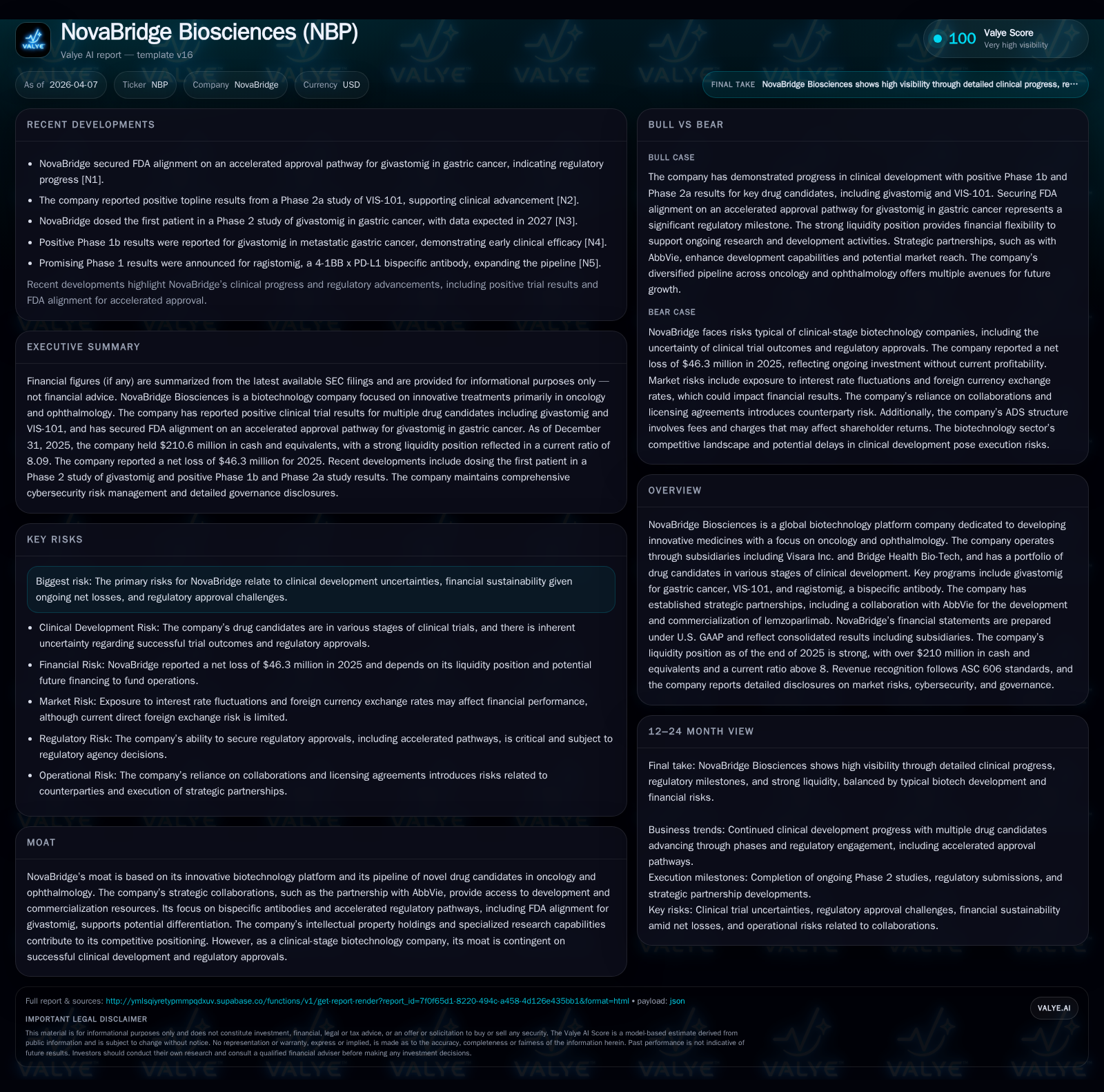
NovaBridge Biosciences remains a clinical-stage biotechnology platform focused on oncology and ophthalmology, with key drug candidates including givastomig and VIS-101. In 2025, the company reported stable but minimal revenues alongside a significant increase in operating losses largely driven by clinical development expenses. Strong cash reserves of over $210 million underpin its financial stability through ongoing trials and regulatory activities, notably recent FDA accelerated approval alignment for givastomig. The company’s return to robust R&D investment and limited capital allocations for buybacks reflect its early-stage status and strategic prioritization of pipeline advancement. Near-term growth hinges on clinical milestones and regulatory outcomes while controlling costs remains critical.
Business Overview and Historical Performance
NovaBridge Biosciences operates as a global biotechnology platform company concentrated on innovative medicines particularly in oncology and ophthalmology. Important subsidiaries include Visara Inc. and Bridge Health Bio-Tech, bolstering both developmental breadth and specialization [S1]. The company's leading drug candidates include givastomig—targeting gastric cancer with promising FDA accelerated approval discussions—as well as VIS-101 and ragistomig, a bispecific antibody advancing through various clinical stages [N2], [N1].
Historically, NovaBridge's business has remained pre-commercial, reflected in minimal revenue generation and consistent operating losses tied to its rising commitment to clinical R&D efforts. The consolidated financials confirm that actual product sales revenue is negligible, underscoring the early-stage nature of the company.
Financially, the company posted revenues of approximately $0.63 million for both fiscal years 2024 and 2025 ([F1])—practically flat which underscores the lack of commercialized drugs within its portfolio so far. By contrast, operating income displayed a marked deterioration from -$51.4 million in 2024 to -$94.3 million in 2025, amounting to an 83% year-over-year increase in operating losses ([F1]). These elevated losses relate primarily to expanded clinical development expenses necessary to drive late-stage studies for multiple candidate therapies including givastomig.
Net income followed suit with net losses widening from -$22.2 million in 2024 to -$46.3 million in 2025—a doubling indicative of both operational scale-up costs and continued absence of offsetting revenues ([F1]). The approximate Return on Equity reached negative 20%, reflecting ongoing negative profitability relative to shareholder capital ([F1]).
Operating cash flow continues to lag significantly with deep cash burn; the latest available CFO estimate points towards over -$183 million consumption when accounting for capex ([F1]). This burn rate aligns with normal expectations for clinical stage biotech companies sustaining pipelines without approved products or meaningful sales.
Historical performance (annual)
| FY | Rev ($mm) | Net ($mm) | CFO ($mm) | OpInc ($mm) | Rev YoY | Net YoY |
|---|---|---|---|---|---|---|
| 2025 | 1 | -46 | -94 | 0.0% | -108.1% | |
| 2024 | 1 | -22 | -51 | -83.8% | +89.2% | |
| 2023 | 4 | -206 | -184 | +112.1% | +43.2% | |
| 2022 | -32 | -364 | -160 |
Source: SEC companyfacts cache [F1].
Capital returns and efficiency (annual)
| FY | Buybacks ($mm) | FCF ($mm) | ROE% |
|---|---|---|---|
| 2025 | 0 | -20.0 | |
| 2024 | 0 | -11.1 | |
| 2023 | 9 | -185 | -85.3 |
| 2022 | 3 | -167 | -86.2 |
Source: SEC companyfacts cache [F1].
Note: Revenue stabilization post-2023 sharp drop due to strategic divestitures; operating cash flow approximated using last reported data.
Recent Strategic Developments
In March 2026, NovaBridge announced positive Phase 2a topline results from its VIS-101 program in respiratory conditions showcasing favorable trial endpoints that advance candidate viability [N1]. Shortly thereafter, the company secured FDA alignment on an accelerated approval pathway for givastomig targeting gastric cancer [N2], suggesting an expedited regulatory timeline conditioned on ongoing favorable data.
Strategic partnerships remain a cornerstone of NovaBridge’s business model—most notably the alliance with AbbVie for lemzoparlimab’s global development and commercialization outside Greater China [S4]. This deal generated upfront payments exceeding $180 million historically plus potential milestone payments up to $1.295 billion upon achievement of commercial success milestones—a measure that provides capital relief whilst diluting some control.
Future Growth Prospects
Growth catalysts center around advancing givastomig through pivotal trials aligned with accelerated FDA approval pathways which could considerably elevate valuation if granted [N2]. Similarly, expanding VIS-101 into further indications post-positive Phase 2a results provides optionality within the respiratory therapeutic area [N1]. The bispecific antibody ragistomig adds pipeline diversification potential.
However, these prospects carry standard biotech risks including trial failures or regulatory delays ([S4], [S12]). Clinical uncertainties remain elevated given the nascent nature of their lead products, translating into volatile development timelines and potential setbacks.
Additionally, NovaBridge continues navigating internal controls remediation—the management identified several material weaknesses related to IT general controls impacting financial reporting integrity that are undergoing active remediation efforts [S1]. This indicates organizational growing pains possibly affecting risk profile for investors collateralizing future funding rounds or partnerships.
Capital Allocation and Returns Analysis
Reflecting early clinical-stage priorities, NovaBridge abstained from share repurchases in the recent fiscal year after modest buybacks earlier ([F1]), channeling capital predominantly towards research expenditures instead of shareholder returns or dividends ([S7], [F1]). Dividends remain non-existent consistent with biotech norms.
Capital expenditures declined drastically from $48k in 2024 to merely $7k in 2025 revealing a shift away from fixed asset investments toward intangible pipeline assets such as licensed IPR&D rights ([F1], [S9]). The company’s balance sheet displays solid total equity nearing $231 million as of end-2025 providing cushioning amid negative earnings trends ([F1]).
Liquid assets surged notably; cash plus equivalents totaled approximately $210 million by year-end versus $68 million the previous year due partly to a sizeable equity offering netting over $61 million after fees executed during mid-2025 ([S5], [S7]). This strong liquidity ensures operational runway through forthcoming critical studies and regulatory submissions.
The current ratio stands at an impressive ~8x ([F1]), signaling ample near-term solvency against current liabilities which totaled about $27 million at year-end ([F1]).
Outlook and Milestones to Monitor
Although explicit forward guidance figures are absent, key upcoming milestones include:
- Completion results from pivotal trials involving givastomig aimed at accelerated FDA approval submission.
- Expansion updates on VIS-101 development program progression post Phase 2a successes.
- Updates on additional bispecific antibody candidates validation such as ragistomig.
- Progression on internal control enhancements impacting reporting quality disclosure.
- Potential milestone payments realization or new partnership formations reflecting pipeline de-risking events.
Monitoring cash burn rates relative to R&D execution pace will be instrumental given no near-term commercial revenues expected beyond collaborations’ upfronts/milestones.
Risks Summary
Key risks highlighted by management include typical clinical development uncertainties such as trial outcomes variability and associated financial stress from continued net losses ([S4]). Also materialize are governance risks from lingering IT control deficiencies requiring close process improvements ([S1],[S12]). Ongoing dependence on collaborative partners exposes NovaBridge to counterparty execution risks affecting commercialization pace or milestone inflows ([S4]). Currency fluctuations appear managed presently but could impact international cost structures given partial RMB exposure ([S22]).
This analysis synthesizes public SEC filings and recent news up to April 2026; it does not incorporate any unpublished internal information or forward-looking projections absent explicit company disclosure. This document serves informational purposes only without providing investment advice or recommendations.
Disclaimer: This is research-only, informational analysis and not investment advice. It may include AI-generated interpretation and general industry context. Always verify important details using primary sources.

Comments