
Stereotaxis’ Progress in Magnetic Navigation and Fiscal Dynamics
Stereotaxis advances its robotic magnetic navigation technology with recent FDA clearance while facing sustained operating losses and capital challenges.
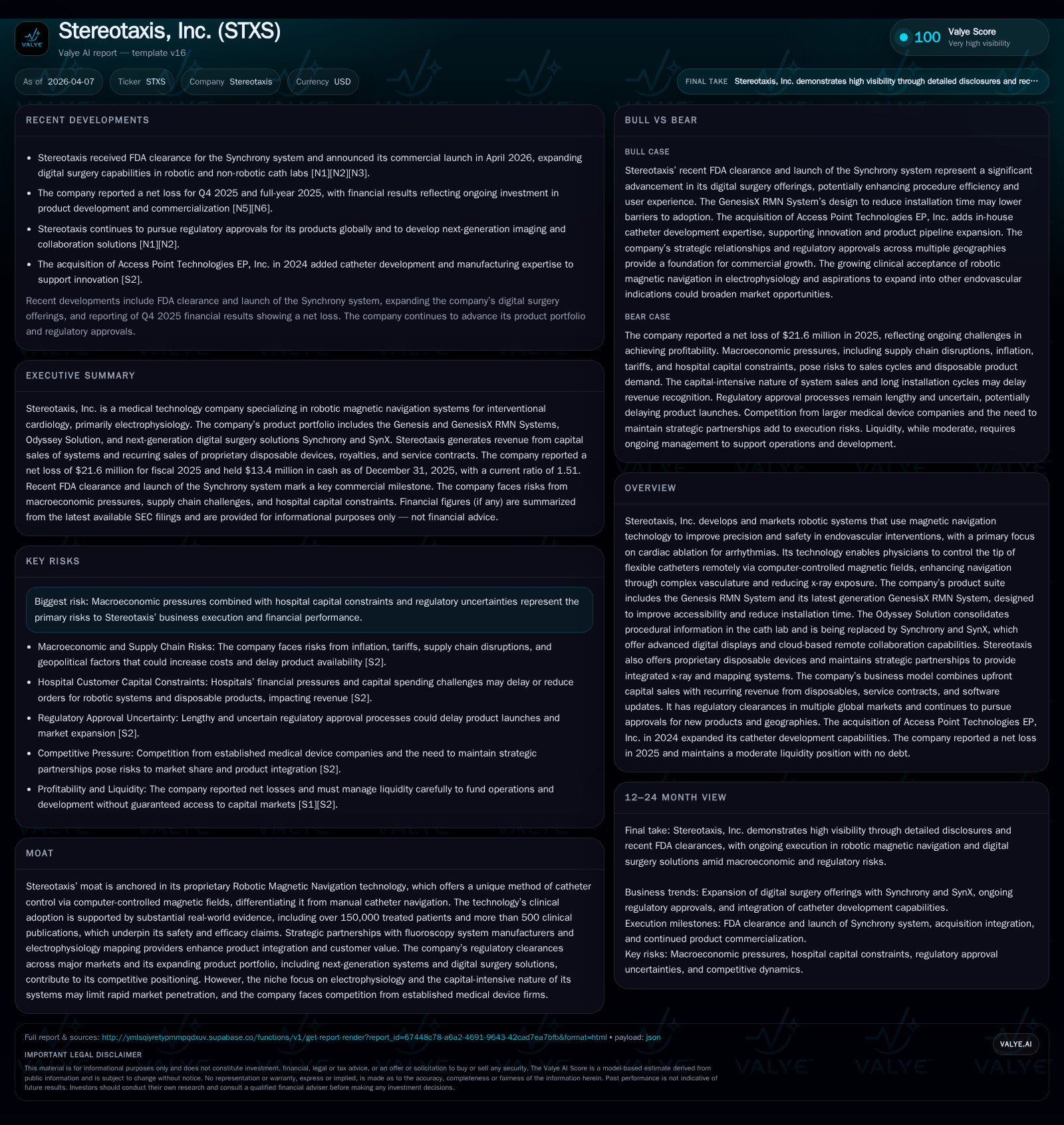
Stereotaxis, Inc. leverages its proprietary Robotic Magnetic Navigation system to transform cardiac ablation procedures, supported by extensive clinical adoption and strategic partnerships. Despite technology progress—including recent FDA clearance of the Synchrony System and introduction of next-generation products—revenue has declined over recent years amid costly R&D and integration expenses. The company continues to operate at a loss, fueled by significant cash burn partially offset by equity financing initiatives that preserve liquidity but dilute equity. Future growth hinges on expanding indications beyond electrophysiology and capitalizing on regulatory approvals, though hospital budget constraints and macroeconomic pressures remain notable headwinds.
Transforming Cardiac Ablation with Robotic Magnetic Navigation
Stereotaxis has carved a unique niche with its proprietary Robotic Magnetic Navigation (RMN) technology that enables electrophysiologists to remotely control the tip of flexible interventional catheters through externally applied computer-controlled magnetic fields [S2]. This mode of direct catheter tip navigation contrasts with traditional manual handle-driven approaches, offering superior precision and stability. Over 150,000 arrhythmia patients have been treated globally using Stereotaxis’ systems, establishing a wide base of real-world clinical validation supported by more than 500 peer-reviewed publications [N7][S2].
Through strategic partnerships with leading fluoroscopy system manufacturers and providers of electrophysiology mapping tools, Stereotaxis integrates its RMN systems within hospitals’ cath lab infrastructure to streamline workflow and improve procedural accuracy [S21]. The company’s evolution from the original Genesis RMN System to the GenesisX iteration focuses on reducing installation time—a key barrier for hospital adoption—thereby improving accessibility for robotic-assisted cardiac ablations [S9][N8].
Historical Financial Performance: Declining Revenues amid Intensified R&D
Between FY2015 and FY2018, Stereotaxis’ revenues descended from approximately $37.7 million in 2015 to about $29.3 million in 2018 [F1]. The latest fiscal year closed with revenues down roughly 5.8% year-over-year relative to prior periods reported [F1], driven by shifting product mix—particularly fluctuations between high-margin disposable devices and capital system sales—and wider market pressures [S7].
Operating losses persisted at significant levels with a $22.1 million loss in FY2025 despite relatively stable operating expense structures [F1]. General and administrative expenses rose due principally to acquisition-related amortization charges following the mid-2024 purchase of Access Point Technologies EP, Inc., which added specialized catheter manufacturing capabilities but also increased fixed costs [S7][S24]. On the other hand, research and development expenditures saw modest decreases partly due to capitalization of costs related to the GenesisX product line into inventory [F1][S7].
Historical performance (annual)
| FY | Net ($mm) | CFO ($mm) | OpInc ($mm) | Capex ($mm) | Net YoY |
|---|---|---|---|---|---|
| 2025 | -22 | -14 | -22 | 0 | +10.0% |
| 2024 | -24 | -8 | -25 | 0 | -16.1% |
| 2023 | -21 | -9 | -22 | 0 | -13.2% |
| 2022 | -18 | -8 | -19 | 2 |
Source: SEC companyfacts cache [F1].
Capital returns and efficiency (annual)
| FY | FCF ($mm) | ROE% |
|---|---|---|
| 2025 | -14 | -160.5 |
| 2024 | -9 | -395.5 |
| 2023 | -10 | -126.7 |
| 2022 | -11 | -69.4 |
Source: SEC companyfacts cache [F1].
*Operating income (OpInc), net income (Net), operating cash flow (CFO), and capital expenditure (Capex) figures are from the latest available filings [F1]. Revenue data post-2018 is not disclosed.
Recent Operational Highlights and Strategic FDA Clearance
Early 2026 brought a milestone FDA clearance for Stereotaxis’ Synchrony System—a state-of-the-art digital surgery solution combining ultra-high-definition displays with cloud-based remote collaboration capabilities via the SynX app [N7][N8][N9]. This system replaces the earlier Odyssey Solution platform consolidating cath lab procedural data onto one integrated screen but extends functionality with remote monitoring features vital for modern interventional workflows.
Synchrony aims to enhance cath lab efficiency and procedure safety while reducing clutter through customizable layouts tailored for robotic magnetic navigation workflows [S26]. Meanwhile, the GenesisX RMN System addresses long-standing adoption barriers faced by large capital equipment installations by streamlining setup times substantially [S9]. These advances cater directly to operational bottlenecks hospitals face during robotic system integration.
The company's integration of Access Point Technologies EP’s portfolio further strengthens its catheter offerings with newly developed robotically compatible disposables such as the MAGiC catheter series now cleared in both Europe (CE Mark) and U.S. (FDA 510(k)) [S17][S19]. This broadens their ecosystem beyond hardware into consumables tightly linked to recurring revenue streams.
Future Growth Opportunities within Electrophysiology and Beyond
While cardiac ablation remains Stereotaxis' core market vertical—valued in the multi-billion-dollar device category—management highlights ambitions to expand RMN’s applicability into coronary artery disease treatments as well as neurovascular and peripheral vascular interventions [S2]. Such expansion would involve adapting robotically navigated magnetic catheters for new delicate vasculatures requiring precise maneuvering beyond cardiac chambers.
This multi-indication strategy hinges critically on demonstrating clinical benefits comparable or superior to manual techniques while managing inherent capital intensity challenges associated with robotic platforms [S2]. Given limited hospital budgets compounded by macroeconomic factors tightening capital spending cycles across healthcare providers—especially in emerging markets—the pace at which these new applications gain traction remains uncertain.
Navigating Capital Structure Amid Continuing Operating Losses
As of September 30, 2025 Stereotaxis held approximately $13.4 million in cash and equivalents with total current assets of $33.8 million against current liabilities of $22.4 million yielding a current ratio around 1.51 indicating moderate liquidity coverage [F1]. Working capital was reported at $6.3 million as of September 30 compared to $4.8 million at end-2024 reflecting modest improvement aided by financing activities [S4][S6].
Capital raising initiatives include a registered direct equity offering completed in July 2025 generating gross proceeds near $8.5 million alongside an agreement for an additional $4 million tranche expected before November end [S4]. Additionally an At-The-Market (“ATM”) facility established provides flexibility issuing up to $50 million shares subject to market conditions for ongoing funding needs without incurring debt—which stood at zero as per last disclosures [S4][S5][S15].
These financing efforts underpin working capital management that counters continuing net operating losses but bear dilutive consequences for shareholders as equity issuance remains primary funding source.
Cash Flow Profiles and Capex Trends
Operating cash flows have been persistently negative averaging around $9 million annually since 2022 rising sharply in FY2025 to nearly $13.7 million in outflows aligned with expanded R&D efforts including product launches such as GenesisX system components capitalization [F1][S4][S7]. Capital expenditures remain exceptionally low relative to prior years suggesting investment focus skewed towards intangible assets like software development rather than physical plant upgrades or system expansion frameworks; FY25 capex was approximately $93k versus over $2 million two years prior [F1].
The company’s emphasis on balancing operational burn without sacrificing innovation led to strategic inventory valuation adjustments related to acquisitions influencing periodic gross margin volatility mainly within disposables segments [S7][S16]. Financing proceeds primarily offset these outflows maintaining baseline operations but underline non-sustainable core cash burn until broader commercial acceptance materializes.
Evaluating Return on Equity and Shareholder Value Strategies
With cumulative net losses exceeding $577 million since inception and FY25 net loss magnitude near $21.6 million against shareholders' equity approximating $13.5 million at year-end implies an approximate return on equity close to negative 160%, flagging deep structural challenges inherent in early-stage commercialization for high-capital medical robotics firms [F1].
Historically no dividends or share repurchases have been declared reflecting prioritization of reinvestment into R&D pipelines over short-term shareholder remuneration [F1]. Shareholder value is thus predominantly linked to successful regulatory milestones and market penetration curves rather than conventional earnings returns.
Risks in Market Access, Regulation & Hospital Capital Spending
The company explicitly cautions about macroeconomic headwinds compressing hospital capital expenditure budgets which could postpone or limit purchases of expensive RMN systems despite their clinical benefits [S2][N1][S9]. Regulatory pathways continue posing uncertainties—even while multiple clearances have been secured worldwide—with ongoing efforts necessary particularly for emerging geographic markets where approval timelines may delay revenue realization.
Supply chain disruptions persist alongside tariff escalations notably affecting specialty alloys critical for manufacturing resulting in potential cost pressures or delivery delays impacting margin stability [S14][S19]. Geopolitical tensions add layers of unpredictability demanding agile mitigation strategies centered around source diversification or pricing adjustments.
Long sales cycles typical within healthcare infrastructure combined with the niche focus on electrophysiology constrain scalability dynamics placing emphasis on continuous innovation cycles backed by significant capital investment requirements—a challenging proposition amidst global economic variability.
Key Metrics Table: Fiscal Years Revenue Through Latest Financials
| FY | Revenue (USD) | Rev YoY % | Operating Income (USD) | OpInc YoY % | Net Income (USD) | Net YoY % | Operating Cash Flow (USD) | CFO YoY % | Capex (USD) | Capex YoY % |
|---|---|---|---|---|---|---|---|---|---|---|
| 2015 | 37,674,524 | |||||||||
| 2016 | 32,164,116 | -14.6% | _ | _ | ||||||
| 2017 | 31_144_100 | -3.2%___ | ___________________________ | ______________ | __________________________ | _____________ | ||||
| 2018 | 29_346_617 | -5.8%___ | ___________________________ | ______________ | __________________________ | _____________ | ||||
| 2022* | -18_776_000_ | _______________ | -18_292_000__ | _______________ | ||||||
| 2023* | -21_839_000_ | -16.3_%___ | -20_713_000__ | -13.2_%__ | ||||||
| 2024* | -24_739_000_ | -13.3_%___ | -24_045_000__ | -16%__ | ||||||
| 2025* | -22_112_000_ | >10_.6_%____ | -21_643_000__ | >10_%_____ |
*OpInc = Operating Income; CFO = Operating Cash Flow; Capex = Capital Expenditure; figures rounded per available data sources [F1]
Disclaimer: This analysis reflects information available from Stereotaxis’ SEC filings up through April 2026 and recent news releases without speculative interpretation beyond stated evidence. It does not constitute investment advice or recommendations.
Disclaimer: This is research-only, informational analysis and not investment advice. It may include AI-generated interpretation and general industry context. Always verify important details using primary sources.

Comments