
Seafarer Exploration Corp’s Liquidity Challenges Amid Speculative Historic Shipwreck Recovery Efforts
Seafarer combines advanced underwater archaeology technology with extensive research but faces severe financial constraints and operational risks.
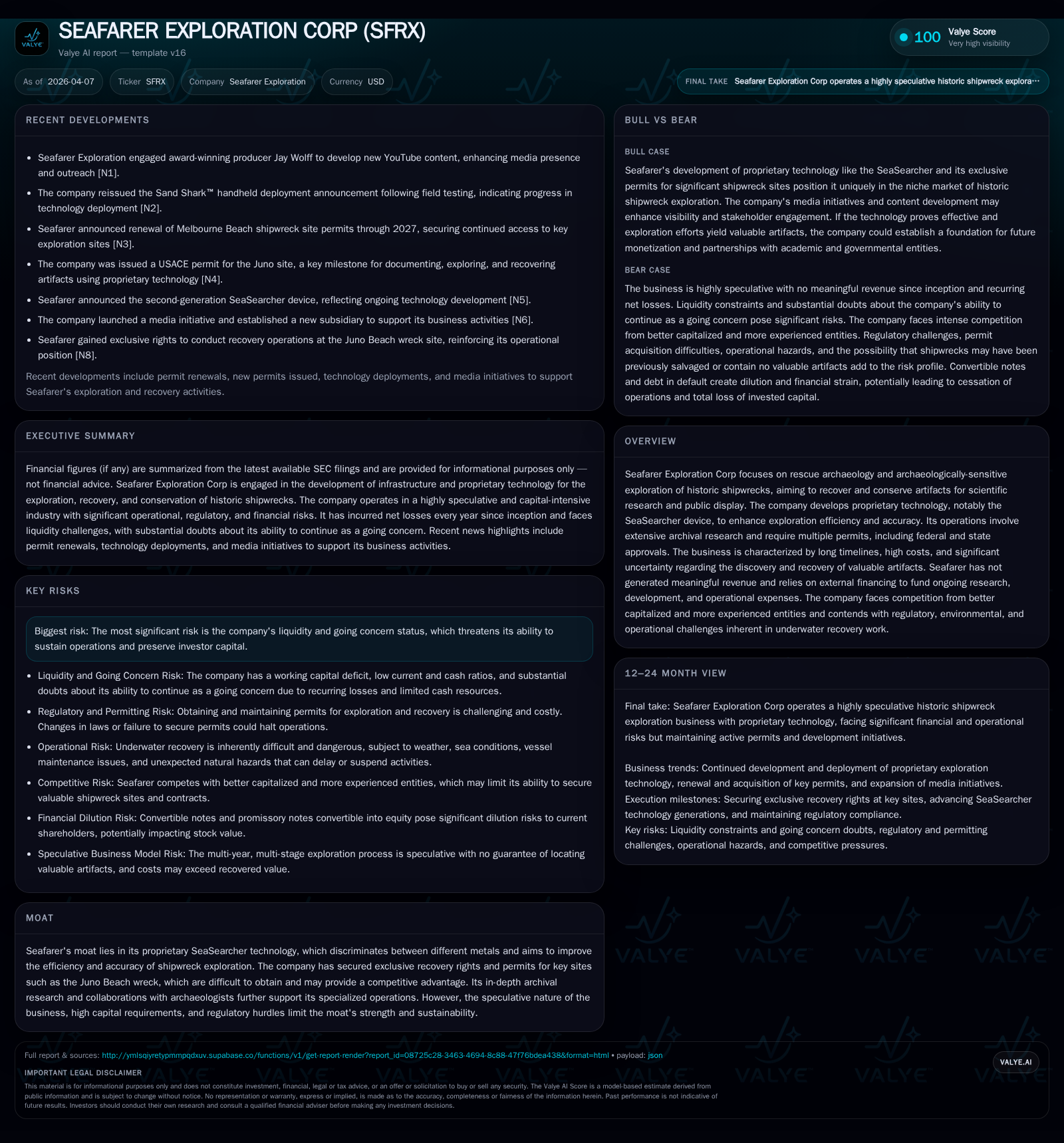
Seafarer Exploration Corp focuses on developing proprietary technology to explore and recover artifacts from historic shipwrecks. Its SeaSearcher device aims to improve exploration efficiency, yet progress remains costly and uncertain. The company operates with minimal revenue, significant operating losses, and a precarious liquidity position marked by defaulted convertible notes and loans. Future viability depends on securing financing, validating technology, obtaining permits, and successfully commercializing artifact recoveries.
Company Overview
Seafarer Exploration Corp, incorporated in 2003 originally as Organetix, Inc., pursues rescue archaeology focused on the exploration, recovery, conservation, and monetization of artifacts from historic shipwrecks. The company’s core technological asset is the proprietary SeaSearcher device designed to discriminate among different metals such as gold and silver underwater. This technology aims to enhance exploration accuracy while minimizing environmental impact around sensitive sites like Juno Beach [S1].
Historical Financial Performance
Seafarer's revenues have remained minimal and relatively flat, reported at $16,303 for both fiscal years 2024 and 2025 after a decrease from $19,235 in 2023. Operating losses have been substantial but showed some improvement from approximately -$3.34 million in 2024 to -$2.55 million in 2025. Correspondingly, net losses narrowed from about -$3.9 million to -$2.74 million year-over-year. Operating cash flows remain negative due to ongoing expenditures related to archaeological projects and continued development of the SeaSearcher technology [F1]. Capital expenditures increased significantly in line with investments in technology refinement.
Historical performance (annual)
| FY | Rev ($) | Net ($mm) | CFO ($mm) | OpInc ($mm) | Rev YoY | Net YoY |
|---|---|---|---|---|---|---|
| 2025 | 16303 | -3 | -2 | -3 | 0.0% | +29.6% |
| 2024 | 16303 | -4 | -3 | -3 | -15.2% | -22.5% |
| 2023 | 19235 | -3 | -2 | -3 | +48.3% | -21.6% |
| 2022 | 12972 | -3 | -2 | -2 |
Source: SEC companyfacts cache [F1].
Capital returns and efficiency (annual)
| FY | Buybacks ($) | FCF ($mm) | ROE% |
|---|---|---|---|
| 2025 | -2 | 80.0 | |
| 2024 | 2400 | -3 | 138.6 |
| 2023 | 2400 | -2 | 193.8 |
| 2022 | -2 | 174.9 |
Source: SEC companyfacts cache [F1].
Figures sourced from latest financial disclosures [F1].
Technology Moat and Operational Model
Seafarer's SeaSearcher device provides a technological advantage by accurately differentiating metal types underwater—addressing challenges faced by conventional magnetometers prone to false positives. Development efforts have encountered environmental difficulties unique to exploration sites such as Juno Beach sediments [S1]. The company's operational model integrates detailed archival research across global repositories informing site selection and planning. Exclusive salvage rights at strategic locations offer potential competitive advantages but also introduce regulatory hurdles that can delay operations.
Industry Challenges and Regulatory Environment
Historic shipwreck recovery is a speculative venture characterized by multi-year or even multi-decade exploration timelines before tangible results may materialize. Extensive permitting requirements including environmental approvals add complexity and cost [S1]. Competition includes better-funded entities capable of absorbing exploration expenses for potential high-value discoveries or public exhibitions.
Liquidity Position and Capital Structure Risks
Seafarer faces critical liquidity constraints with cash reserves around $24 thousand as of late 2025 and a working capital deficit exceeding $3 million [S4][F1]. The current ratio near 0.02 highlights severe short-term solvency pressure [F1]. The capital structure includes numerous convertible notes payable—many in default—along with notes payable also in default totaling millions of dollars. Related party debts increase complexity regarding governance and refinancing options [S5][S8][S9].
These defaults expose the company to litigation risk or foreclosure actions on secured assets that could force cessation of operations resulting in total loss of invested capital [S3][S4]. Convertible debt conversions at prices generally below market levels pose substantial dilution risk for existing shareholders [S3]. Management acknowledges an urgent need for further capital through equity or debt issuance though timing remains uncertain [S4][S5].
Returns and Capital Allocation History
There have been no dividend distributions or meaningful share repurchases during the historical period aside from nominal buybacks ($2.4k) prior years [F1]. Negative operating cash flows combined with capital spending concentrated on research and development reflect prioritization of technology maturation over near-term financial returns.
Growth Outlook: Opportunities Versus Constraints
Future growth depends heavily on successfully commercializing recovered artifacts through scientific partnerships or licensing arrangements—a goal not yet realized given limited revenues. Further improvements in SeaSearcher performance could accelerate site identification reducing operational costs.
Expansion into salvage permits beyond restrictive state waters could facilitate faster permitting processes although progress remains contingent upon securing additional financing under challenging credit conditions amid macroeconomic uncertainties .
The venture remains highly speculative with elevated failure risk due to extended exploration periods without artifact recovery or persistent technical challenges.
Milestones To Monitor
- Completion and field validation of next-generation SeaSearcher prototypes improving detection accuracy.
- Securing new exclusive salvage permits beyond current sites with fewer regulatory barriers.
- Initiation of commercial expeditions yielding recoveries suitable for scientific or commercial use.
- Progress in refinancing or restructuring defaulted convertible notes and loans mitigating insolvency threats.
- Development of partnerships that generate revenue through referral agreements or service contracts leveraging proprietary technology.
Summary
Seafarer Exploration Corp operates at the intersection of advanced technology development and historic archaeology within a niche but highly speculative sector. While its proprietary SeaSearcher sensor offers potential operational advantages over traditional methods, ongoing financial distress marked by large losses and tight liquidity casts doubt on near-term sustainability absent significant capital infusion.
The company exemplifies the inherent risks of long-duration exploratory ventures subject to environmental uncertainties and regulatory complexities. Continued close observation of liquidity developments alongside any technological breakthroughs or permit acquisitions will be critical indicators of future viability.
This analysis is based exclusively on publicly available SEC filings and verified financial data [F1] without offering investment advice.
Disclaimer: This is research-only, informational analysis and not investment advice. It may include AI-generated interpretation and general industry context. Always verify important details using primary sources.

Comments