
Cambium Networks Faces Delisting and Negative Equity Amid Rising Losses and Supply Chain Risks
Sustained operating losses, credit covenant breaches, and distributor concentration challenge Cambium's financial stability and constrain strategic options in wireless broadband markets.
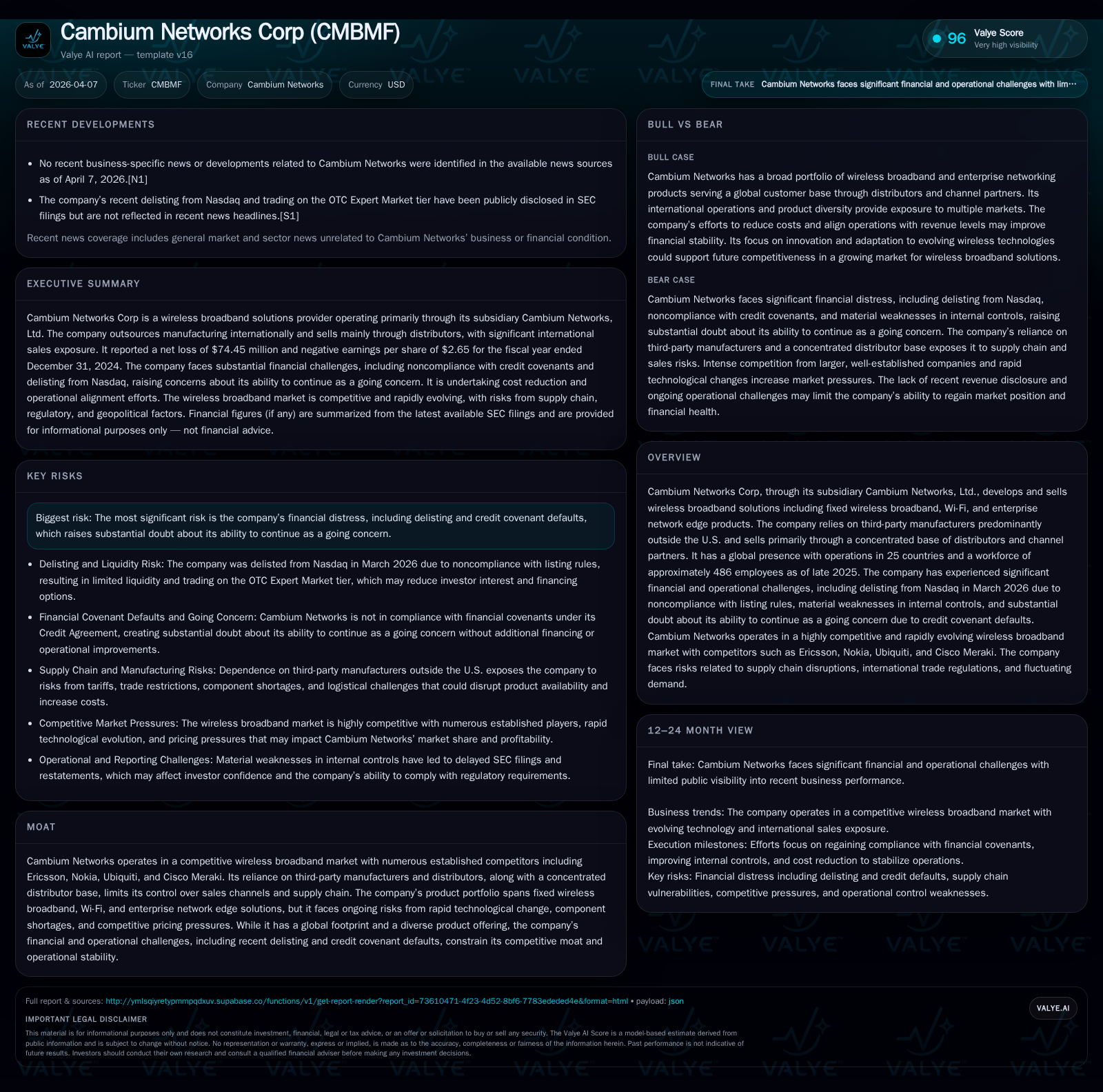
Cambium Networks Corp has experienced a marked financial decline through escalating operating losses and negative cash flows over the past four years, culminating in a Nasdaq delisting due to covenant breaches under its credit agreement. Despite a diverse international footprint and product portfolio in wireless broadband, the company contends with concentration risks in distributors, reliance on offshore manufacturing amid global logistics challenges, and intense competition from established industry players. Liquidity constraints limit capital allocation options and strategic initiatives. Recovery prospects depend on successful covenant remediation, potential refinancing, operational cost management, and stabilization of supply chain and channel dynamics.
Financial Performance Trends Reflect Deepening Challenges
Cambium Networks' financial results over the four fiscal years ending 2024 illustrate a pronounced deterioration in profitability and liquidity metrics [F1]. Operating income plummeted from a positive $36.4 million in FY2021 to an operating loss of $70.4 million by FY2024, representing a continued downward trajectory (-15.7% year-over-year decline between FY2023 and FY2024).
Net income followed suit with a swing from $37.4 million profit in FY2021 to a net loss of $74.5 million in FY2024 [F1], signifying persistent challenges that extend beyond core operations.
Operating cash flow shifted sharply negative beginning FY2022; it was -$15.0 million in FY2024 despite increased capital expenditures rising nearly 40% year-over-year to approximately $6.4 million [F1]. This resulted in a substantial free cash flow deficit exceeding $21 million.
Equity capital eroded significantly from $112 million at the end of FY2021 to negative $3.24 million by the close of FY2024 [F1], underscoring accumulated losses surpassing invested shareholder funds.
Historical performance (annual)
| FY | Net ($mm) | CFO ($mm) | OpInc ($mm) | Capex ($mm) | Net YoY |
|---|---|---|---|---|---|
| 2024 | -74 | -15 | -70 | 6 | +3.8% |
| 2023 | -77 | -17 | -61 | 5 | -483.3% |
| 2022 | 20 | -3 | 20 | 5 | -46.0% |
| 2021 | 37 | 30 | 36 | 6 |
Source: SEC companyfacts cache [F1].
Capital returns and efficiency (annual)
| FY | FCF ($mm) | ROE% |
|---|---|---|
| 2024 | -21 | 2300.0 |
| 2023 | -22 | -95.7 |
| 2022 | -8 | 13.9 |
| 2021 | 24 | 33.4 |
Source: SEC companyfacts cache [F1].
Return on equity is approximated for periods with positive equity only.
International Operations during Supply Chain and Channel Concentration Risks
Cambium derives an increasing portion of revenue internationally—approximately half of total revenues originated outside the U.S. in 2024 compared to 40% the prior year [S5]. The company operates across roughly 25 countries supported by distribution centers located strategically in the United States, Netherlands and Vietnam [S6,S10].
However, reliance on third-party manufacturers concentrated primarily in Southeast Asia exposes Cambium to risks related to global logistics challenges including container shortages and port delays that could impact timely delivery and customer satisfaction [S6].
Channel sales are concentrated: three largest distributors accounted for roughly one-third of revenues both in 2023 (37%) and again at about 34% in 2024 [S9]. These partners often carry competing products as well as Cambium’s offerings [S9,S23], which may affect revenue stability.
Loss or weakening of relationships with major distributors or their key customers could produce abrupt revenue declines or working capital impacts.
Liquidity Constraints Heighten Going Concern Uncertainty
The company remains out of compliance with multiple financial covenants under its Credit Agreement secured with Bank of America [S4,S7]. This noncompliance exposes Cambium to risk of debt acceleration requiring immediate repayment; failure to meet such obligations could lead to foreclosure on substantially all assets.
While discussions continue with the lender regarding covenant waivers or restructuring [N1,S7], restrictive covenants limit Cambium's ability to incur additional debt or engage freely in asset sales without lender consent.
Cost control measures including deferral of expenditures have been implemented but may constrain research and development investments critical for competitive positioning [S4,S18].
Without resolution before maturity deadlines later this year (November 2026), there is heightened uncertainty regarding Cambium’s ability to continue as a going concern.
Competitive Landscape Demands Continuous Innovation Amid Resource Constraints
Cambium operates within highly competitive wireless broadband markets including fixed wireless access (FWA), enterprise Wi-Fi solutions and edge network infrastructure [S17,S28]. Its competitors range from large incumbents like Ericsson and Nokia serving licensed spectrum markets to cost-focused providers such as Ubiquiti targeting unlicensed bands.
Rapid technological evolution requires ongoing innovation including developments around network management platforms like cnMaestro X and millimeter-wave cnWave products targeting dense urban deployments [S28]. Price competition from both lower-cost entrants and bundled offerings by incumbents places pressure on margins.
Regulatory certification requirements vary internationally adding complexity and potential delays impacting time-to-market especially outside the U.S.[S5,S27].
Outlook: Key Milestones to Monitor
No formal guidance or forecasts have been publicly disclosed regarding recovery timelines or milestones [N1,S4]. Management focuses on aligning cost structures with revenue realities while negotiating with lenders for covenant relief or alternative financing arrangements.
Investors should monitor:
- Progress on credit covenant waiver negotiations or refinancing outcomes;
- Changes in distributor concentration or channel diversification efforts impacting revenue visibility;
- Improvements or continued disruptions within supply chain logistics affecting delivery reliability;
- Regulatory certifications enabling broader international market access;
- Updates on corporate governance remediation addressing internal control weaknesses noted by regulators [S1];
- Developments related to intellectual property claims given ongoing industry litigation risks [S12,S20];
- Broader macroeconomic factors influencing demand for telecom infrastructure investments globally.
These factors will be pivotal indicators shaping Cambium’s ability to stabilize operations amidst ongoing market pressures.
Capital Allocation Under Financial Pressure
Despite severe cash flow constraints reflected by negative operating cash flows exceeding capital expenditures resulting in persistent free cash flow deficits above $21 million annually [F1], Cambium increased capex nearly +40% YoY between FY2023 and FY2024.
No dividends or share repurchases have been declared recently consistent with liquidity preservation priorities amid covenant defaults [S4,F1].
This pattern illustrates tension between necessary investment for product competitiveness against survival-driven cost containment measures impacting overall financial health.
This analysis is based exclusively on available SEC filings ([F1], [S#]) and recent news ([N#]) without speculative forecasts or recommendations.
Disclaimer: This is research-only, informational analysis and not investment advice. It may include AI-generated interpretation and general industry context. Always verify important details using primary sources.

Comments