
Cell Source, Inc.’s Developmental Trajectory Encumbered by Clinical and Financial Constraints
Early-stage immunotherapy innovator Cell Source strives to advance allogeneic transplant technology amid regulatory and capital challenges.
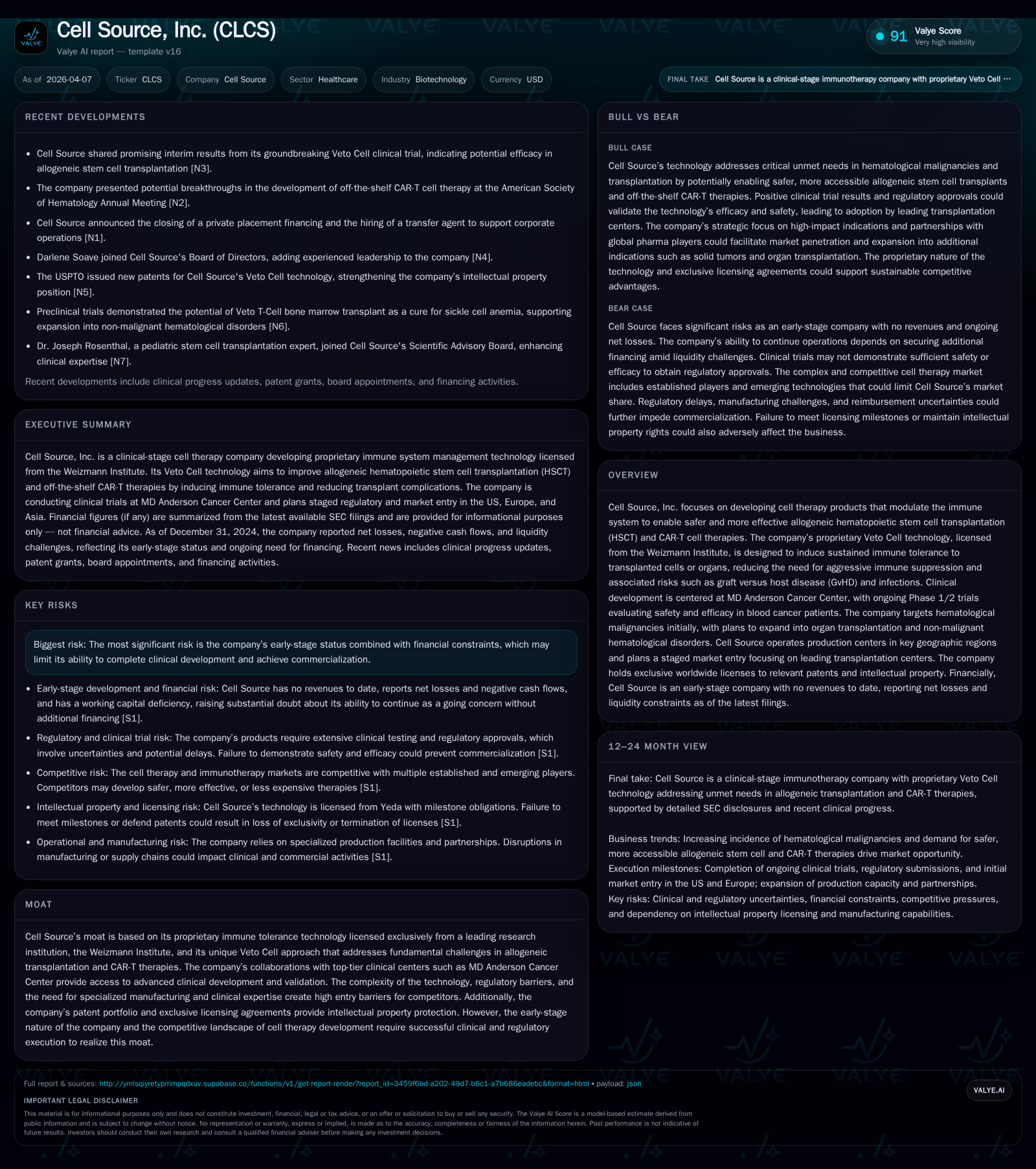
Cell Source, Inc. leverages proprietary Veto Cell technology licensed from the Weizmann Institute to target immune tolerance in hematopoietic stem cell transplantation and CAR-T therapy. The company’s clinical programs, centered at MD Anderson, remain early stage with Phase 1/2 trials ongoing. Financial data reveal persistent operating losses and a challenging liquidity position, underscoring significant execution risk. Future growth depends on successful regulatory approvals, trial outcomes, and expanding indications beyond blood cancers. Capital constraints and regulatory complexity represent material barriers to commercialization.
Company Background and Proprietary Technology
Cell Source, Inc. is a cell therapy company pioneering immune modulation technologies to enhance allogeneic hematopoietic stem cell transplantation (HSCT) and CAR-T therapies. Central to its scientific foundation is the Veto Cell technology licensed exclusively from Yeda Research & Development Company Limited, the commercial entity of the Weizmann Institute of Science. This modality is designed to induce prolonged immune tolerance (chimerism) by enabling recipients’ immune systems to accept transplanted cells while minimizing immunosuppressive side effects such as graft versus host disease (GvHD) and infection vulnerabilities.
The company focuses initially on blood cancer indications—leukemia, lymphoma, multiple myeloma—where HSCT remains a curative option but faces donor matching limitations and complications arising from immune rejection [S1][S4]. By facilitating haploidentical transplantation with reduced conditioning regimens, Cell Source aims to improve patient outcomes and accessibility.
Past Growth and Historical Financial Performance
Cell Source operates in a nascent phase without product revenues; its growth thus far has been driven by research collaborations, particularly with MD Anderson Cancer Center where clinical activities are conducted.
Financially, the company has experienced consistent operating losses through recent years reflecting ongoing R&D expenditures necessary for clinical development:
Historical performance (annual)
| FY | Net ($mm) | CFO ($mm) | OpInc ($mm) | Net YoY |
|---|---|---|---|---|
| 2024 | -5 | -3 | -4 | +15.2% |
| 2023 | -5 | -2 | -4 | -3.0% |
| 2022 | -5 | -3 | -4 | +5.6% |
| 2021 | -5 | -3 | -4 |
Source: SEC companyfacts cache [F1].
Capital returns and efficiency (annual)
| FY | ROE% |
|---|---|
| 2024 | 24.3 |
| 2023 | 34.1 |
| 2022 | 40.9 |
| 2021 | 55.7 |
Source: SEC companyfacts cache [F1].
These figures illustrate a persistent net loss profile typical of early-stage biopharma companies investing heavily in clinical development without product revenues [F1]. Operating cash flows remain negative indicating continuing cash burn that outpaces capital formation.
Future Growth Prospects and Commercial Strategy
Growth upside hinges critically on advancing clinical programs successfully through regulatory pathways. The proprietary Veto Cell technology represents a distinctive approach within allogeneic transplant immunology and potentially broader applications including organ transplantation and non-malignant diseases like sickle cell anemia or beta thalassemia.
Cell Source’s strategic roadmap includes staged geographic entry commencing in North America and Western Europe with concurrent attention to China. The initial focus remains on late-stage B-cell malignancies with plans for subsequent expansion into solid tumors via VETO CAR-T constructs and custom Veto Cell applications [S4][S24].
The company intends to establish manufacturing hubs proximate to major transplant centers to ensure quality control while maintaining production scalability across these territories [S15].
Success here depends on achieving regulatory clearances—which are inherently uncertain—as well as demonstrating compelling safety/efficacy profiles relative to competing therapies [S6][S13]. Interactions with regulatory bodies like the FDA underscore the variability in approval timing (12–18 months post application) and risk of delay or denial due to insufficient trial data or manufacturing compliance issues.
Regulatory Environment and Clinical Trial Status
As of the latest disclosures dated April 2026 filings:
- Phase 1/2 trials for Veto Cell products are ongoing at MD Anderson Cancer Center focusing on safety and preliminary efficacy endpoints in hematologic cancer patients.
- An independent compassionate-use trial in Italy employs similar protocols though Cell Source is not the official sponsor [S21].
- No products have yet achieved regulatory commercialization approval globally.
Given the novelty of technology platforms in cell therapy involving genetic engineering and immuno-oncology mechanisms (e.g., CAR-T combined with immune tolerance), regulatory scrutiny remains extensive across all phases including IND submissions through post-market surveillance obligations [S26][S10].
Returns Profile and Capital Allocation
Operating losses have persisted consistently without positive free cash flow generation; based on latest year metrics:
- Approximate Return on Equity (ROE) is positive circa 24%, which reflects an accounting artifact given deep negative equity paired with losses—it does not indicate profitable operations but rather accumulated deficits exceeding shareholder equity [F1].
- Capital expenditures have been minimal historically; no significant asset investments reported indicative of R&D-heavy cost structures rather than fixed asset accumulation.
- Cash reserves are reported very low ($21k as of mid-2023), signaling highly constrained liquidity conditions [F1][S28].
- No dividend payments or share repurchase activity exist; all financing has come from equity/debt issuances reflecting the developmental nature of the enterprise.
This financial profile highlights pressing capital needs; failure to secure additional funding will materially imperil continuation of current clinical programs.
Risks Summary
Principal risks detailed by management include:
- Regulatory uncertainty surrounding novel cell therapies requiring extensive testing across multiple jurisdictions.
- Potential delay or failure in clinical development that could stall or preclude product approvals.
- Intense competition from other cell therapy innovators backed by large pharma entities who may develop alternative platforms faster or more cost-effectively.
- Intellectual property license dependence; loss or dispute regarding exclusive licenses granted by Yeda Research & Development could disable core technological access.
- Severe cash flow constraints raising questions about sustaining operations absent successful capital raises imminently [S6][S8][S20][S28].
Analysis: Path Forward Observations
Cell Source stands at a classic inflection point common among emerging biotechnology firms specializing in complex ex vivo cell engineering treatments. Its Veto Cell approach addresses a well-recognized unmet medical need: enabling safer allogeneic HSCT by reducing requirement for broad immunosuppression that leads to infections and GvHD morbidity.
However:
- Early-phase data must evolve convincingly into larger pivotal trials meeting stringent regulatory endpoints for safety and efficacy.
- Manufacturing scale-up must accompany demonstration of quality control across global production centers ensuring reproducible product performance.
- Market acceptance will require establishing trial centers as leaders in adoption who can influence referral networks broadly across oncology transplant spheres.
- The company’s precarious liquidity position necessitates either timely capital infusion or strategic partnerships/licensing that can underwrite expensive late-stage trials and commercialization infrastructure.
It remains essential for stakeholders to monitor upcoming clinical milestones carefully alongside any announcements related to fundraising or alliance formation which will materially define the company’s viability beyond this inception phase.
This analysis is based solely on information provided by official company disclosures including SEC filings up to April 2026. It does not constitute investment advice.
Disclaimer: This is research-only, informational analysis and not investment advice. It may include AI-generated interpretation and general industry context. Always verify important details using primary sources.

Comments