
Jaguar Health Faces Persistent Losses and Nasdaq Listing Risks Amid Botanical Drug Commercialization
The company’s reliance on licensed botanical drug products and a single commercial partner underpins financial pressures and operational uncertainties.
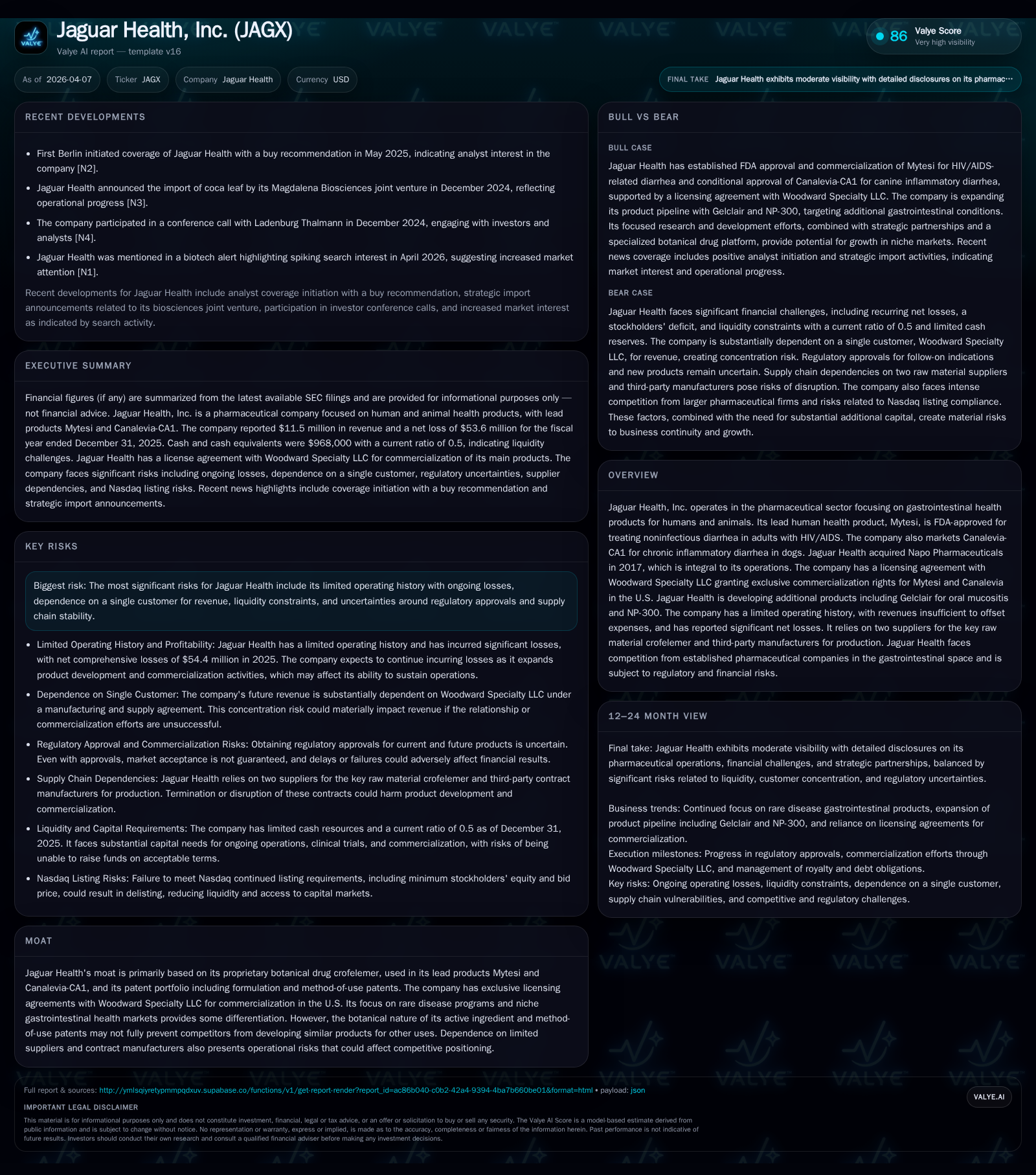
Jaguar Health, Inc. generates revenues primarily through royalty income under an exclusive license with Woodward Specialty LLC for its lead botanical-derived gastrointestinal drugs Mytesi and Canalevia-CA1. The company continues to report significant net losses and negative operating cash flows, with limited liquidity and a weak current ratio of 0.5 at the end of 2025. Growth prospects depend on regulatory approvals for expanded indications, successful commercialization efforts by its licensee, and pipeline development including Gelclair. Jaguar faces concentrated supply chain risks, intellectual property challenges limited to method-of-use patents, and regulatory as well as Nasdaq listing compliance risks due to sustained share price declines and multiple reverse stock splits. Capital requirements remain substantial given ongoing losses and negative free cash flow.
Historical Financial Performance
Jaguar Health's revenue has remained relatively stable but without growth momentum in recent years. Total revenues were approximately $11.5 million in fiscal year 2025, slightly declining from $11.7 million in 2024 and $11.9 million in 2022 [F1]. Earlier growth from $9.4 million in 2020 plateaued as the company faced challenges scaling sales.
Operating income reflects sustained substantial losses worsening from negative $30.8 million in 2024 to negative $45.9 million in 2025 [F1]. Net losses similarly expanded sharply from a modest loss of about $39,000 in 2024 to over $53.6 million in 2025 [F1], underscoring continued financial strain.
Operating cash flows remained deeply negative at approximately minus $23.7 million for the year ended December 31, 2025 [F1]. Capital expenditures were minimal relative to operational outflows, highlighting focus on research and marketing activities rather than fixed asset investments [F1].
Liquidity metrics reveal tight conditions with cash and equivalents under $1 million at year-end 2025 alongside current liabilities exceeding current assets by more than twofold, resulting in a current ratio near 0.5 [F1]. This signals potential near-term working capital challenges.
Historical performance (annual)
| FY | Rev ($mm) | Net ($mm) | CFO ($mm) | OpInc ($mm) | Rev YoY | Net YoY |
|---|---|---|---|---|---|---|
| 2025 | 12 | -54 | -24 | -46 | -1.5% | -136396.8% |
| 2024 | 12 | 0 | -29 | -31 | +99.9% | |
| 2023 | -41 | -33 | -34 | |||
| 2022 | 12 | -33 | -34 |
Source: SEC companyfacts cache [F1].
Capital returns and efficiency (annual)
| FY | FCF ($mm) |
|---|---|
| 2025 | -24 |
| 2024 | -29 |
| 2023 | -33 |
| 2022 | -33 |
Source: SEC companyfacts cache [F1].
Business Model Overview
Jaguar Health focuses on botanical drug innovation centered on crofelemer extracted from the Croton lechleri tree. Its FDA-approved human prescription drug Mytesi treats noninfectious diarrhea associated with HIV/AIDS while Canalevia-CA1 targets chronic inflammatory diarrhea in dogs with conditional FDA approval.
The acquisition of Napo Pharmaceuticals consolidated key patents protecting formulation and method-of-use exclusivities essential for these products [S1][S21]. The company has licensed exclusive US commercial rights for Mytesi and Canalevia-CA1 to Woodward Specialty LLC under a royalty-bearing manufacturing and supply agreement effective January 12, 2026 [S3][S27]. This arrangement centralizes revenue generation but creates dependency on a single licensee.
Patent protection primarily arises from method-of-use filings that do not prevent competitors from developing botanically derived alternatives for distinct indications [S22]. Additionally, Jaguar relies heavily on two suppliers for crofelemer raw material extraction plus third-party contract manufacturers for production [S21].
Other pipeline assets such as Gelclair (for oral mucositis) and NP-300 represent diversification efforts but remain early-stage with uncertain regulatory or commercial outcomes [S21]. Competitive pressure includes traditional small-molecule drugs as well as emerging biologics targeting gastrointestinal conditions.
Risks: Regulatory Challenges and Nasdaq Compliance
Jaguar Health continues to operate at a loss without sustained profitability or positive cash flow beyond royalties received via Woodward licensing [S21]. The company's listing on Nasdaq faces jeopardy due to persistent sub-$1 share prices compounded by multiple reverse stock splits aggregating to a one-for-250 share consolidation over two years [S25][S29]. This situation excludes Jaguar from relief periods under revised Nasdaq rules increasing delisting risk.
Regulatory hurdles include obtaining approvals for expanded indications or new claims for Mytesi or Canalevia-CA1 as well as marketing licenses outside current narrow approvals [S18]. Failure could materially impact future revenues.
Reimbursement by private insurers or government payers remains uncertain; limitations or higher patient co-pay requirements could reduce access to specialty drugs like Mytesi or Gelclair impacting adoption rates [S13]. Expansion into emerging markets introduces additional legal compliance complexities including adherence to anti-corruption laws such as the US Foreign Corrupt Practices Act (FCPA) [S23].
Post-market pharmacovigilance demands impose regulatory reporting obligations; failure to comply may result in sanctions including fines or product recalls [S20][S24]. Intellectual property litigation risk is present given limited patent scope potentially inviting challenges or infringement claims [S16][S19]. Increasing Environmental Social Governance (ESG) expectations also pose reputational risks if unmet [S8].
Growth Outlook
Growth depends largely on Woodward's ability to commercialize Mytesi and Canalevia-CA1 effectively alongside securing FDA approvals for additional indications supported by existing method-of-use patents [N1][S27]. Success of novel candidates like Gelclair depends on achieving adequate payer reimbursement amidst competitive landscapes.
Jaguar anticipates substantial capital requirements given ongoing negative free cash flow approximating minus $23.7 million annually after minimal capex spend [F1][S27]. While strategic partnerships beyond Woodward may be explored to support product development or geographic expansion none have been disclosed.
Investors should monitor regulatory filings related to Napo’s follow-on applications and updates from licensee commercialization efforts as key milestones.
Capital Allocation and Financial Returns
The company exhibits no positive earnings generation; approximate return on equity calculated as net income divided by equity was about negative 311% at the end of fiscal year 2025 reflecting significant capital erosion [F1]. Jaguar does not pay dividends nor has meaningful share repurchase activity recently beyond immaterial amounts reported several years prior [F1].
Negative operating cash flows highlight ongoing high spending relative to revenue inflows stemming largely from royalties which are insufficient to cover expenses leading to liquidity constraints with less than $1 million cash on hand at the latest reporting period [F1][S27].
Management must balance dilutive financing against leveraging collaborations that can enable pipeline progress or market expansion without substantial capital outlay.
Conclusion
Jaguar Health remains an early-stage life sciences company focused on botanical drug innovation commercialized through a sole licensee amid chronic unprofitability compounded by Nasdaq listing compliance risks. Its path toward financial stability relies heavily on regulatory success expanding product indications combined with effective commercialization execution by Woodward Specialty LLC.
Supply chain concentration alongside limited intellectual property barriers presents competitive challenges while capital scarcity constrains aggressive growth initiatives.
Stakeholders should closely track upcoming regulatory milestones affecting follow-on approvals plus progress on pipeline development against ongoing exchange listing compliance status.
This analysis is based on SEC filings through April 7, 2026 [S#], company facts data [F1], and relevant news sources [N#].
Disclaimer: This is research-only, informational analysis and not investment advice. It may include AI-generated interpretation and general industry context. Always verify important details using primary sources.

Comments