
Elvictor Group’s Strategic Expansion Amid Cash Flow Improvements and Margin Pressures
Elvictor Group is evolving its maritime crew management business through acquisitions and vessel ownership plans, navigating liquidity constraints accompanied by modest revenue growth and operational challenges.
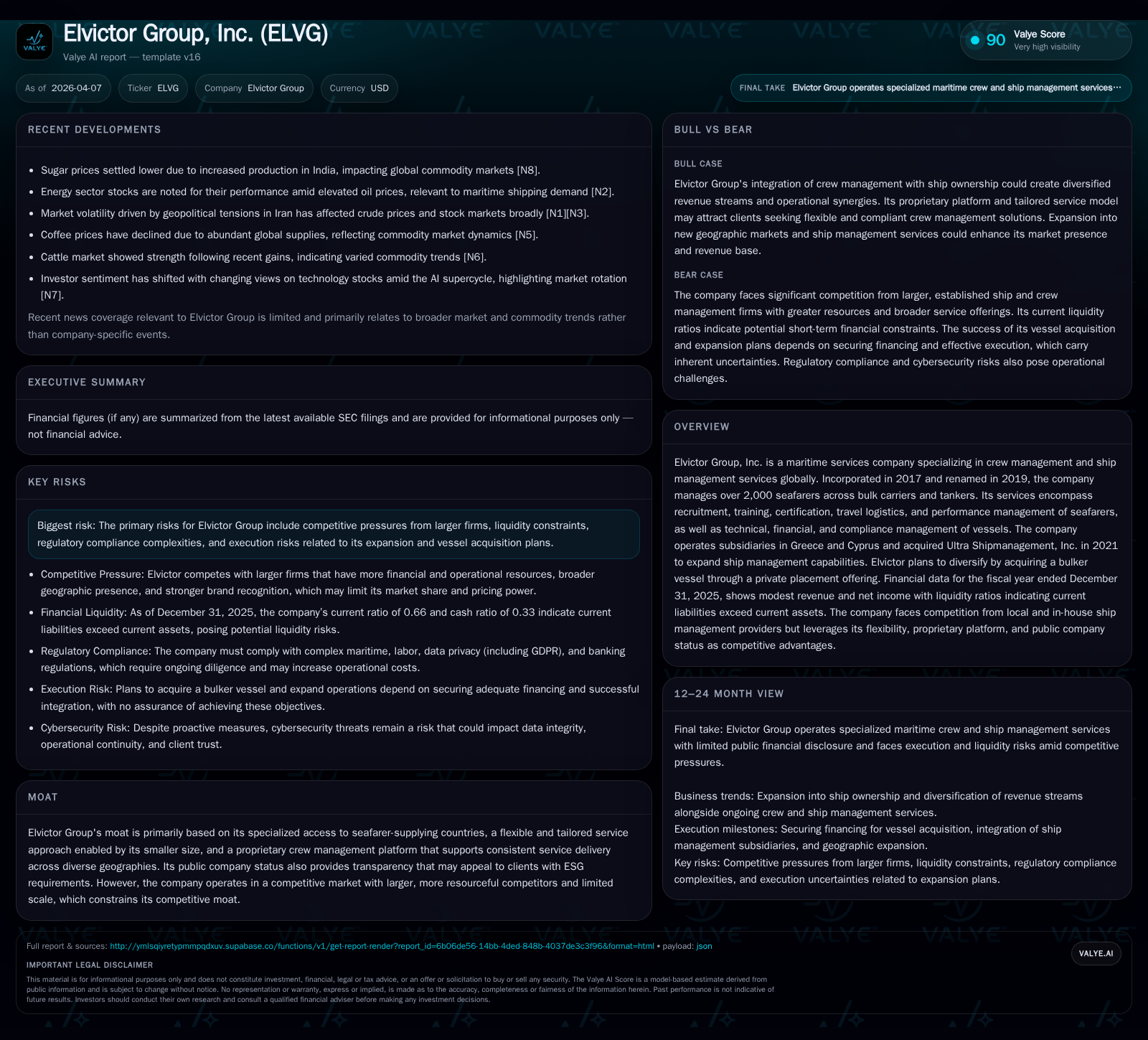
Elvictor Group, Inc., a relatively young maritime services firm specializing in crew and ship management, has achieved modest top-line stability near $2.4 million annually while fluctuating between operating losses and gains. The company’s strategic acquisition of Ultra Shipmanagement in 2021 expanded its ship management capabilities, simultaneously exposing margin pressures typical for a smaller operator in a competitive maritime market. In 2025, Elvictor reported a positive net income turnaround alongside improved operating cash flow, yet its balance sheet signals tight liquidity with current liabilities outpacing current assets. Future growth hinges on plans to acquire a bulk carrier vessel via private placement and continuing geographic expansion through subsidiaries, balanced against risks from larger competitors, regulatory compliance complexity, and funding constraints.
Company Evolution and Market Positioning in Maritime Services
Elvictor Group, Inc. traces its origins to November 2017 when it was incorporated as Thenablers, Inc., initially focusing on international business development services unrelated to maritime operations [S1]. However, a fundamental strategic transition occurred by late 2019 when the company's leadership changed dramatically — appointing Konstantinos Galanakis as CEO and Stavros Galanakis as Chairman — refocusing the business toward global maritime crew management and ship management services [S1]. Concurrently, the company rebranded as Elvictor Group, Inc., aligning its identity with the maritime sector.
The company’s core business revolves around providing comprehensive crew services for vessels worldwide. Its offerings include recruitment of seafarers primarily for bulk carriers and tankers; extensive training programs with certification support aligned with international maritime standards; travel coordination logistics for crew mobilization; as well as performance monitoring . This integrated approach positions Elvictor within the complex ecosystem of global shipping where labor quality directly influences vessel operation efficiency.
Elvictor maintains subsidiaries headquartered in Greece and Cyprus—both strategically important hubs for Mediterranean shipping—with the aim to leverage regional expertise while expanding operational reach . A transformative milestone arrived in 2021 when Elvictor acquired Ultra Shipmanagement, Inc., significantly bolstering its ship management portfolio . This acquisition expanded not only fleet oversight capacity but also technical and financial management services provided under one umbrella.
Unique among many smaller players is Elvictor's proprietary crew management platform that harmonizes service delivery across multiple geographies. This proprietary technology likely aids consistent compliance adherence amidst diverse regulatory regimes—a critical factor given seafarer certifications' varying international standards . Being publicly listed adds transparency which may appeal to clients increasingly scrutinizing ESG factors tied to workforce welfare.
Review of Historical Financial Performance: Revenue Stability Against Income Volatility
Between fiscal years 2022 and 2025 Elvictor's revenues have shown remarkable stability despite challenging operational circumstances (see Table 1). Revenues hovered near the $2.4 million mark during this period: $2.48M (FY22), $2.36M (FY23), $2.42M (FY24), and $2.43M (FY25), reflecting only modest growth of approximately +0.3% year-over-year from FY24 to FY25 [F1].
Operating income reveals sharper volatility reflective of scale limitations and cost structure inflexibility characteristic of emerging maritime service firms. After posting losses of -$324K in FY22 and -$275K in FY23, Elvictor achieved an operating profit of $178K in FY24 before reverting to a loss of -$210K in FY25 [F1]. This swing corresponds roughly to a -218% decline year-over-year from FY24 to FY25 operating income.
On the bottom line, net income turned positive again in FY25 at approximately $8.6K —a +125% improvement over the prior year's net loss (-$35K) [F1]. Although marginally profitable by dollar terms given its niche scale size this achievement signals an inflection point toward improved cost containment or operational leverage.
Historical performance (annual)
| FY | Rev ($mm) | Net ($) | CFO ($) | OpInc ($) | Rev YoY | Net YoY |
|---|---|---|---|---|---|---|
| 2025 | 2 | 8585 | 418351 | -209737 | +0.3% | +124.9% |
| 2024 | 2 | -34541 | -583519 | 177519 | +2.5% | -3.1% |
| 2023 | 2 | -33503 | 206181 | -274818 | -4.6% | +86.0% |
| 2022 | 2 | -238858 | 210365 | -324389 |
Source: SEC companyfacts cache [F1].
Capital returns and efficiency (annual)
| FY | FCF ($) | ROE% |
|---|---|---|
| 2025 | 407157 | 2.4 |
| 2024 | -590370 | -6.5 |
| 2023 | 200743 | -14.6 |
| 2022 | 195454 | -52.8 |
Source: SEC companyfacts cache [F1].
Table note: Operating income volatility reflects margin pressures inherent in small-scale maritime service operations compounded by integration costs post-acquisition.
Key Drivers Behind Past Performance: Service Model and Acquisition Impact
The acquisition of Ultra Shipmanagement marked a pivotal catalyst shaping Elvictor's recent performance trajectory . Integrated progressively during late 2020 through end-2021 according to SEC disclosures [S1], Ultra Shipmanagement contributed additional ship management contracts enhancing scale but also introduced complexities including increased overhead costs.
Elvictor's service model distinguishes itself by leveraging specialized access to seafarer-supplying countries combined with a nimble organizational structure characteristic of smaller companies . While larger competitors often operate rigid standardized processes serving mass-market clients, Elvictor emphasizes tailored service delivery optimizing client-specific needs—enabled partly through its proprietary crew management platform.
However, limited scale caps bargaining power on cost inputs such as recruitment fees or training infrastructure investments thereby compressing margins. The integration burden from mergers like Ultra Shipmanagement adds short-term operational costs before long-term synergies materialize typically over multiple years for maritime services firms.
Consequently, profitability exhibits significant oscillations reflective both of external market conditions (e.g., crewing supply-demand cycles) and internal execution phases tied to acquisitions.
Future Growth Prospects: Vessel Acquisition Plans and Geographic Expansion
A defining element shaping Elvictor's evolution involves its aspiration for asset ownership diversification beyond pure crew management . The company plans to acquire a bulker vessel through a private placement offering—a move that would mark entry into the capital-intensive domain of owning operating vessels which present fundamentally different risk-return profiles compared with service contracts alone.
Such vessel acquisition could broaden revenue streams through freight charter opportunities or tripartite commercial engagements linking crew provision directly with shipping operations under Elvictor’s oversight . Meanwhile geographic expansion ambitions remain anchored by sustaining subsidiary operations primarily within Greece and Cyprus—regions offering established crewing pools plus proximity to Mediterranean shipping lanes .
Technological innovation is another prospective growth lever highlighted by ongoing internal enhancements such as developing a proprietary cloud-based information system supporting cybersecurity resilience and operational scalability outlined in recent SEC disclosure [S2]. These IT investments may bolster data security critical for sensitive personnel information while enhancing real-time analytics capabilities integral for efficient crewing logistics.
No explicit financial guidance or milestone timing regarding these initiatives has been publicly disclosed; hence any forecast requires cautious conditional framing centered on successful execution risks inherent at this stage .
Liquidity and Capital Structure Evaluation: Current Assets vs Liabilities
Examining Elvictor's balance sheet highlights challenging liquidity conditions typical for growing smaller firms balancing cash flow timing mismatches inherent within global crewing operations (payments for travel logistics often precede revenue realization).
At the end of FY25 current assets stood at approximately $979K against current liabilities totaling about $1.49M yielding a current ratio near 0.66—a level signaling potential working capital deficits absent external financing or cash flow improvement [F1].
This imbalance underscores vulnerability particularly when rapid changes occur in client payment terms or unexpected expenses arise requiring immediate cash settlement—elements that can disrupt smaller maritime service companies actively managing crews crossing international borders frequently.
As crew payments are often highly time-sensitive due to contractual obligations coupled with travel agency fees for mobilizing seafarers globally this liquidity squeeze imposes pressure on operational agility.
Capital Allocation Patterns: Cash Flow Recovery, Capex, and Shareholder Returns
Despite continuing operating losses Elvictor exhibited marked improvement on cash flow metrics entering FY25 after suffering substantial negative operating cash flow of nearly -$584K in FY24 [F1]. In FY25 however the company reversed this trend achieving positive CFO around $418K representing a +172% year-over-year improvement indicative of better working capital management or collection efficiencies.
Capital expenditures remain immaterial relative to operations averaging around $11K annually illustrating minimal fixed asset investment consistent with service-based company strategy focused more on human capital than physical infrastructure [F1].
No dividends have been declared nor stock buybacks reported throughout this timeframe likely reflecting preservation priorities amid narrow profitability margins plus liquidity constraints limiting free cash deployment flexibility.
Approximate return on equity calculated from net income divided by shareholders’ equity stands near a modest but positive level of about 2.4%, portraying early-stage shareholder value creation amid residual earnings volatility [F1].
Free cash flow (CFO minus Capex) was roughly $407K positive in FY25 highlighting internal funding capability despite lingering profit challenges—an encouraging sign if sustained moving forward.
Competitive Moat and Risks: Specialized Access vs Larger Competitors
Elvictor’s protective moat centers on several niche yet meaningful advantages . First is access to specific seafarer-supplying countries enabling reliable recruitment pipelines crucial amid global maritime labor shortages exacerbated by regulatory tightening worldwide.
Second is the proprietary crew management platform which harmonizes processes cross-border maintaining compliance integrity while personalizing client service—advantages more difficult to replicate by larger impersonal conglomerates relying on standardization.
Thirdly being a public company affords an additional layer of governance transparency attractive for clients emphasizing ESG accountability particularly regarding seafarer welfare—now under increased scrutiny globally .
Yet significant risks remain: larger competitors possess greater resource depth enabling pricing flexibility; regulatory frameworks governing multinational crewing grow ever more complex imposing compliance burdens; liquidity constraints increase vulnerability during credit market stress periods; finally successful execution of expansion plans including vessel acquisition remains uncertain with attendant integration risk impacts relevant here.
Looking Ahead: Milestones to Watch and Potential Constraints
Stakeholders should monitor several critical developments going forward:
- Completion status of bulk carrier acquisition via private placement offering signaling strategic diversification impact;
- Integration effectiveness post-Ultra Shipmanagement deal affecting margin stabilization;
- Liquidity improvements especially current ratio shifts crucial for sustaining daily operations;
- Updates on cybersecurity strategy refinement maintaining operational resilience per SEC disclosures;
- Any emergence of dividends or share repurchase programs indicating shifts in capital allocation philosophy.
Absent explicit forward guidance capturing these variables remains fragmented implying cautious yet constructive outlook subject heavily to execution precision particularly given competitive intensity within crew/ship management sectors worldwide.
This report is prepared solely for informational purposes utilizing available public disclosures without providing investment advice or recommendations regarding security transactions related to Elvictor Group, Inc.
Disclaimer: This is research-only, informational analysis and not investment advice. It may include AI-generated interpretation and general industry context. Always verify important details using primary sources.

Comments