
Gladstone Land’s Fiscal Chapter: Growth Metrics and Capital Strategy in 2025
A detailed examination of Gladstone Land’s financial performance, asset management, and capital allocation during 2025 reveals insights into its sustainable growth path within agricultural real estate.
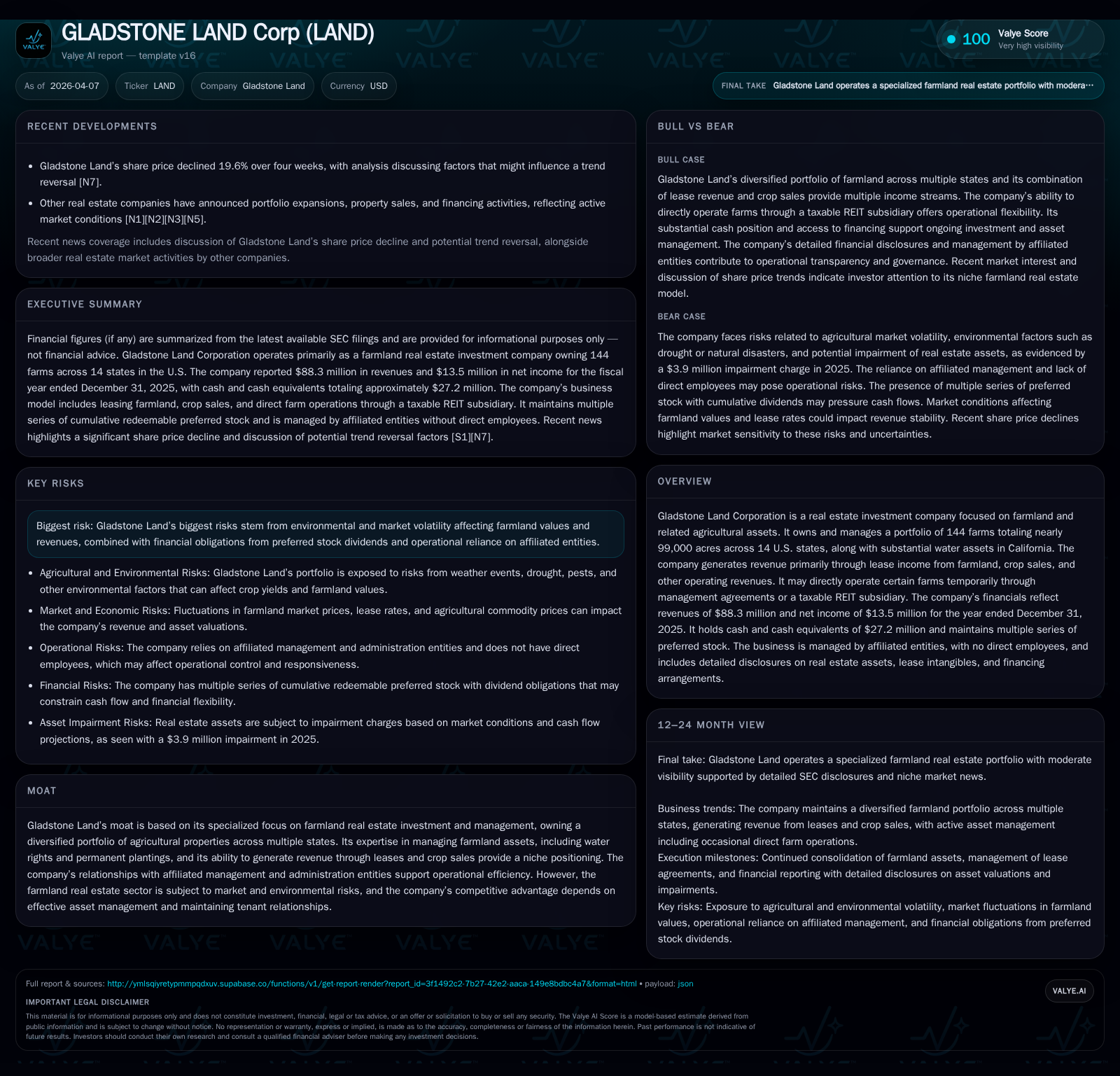
Gladstone Land Corporation owns nearly 99,000 acres of farmland across 14 U.S. states, generating revenue primarily from lease income and crop sales. In 2025, the company reported modest revenue growth of 3.7% to $88.3 million alongside a slight net income increase. However, operating cash flow significantly contracted due to changes in working capital and investment timing. The firm’s moat stems from its diverse agricultural portfolio and water rights assets, particularly in California. Its capital structure includes multiple preferred stock series and secured debt, balancing liquidity with dividend obligations. Monitoring upcoming preferred dividend events and portfolio expansion remains crucial for understanding future growth dynamics.
From Acreage to Earnings: Gladstone's Historical Financial Trajectory
Gladstone Land Corporation operates a unique niche in farmland real estate investment trust (REIT) focused exclusively on agricultural properties. As of December 31, 2025, it owned 144 farms totaling approximately 98,688 acres across fourteen states, complemented by substantial water assets in California critical for farming operations [S12]. This asset base grounds Gladstone’s revenue model primarily on farmland lease income augmented by crop sales.
Financially, Gladstone saw revenues increase modestly by about +3.7% year-over-year to $88.3 million in FY2025 from $85.2 million the prior year [F1]. Net income followed a similar pattern with a slight rise (+1.8%) to $13.5 million – reinforcing a consistent but measured profitability profile despite sector headwinds like commodity price fluctuations and environmental uncertainties.
Operational cash flows, however, told a different story: a sharp contraction of roughly -76% year-over-year to $7.0 million reflected atypical working capital outflows and investing activities timing affecting liquidity [F1]. Stockholders’ equity declined marginally but remained sizable at $670 million as the company maintains a conservative balance sheet approach [F1].
Historical performance (annual)
| FY | Rev ($mm) | Net ($mm) | CFO ($mm) | Rev YoY | Net YoY |
|---|---|---|---|---|---|
| 2025 | 88 | 14 | 7 | +3.7% | +1.8% |
| 2024 | 85 | 13 | 30 | -5.7% | -8.8% |
| 2023 | 90 | 15 | 40 | +1.3% | +209.4% |
| 2022 | 89 | 5 | 44 |
Source: SEC companyfacts cache [F1].
Capital returns and efficiency (annual)
| FY | ROE% |
|---|---|
| 2025 | 2.0 |
| 2024 | 1.9 |
| 2023 | 2.0 |
| 2022 | 0.6 |
Source: SEC companyfacts cache [F1].
Note: CFO drop in FY2025 reflects increased investment in working capital components and temporary operating cash constraints related to property acquisitions or maintenance commitments.
The Agricultural Lease Model and Crop Sales: Revenue Drivers Unpacked
Gladstone generates the bulk of its revenue through structured leases with tenants that operate the farmland under agricultural use contracts [S12]. These leases frequently incorporate variable components based on gross revenues from certain farms—enabling Gladstone to benefit from upside while maintaining base rental security.
The company’s portfolio is geographically diversified yet notably includes water rights assets totaling over fifty-five thousand acre-feet in California – an essential differentiator within an increasingly water-scarce agricultural landscape [S12]. These water rights safeguard crop yields on certain farms during drought cycles and support higher rent valuations compared with farms lacking such resources.
Additionally, Gladstone may engage temporarily in direct farm operations via taxable REIT subsidiaries or through management agreements when transitioning properties or optimizing tenant arrangements — showcasing operational flexibility uncommon among traditional REITs strictly leasing assets [S12]. Crop sales provide complementary revenue streams when the company holds harvested crops or enters cultivation partnerships.
This hybrid revenue model balances steady lease income with market-sensitive crop sales — supporting resilience amid farming sector cyclicality.
Environmental and Market Headwinds Shape Future Outlook
Despite diversified locations spanning fourteen states, Gladstone is exposed to climatic unpredictability including droughts, floods, or other natural calamities that can depress farmland productivity or necessitate longer tenant downtimes [S5]. Water asset concentration in California mitigates some risk but introduces regulatory uncertainty that could influence property value or operational licenses.
Market sentiment has recently seen volatility; LAND's shares experienced about a -19% drop over four weeks but analysts cautiously cite potential reversal catalysts including improving agricultural commodity prices and renewed investor interest in niche farmland REITs [N8]. The company also faces pressure from fixed-cost preferred stock dividends which limit free cash flow bandwidth — posing constraints on growth funding if earnings fail to accelerate sufficiently.
Persistence of these environmental factors combined with financial burdens from cumulative preferred dividends demands vigilant asset management and agile capital strategy execution going forward.
Capital Structure Overview: Debt Instruments, Preferred Stock, and Liquidity
Gladstone Land leverages a multi-faceted capital structure comprising several series of cumulative redeemable preferred stock (Series B, C, D, E), accompanied by secured long-term mortgage notes payable and revolving credit lines allowing short-term liquidity management [S4][S6][F1].
Weighted average interest rates differ notably between fixed-rate mortgage bonds issued primarily against specific farm portfolios versus variable-rate credit facility borrowings—a balance struck for cost containment without sacrificing funding availability during acquisition cycles.
Cash and equivalents stood at $27.2 million as of December’25 end – up from prior periods – underscoring an emphasis on maintaining liquidity buffers amidst acquisition activity and dividend obligations [F1][S6]. Preferred dividends represent a significant outlay annually (~$24 million), thus affecting financing decisions around leverage usage versus equity issuance.[S15][S17]
Dividend Policy, Cash Flows, and Shareholder Returns
Common stock dividends held relatively firm near $20 million paid annually over recent years reflecting commitment to returning capital despite operating cash flow fluctuations [F1][S14][S15]. Distributions on cumulative redeemable preferreds consume an equivalent magnitude (~$24 million), cumulatively compressing free cash flow available for reinvestment or buybacks.
There have been no recent common share repurchases disclosed; instead Gladstone appears focused on balance sheet prudence given cyclical farming realities and ongoing portfolio expansion plans through strategic acquisitions funded partly via equity offerings.[S10][S17]
The stable dividend payout underscores confidence in recurring lease income streams yet signals caution given reduced CFO levels undermining coverage metrics somewhat this past fiscal year.
Key Milestones on the Horizon: What Investors Should Watch
Absent explicit corporate guidance forecasting near-term earnings or leasing milestones; monitoring key developments such as Series C preferred stock ex-dividend dates will be imperative due to their impact on cash flow distribution schedules [N13]. Additionally, investor attention should focus on portfolio diversification efforts announced via earnings filings or property acquisitions which drive rental income sustainability.
Refinancing terms for existing mortgage notes alongside potential adjustments to affiliated management agreements may also signal shifts in cost structure influencing profit margins.[N13]
Operational Leverage through Affiliated Management Arrangements
Gladstone Land outsources operational management to affiliates including Gladstone Management Corporation (Advisor) and Gladstone Administration LLC (Administrator), enhancing cost efficiency by leveraging specialized expertise without direct employee overheads [S1][S5].
While this creates scalable administration benefits typical within externally managed REIT structures coupled with taxable REIT subsidiary farming operations flexibility — it simultaneously introduces dependency risks relating to contract renewals or fee escalations impacting net returns.
Accounting practices follow ASC guidance for asset acquisition allocations incorporating tangible assets like land/improvements along with intangible lease-related values reflecting tenant relationships—a critical factor underpinning fair value estimations for Gladstone’s diverse array of farmland properties [S9][S16].
Overall this arrangement underlines Gladstone’s niche specialization yet warrants scrutiny during periods of market stress or rising administrative costs.
This analysis refrains from predictive investment opinions but grounds discussions strictly in reported data from Gladstone Land Corporation's SEC filings and relevant news sources as of April 2026.
Disclaimer: This is research-only, informational analysis and not investment advice. It may include AI-generated interpretation and general industry context. Always verify important details using primary sources.

Comments