
Skillsoft's Strategic Crossroads: Balancing Digital Platforms and In-Person Training Amid Capital Pressures
Skillsoft Corp. maintains a dual-segment learning business model but grapples with financial headwinds and NYSE market cap risks.
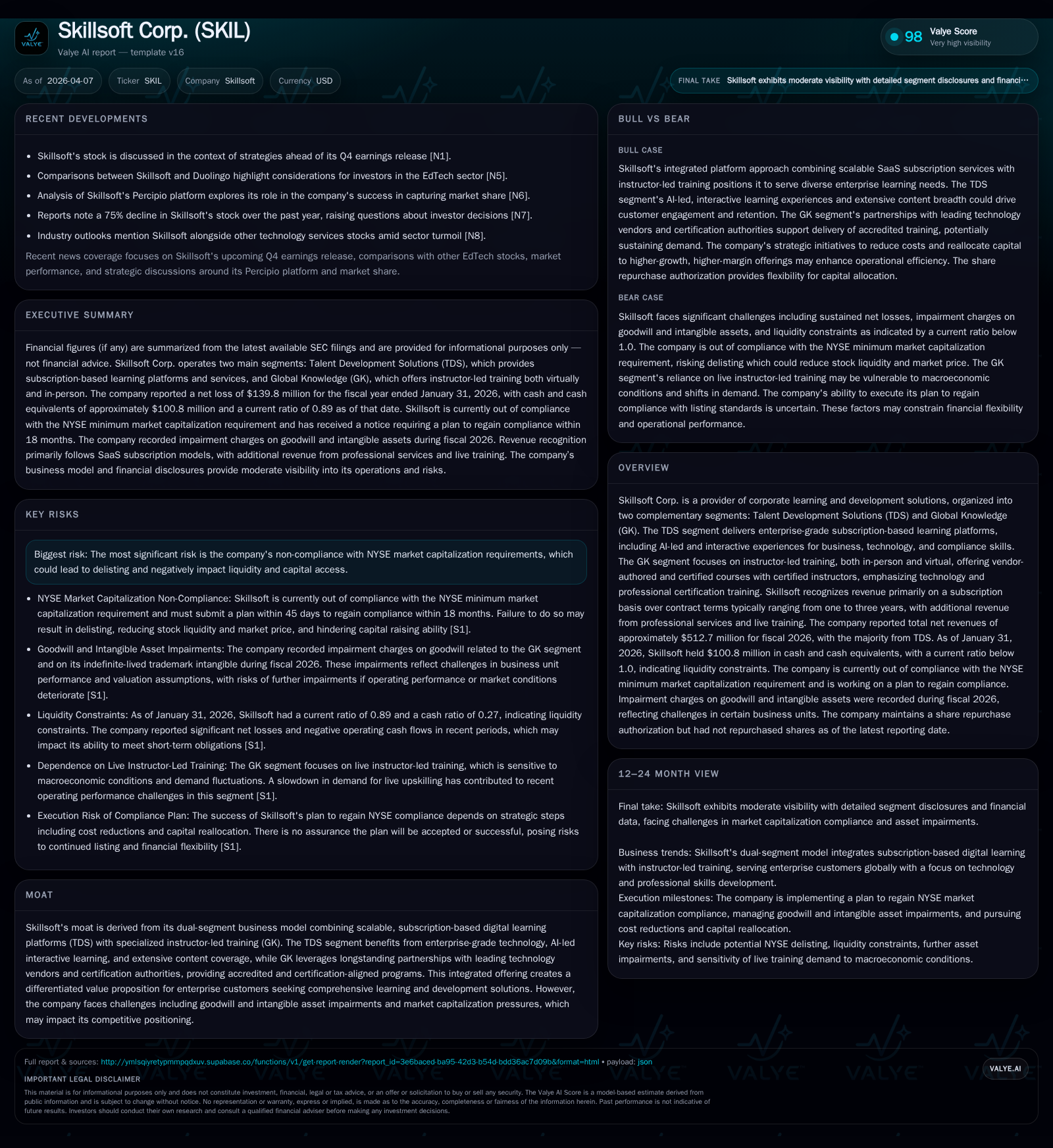
Skillsoft operates through two complementary segments: scalable AI-driven subscription Talent Development Solutions (TDS) and instructor-led Global Knowledge (GK) training. While TDS shows solid subscription revenue growth, the company continues to post operating losses impacted by impairments and waning demand in GK. Facing non-compliance with NYSE market capitalization requirements, Skillsoft must balance capital allocation with strategic pivots toward higher-margin offerings. Its liquidity position remains constrained, with ongoing efforts focused on cost reduction and segment realignment to drive future growth.
Historical Performance: Revenue Growth from a Dual-Segment Platform
Skillsoft reported total revenues of about $512.7 million for fiscal year 2026 ending January 31, predominantly generated from its Talent Development Solutions (TDS) segment [F1]. This compares against $531.0 million in FY2025 and $553.2 million in FY2024, indicating a deceleration in top-line growth largely attributable to softness in its Global Knowledge (GK) segment [F1][S9][S23]. The company's subscription-based digital platform (TDS), encompassing AI-driven interactive learning experiences across business, technology, and compliance skill sets, has shown relative resilience. Conversely, instructor-led GK revenues have declined during weakening demand for live upskilling sessions both virtually and in-person [S9][S1].
Despite improving revenue stability within TDS, Skillsoft's operating income remained negative at an adjusted loss of approximately -$89.5 million in FY2026, though representing a 28.5% improvement from -$69.6 million recorded the prior year [F1]. The persistence of operating losses reflects continued investment into product innovation alongside impairment charges related to goodwill and intangible assets [S1][F1]. The net loss widened slightly to around -$139.8 million in FY2026 but improved modestly from -$121.9 million in FY2025 [F1].
Historical performance (annual)
| FY | Net ($mm) | CFO ($mm) | OpInc ($mm) | Capex ($mm) | Net YoY |
|---|---|---|---|---|---|
| 2026 | -140 | 25 | -89 | 2 | -14.7% |
| 2025 | -122 | 30 | -70 | 2 | +65.1% |
| 2024 | -349 | 3 | -309 | 4 | +51.8% |
| 2023 | -725 | -21 | -804 | 5 |
Source: SEC companyfacts cache [F1].
Capital returns and efficiency (annual)
| FY | Buybacks ($mm) | FCF ($mm) | ROE% |
|---|---|---|---|
| 2026 | 0 | 23 | 462.6 |
| 2025 | 0 | 28 | -129.9 |
| 2024 | 8 | -1 | -169.9 |
| 2023 | 3 | -26 | -136.3 |
Source: SEC companyfacts cache [F1].
Figures sourced from SEC filings and company facts [F1][S9]. Operating income improvements reflect operational adjustments but remain negative due to heavy amortization and impairment burdens.
Financial Headwinds: Operating Losses, Market Cap Risks, and Impairments
Beyond operational losses, Skillsoft disclosed it is currently out of compliance with the New York Stock Exchange’s minimum market capitalization requirements [S1]. The company received a notice indicating risk of delisting if remedial plans do not succeed within an 18-month window following submission of a compliance plan.
This regulatory pressure compounds existing challenges including goodwill and intangible asset impairments incurred over the last several years stemming from acquisitions such as Codecademy [S1][F1]. These non-cash charges affect equity valuations but underscore market skepticism regarding Skillsoft’s longer-term competitive positioning amid shifting corporate spending trends.
The firm recognizes that subdued demand for live upskilling within its Global Knowledge segment has materially depressed operating performance lately, influencing both stock trading volumes and shareholder sentiment negatively [S1][N1]. A potentially self-reinforcing cycle emerges where valuation declines hinder raising equity financing required for strategic initiatives or balancing leverage.
Growth Drivers Within Talent Development Solutions
The TDS segment anchors Skillsoft’s growth strategy by providing enterprise-grade subscription platforms combined with AI-driven learning tools aimed at enhancing employee capabilities efficiently across multi-year contract terms [S9][N7]. This bimodal offering includes Skills Management Platforms enabling organizations to track workforce development alongside Learner Platforms delivering interactive practice-based technology upskilling.
AI-led features integrated into the platform ecosystem offer adaptive learning experiences calibrated to individual learner needs—an attractive feature increasingly demanded by corporate buyers seeking measurable skill acquisition outcomes [N7][S20]. Additionally, comprehensive content coverage spanning business leadership, compliance frameworks, technology skills, and certification preparation supports broad adoption across diverse industries.
Recurring SaaS subscription revenues within TDS provide stable cash flow visibility crucial for funding R&D investments directed at enhancing user engagement and platform scalability [S20]. Contractual billing over one-to-three-year periods yields an important deferred revenue backlog that underpins future realization of revenues.
Challenges in Global Knowledge Segment Uptake
Conversely, the GK segment contends with muted demand for traditional instructor-led training delivered via virtual classrooms or on-site sessions [S9][S1]. Market sensitivity to economic conditions combined with evolving preferences for more flexible digital experiences has slowed uptake notably.
Longstanding vendor partnerships enabling certified course delivery remain a strength; however, the economics of live instructor-led formats are less favorable compared to scalable subscription models due to higher fixed cost bases and scheduling complexities [S9][N1]. Skillsoft’s public filing acknowledges active consideration of strategic alternatives including possible divestitures or restructurings aimed at right-sizing GK operations consistent with altered market dynamics [S1].
Capital Structure and Liquidity Management
Skillsoft’s capital structure is heavily weighted toward term loans aggregating around $583 million outstanding as of January 31, 2026—scheduled to mature by mid-2029 [S4][S5][F1]. The debt carries interest linked to SOFR plus margins around 5-6%, with quarterly principal repayments beginning fiscal year 2027 [S6][S8].
The company maintains a revolving accounts receivable credit facility with a capacity of $75 million but only approximately $1 million drawn as of fiscal year-end reflecting cautious liquidity management given covenant constraints [S5][S12]. At end-FY2026, cash and equivalents stood near $100.8 million while current liabilities measured at roughly $373 million yield a suboptimal current ratio near 0.89x highlighting working capital pressure points [F1][S19].
Credit agreements impose customary affirmative/negative covenants covering indebtedness limits, asset sales restrictions, and reporting obligations ensuring lender oversight over financial policies [S4][S13]. Meeting these covenants remains critical amidst ongoing market cap uncertainty given refinancing hurdles could arise if share price volatility persists.
Share Repurchases and Dividend Policy: Analyzing Returns to Shareholders
Despite receiving board authorization in mid-2024 allowing up to $10 million for share repurchases extending four years forward, Skillsoft has not repurchased any stock through January 31, 2026 reflecting conservative capital allocation amid operational challenges [S1]. No dividends have been declared or paid historically corroborating a focus on reinvestment or debt servicing rather than direct shareholder distributions.
ROE metrics are complicated by sizable accumulated deficits culminating in negative equity (~$30 million deficit at FY26 close), making traditional return calculations unrepresentative of intrinsic business performance [F1]. Positive operating cash flows partially offset losses on paper providing some comfort around business sustainability despite earnings deficits.
Outlook and Strategic Priorities: What to Watch Next
Absent explicit formal guidance for upcoming quarters or fiscal years beyond SEC reports and recent news commentary, investors should watch Skillsoft’s ability to submit an effective NYSE compliance plan outlining credible milestones reinforcing pathway back to listing standards [S1][N2]. Progress on streamlining the Global Knowledge segment through potential divestiture or operational restructuring represents another key milestone likely shaping near-term margin profiles.
Technological advancements within Talent Development Solutions—particularly enhancements to AI-powered learning modules—could accelerate customer acquisition or renewal rates supporting incremental recurring revenue growth if executed successfully [N7]. Monitoring deferred revenue trends will also provide insight into backlog visibility and future revenue recognition trajectories.
Liquidity management balanced with targeted technology investments will be pivotal to sustaining competitive differentiation while navigating macroeconomic headwinds impacting corporate learning spend levels.
Key Risks: Delisting Threat and Market Dynamics
Risk disclosures prominently emphasize the threat posed by NYSE non-compliance which could precipitate delisting affecting secondary market liquidity severely – a detrimental outcome constraining equity raises further [S1][N1]. Reduced trading volumes compound volatility risks potentially discouraging institutional participation.
Broader industry context suggests B2B edtech providers like Skillsoft are vulnerable during periods of economic uncertainty as corporations prioritize discretionary spend cuts including employee development budgets—a dynamic currently manifesting within their GK segment results [N6][N1]. Intellectual property risks appear contained given indemnifications provided against infringement claims without material historical charges noted [S16].[F1]
Disclaimer: This report is prepared solely for informational purposes based on publicly available data from SEC filings and reputable news sources as cited without any investment advice or recommendations.
Disclaimer: This is research-only, informational analysis and not investment advice. It may include AI-generated interpretation and general industry context. Always verify important details using primary sources.

Comments