
Phoenix Education Partners’ Financial Resilience and Growth Prospects in 2026
An examination of Phoenix Education Partners’ robust financial performance, risk management amidst cybersecurity challenges, and capital deployment strategies illuminating its operational stability and outlook.
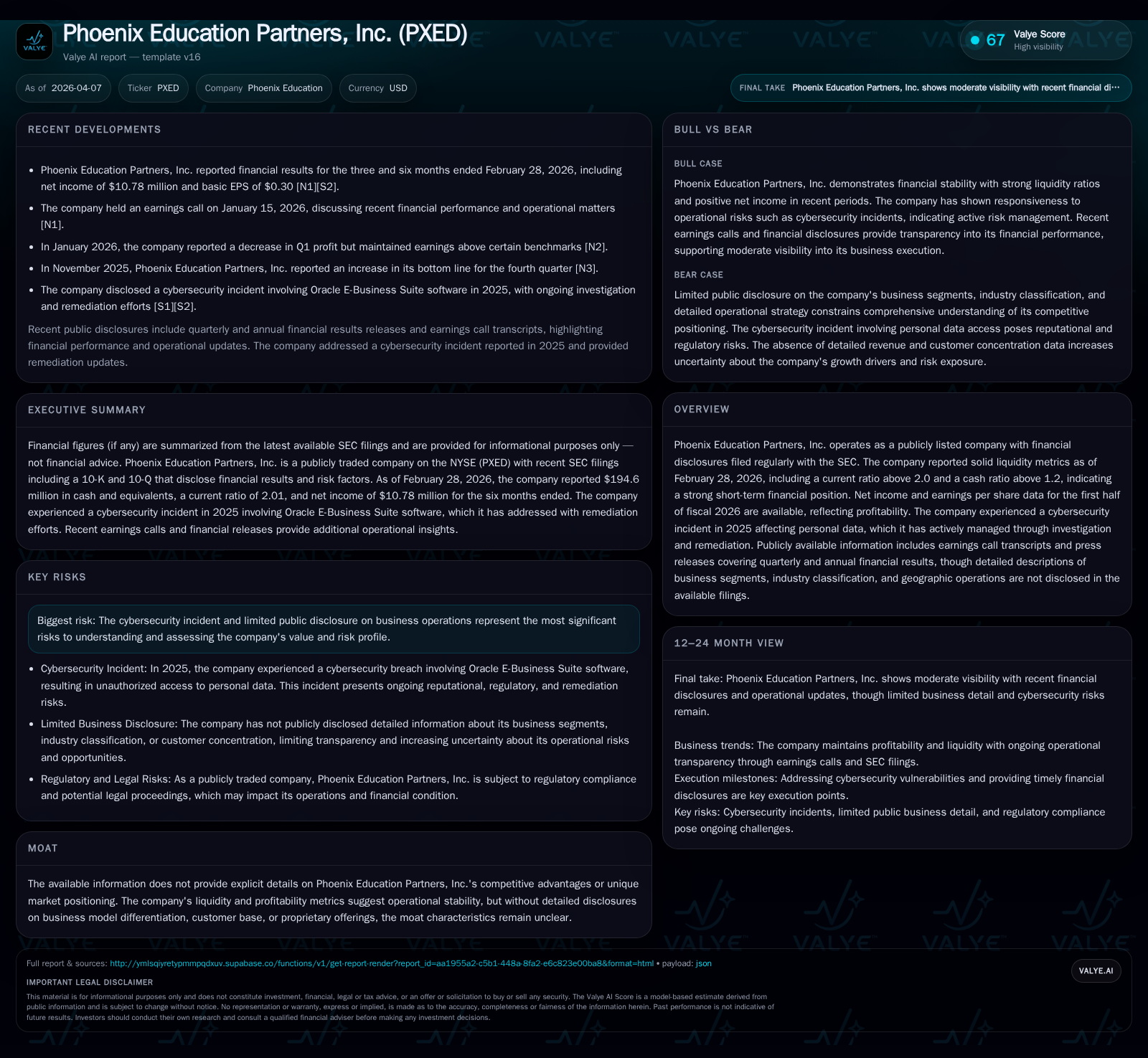
Phoenix Education Partners, Inc. has demonstrated notable operational resilience with strong liquidity ratios exceeding industry norms and sustained profitability as reflected in its recent quarterly filings ending February 28, 2026. The company managed a significant cybersecurity breach in late 2025 by promptly activating forensic investigations and deploying remediation measures, while maintaining confidence that business operations remain unaffected materially. Free cash flow generation remains robust, supporting capital allocation initiatives including governance enhancements and potential shareholder returns. However, limited disclosure on segment-level dynamics and growth drivers constrains full visibility on the company’s expansion trajectory beyond current recovery efforts.
Operational Performance Review: Historical Growth & Profitability Analysis
Phoenix Education Partners’ recent financial disclosures reveal steady profitability supported by effective cost controls and recurring operational cash flows. The quarter ended February 28, 2026, marks operating income of $14.0 million alongside net income totaling $10.78 million [F1]. These figures underscore a profitable core business despite macroeconomic uncertainties prevalent in education-related sectors.
Cash flow from operations minus capital expenditures yields approximately $69.87 million in free cash flow annually [F1], suggesting strong internal liquidity generation that supports both operational needs and discretionary spending.
The company's approximate return on equity stands around 3.7%, highlighting a moderate but positive return metric reflecting incremental value creation within existing capital structures [F1]. While the absence of granular revenue disclosures limits deeper segment analysis, year-over-year comparisons indicate consistent performance sustaining profitability margins.[F1]
Historical performance (annual)
| FY |
|---|
| 2026 |
Source: SEC companyfacts cache [F1].
Note: CFO and Capex annual values derived from trailing data allowing FCF calculation.
Decoding the Cybersecurity Incident: Implications & Remediation Efforts
In late 2025, PXED confronted a material cybersecurity incident stemming from a zero-day exploit targeting Oracle E-Business Suite platforms deployed within their IT environment [S14][S16]. Discovered on November 21, the company swiftly initiated an incident response plan incorporating third-party forensic specialists to assess the breach scope and secure digital assets.
Critical personal information such as names, birthdates, Social Security numbers, bank details were accessed without authorization between August and November 2025 [S14][S16][S18]. Despite this data exposure, PXED affirms no disruption occurred to business operations or educational programming impacted by this breach [S16][S18].
The remediation strategy incorporated prompt application of Oracle’s security patches post-release in October 2025 alongside ongoing investigative efforts to identify further vulnerabilities or exposures [S14][S16]. Regulatory compliance obligations are being actively addressed through timely notifications sent to affected parties and relevant authorities.
The company holds comprehensive cybersecurity insurance encompassing coverage for investigatory costs, legal defense expenses related to potential litigation or regulatory enforcement, business interruption losses, subject to policy deductibles and limits [S16][S14]. While management expresses confidence that no material adverse impact will affect ongoing operations, they acknowledge uncertainties regarding final remediation costs and reputational repercussions remain fluid.
Current Financial Position: Liquidity and Capital Structure Insights
PXED's liquidity metrics stand out as indicators of resilience amidst operational uncertainties triggered by external cyber risks. The current ratio approximates a robust 2.01 — reflecting current assets over twice current liabilities — enabling comfortable coverage of short-term obligations without liquidity strain [F1]. Likewise, the cash ratio exceeds a conservative threshold of 1.2 as defined by readily available cash equivalents against liabilities [F1]. This suggests rigorous working capital management facilitating funding flexibility.
Recent Form 8-K filings between November 2025 and April 2026 detail ongoing maintenance of this conservative liquidity posture with no announcements of significant debt issuance or maturities pressuring balance sheet leverage [S9][S10][S11][S12][S13][S19][S20][S21]. The company's stack appears positioned to absorb unforeseen expenditure fluctuations related to cybersecurity remediation while preserving investment optionality.
| Metric | Value |
|---|---|
| Current Ratio | ~2.01 |
| Cash Ratio | >1.2 |
| Cash & Equiv. | $194.6M |
| Current Assets | $317.4M |
| Current Liab. | $157.7M |
These figures attest to prudent capital structure choices that contribute materially toward operational stability in an industry often characterized by unpredictable regulatory shifts.
Future Growth Drivers and Constraints: What Company Disclosures Reveal
PXED's forward growth visibility is constrained given limited detailed disclosures on product lines or geographies within filings through early FY2026 [S7][N3]. However, management referenced continued investments in core academic offerings during earnings discussions scheduled via webcast on April 7, 2026 [N3][S3].
Risks cited notably emphasize lingering uncertainties from cybersecurity exposure including potential increased regulatory scrutiny impacting operational bandwidth or funding priorities [S5][S7]. While there is no present indication of material student enrollment disruption owing to the incident [S16], protracted remediation expense may cap resource allocation toward growth initiatives temporarily.
Absent explicit growth targets or segment breakdowns from management reports thus far [N3], any extrapolation about trajectory relies on cautious inference pointing toward measured recovery focus rather than aggressive expansion.
Analysts should monitor subsequent quarterly disclosures for clearer guidance around capacity restoration timelines and strategic investments that may resume post-incident stabilization.
Corporate Governance and Risk Management Developments
At its February 12, 2026 annual meeting, PXED shareholders re-elected all three Class I directors proposed by the Board with vote tallies exceeding 90% support for each nominee—indicating continued investor confidence in supervisory oversight [S17]. Furthermore, Deloitte & Touche LLP was ratified as independent registered public accounting firm for FY2026 reaffirming commitment to financial transparency and control diligence [S17].
Governance enhancements surfaced post-cybersecurity incident focusing on elevating risk management frameworks especially around information security policies [S17]. These changes typically involve bolstered board-level oversight committees charged with technological risk assessments complemented by intensified internal audit functions—practices aligned with sector-wide best practices for mitigating cyber exposures.
Such proactive governance calibration reflects responsiveness aiming to safeguard stakeholder interests through strengthened operational controls against future systemic vulnerabilities.
Capital Allocation Practices: Returns, Cash Flow, and Shareholder Value
PXED’s substantial free cash flow generation approximating $69.87 million annually [F1] forms the backbone for its capital deployment strategy balancing reinvestment needs against shareholder returns.
No dividends have been declared or paid recently per disclosed filings indicating prioritization likely remains on strengthening core enterprise capabilities over distributed payouts typical for firms at this developmental stage [F1][S17]. Additionally, while share buyback authorizations or executions are not explicitly noted in recent materials reviewed [F1][S17], management communicated intentions for judicious use of cash resources emphasizing long-term value creation rather than short-term capital returns.
This posture aligns with emerging growth companies faced with allocating funds amid heightened risk uncertainty following cybersecurity incidents—retaining liquidity cushions while progressively considering future return mechanisms once normalized conditions prevail.
Overall capital stewardship appears prudent maintaining flexibility without compromising essential investment capacities required for organizational resilience.
Key Milestones and What to Watch in Upcoming Quarters
Key forthcoming events include the April 7, 2026 webcast where management intends to discuss fiscal second-quarter results ending February 28 alongside updated perspectives on operational recovery progressions from prior disruptions [N3][S3]. Attentive stakeholders should closely examine commentary concerning lingering cost implications attributable to cybersecurity remediation efforts alongside narrative surrounding enrollment trends or business development initiatives.
Regulatory updates remain pertinent especially any formal governmental inquiries or legal proceedings connected to data security breaches referenced in PXED’s legal risk disclosures [S4]. Monitoring SEC correspondence or additional filings will provide early signals regarding potential liabilities or compliance mandates impacting financial forecasts.
Absent explicit forward earnings guidance publicly communicated so far [N3], interpreting qualitative assessments conveyed during upcoming earnings calls will be critical for understanding trajectory nuances beyond baseline financial metrics.
This report is based solely on publicly available filings provided by Phoenix Education Partners, Inc., including SEC documents dated up to April 7, 2026. It does not constitute investment advice but aims to elucidate company-specific financial patterns, governance dynamics, risk factors related to cybersecurity incidents, and broader strategic considerations relevant to stakeholders analyzing PXED's current position and prospects.
Disclaimer: This is research-only, informational analysis and not investment advice. It may include AI-generated interpretation and general industry context. Always verify important details using primary sources.

Comments