
Security Midwest Bancorp’s Transition: Analyzing Growth, Conversion, and Capital Strategy
The company’s modest 2025 earnings coincide with a pivotal mutual-to-stock conversion, highlighting both financial resilience and transition risks.
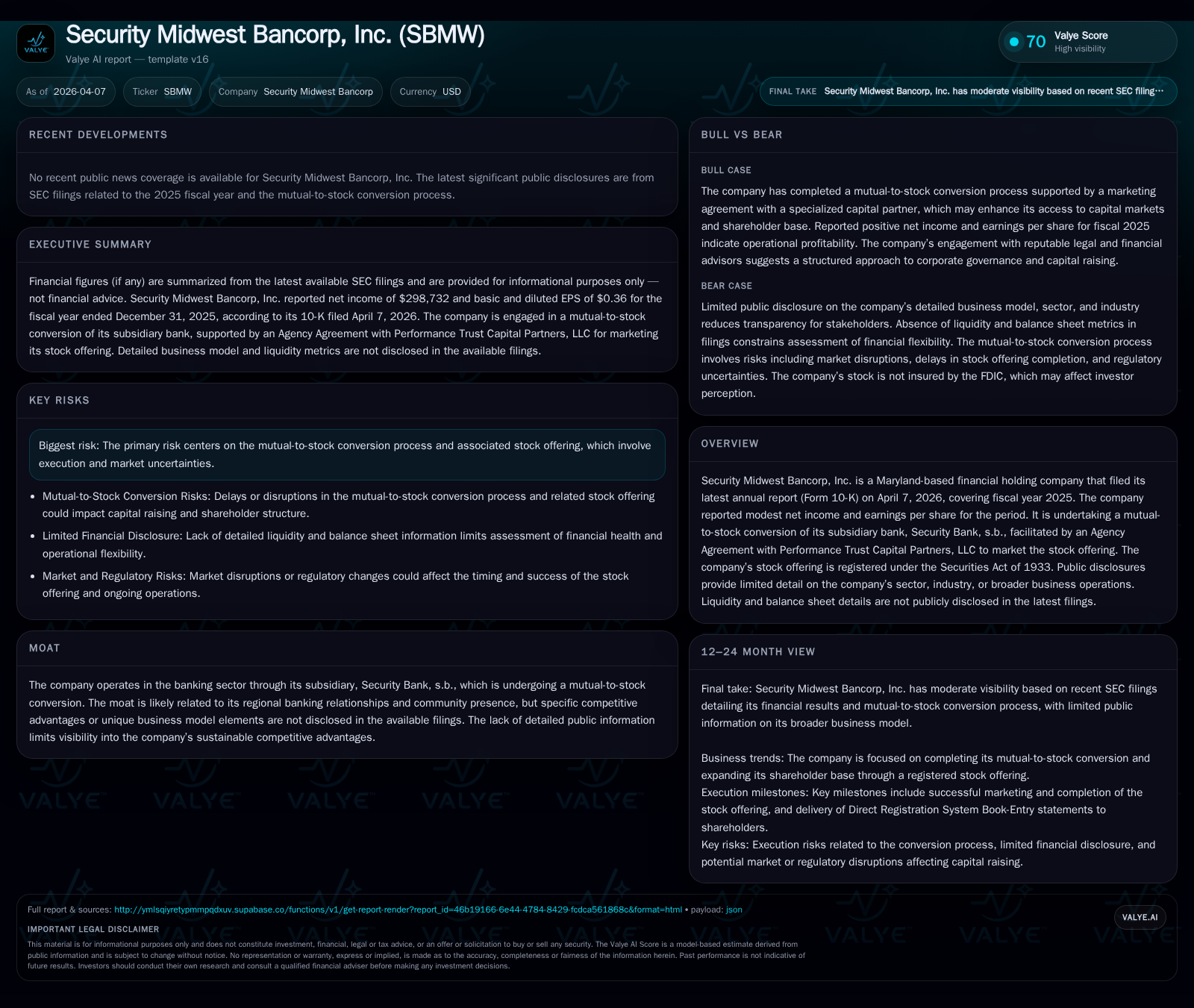
Security Midwest Bancorp, Inc. reported modest net income of approximately $299K in 2025 alongside low but positive return on equity and free cash flow. Its strategic focus centers on transitioning its subsidiary, Security Bank, s.b., from a mutual to a stock organization through an equity offering anticipated to generate around $8.9 million in gross proceeds. The success of this conversion carries execution risks amid uncertain market appetite, but also sets the stage for growth driven by fresh capital infusion enhancing loan and service capabilities typical for community banks. Key indicators to watch include post-conversion earnings trends, regulatory developments, and stock market reception on the OTCQB.
2025 Financial Overview: Modest Earnings Amidst Structural Shift
Security Midwest Bancorp, Inc.’s fiscal year 2025 represents a transitional phase marked by modest profitability alongside significant organizational change. The company reported net income of $298,732 for the year ending December 31, 2025 [F1]. This translated into an approximate return on equity (ROE) of just 1.3%, signaling minimal but positive shareholder returns in a period overshadowed by structural reorganization. Despite subdued earnings, the firm generated positive free cash flow close to $2.15 million — derived as operating cash flow less capital expenditures [F1] — implying operational cash resilience which could support forthcoming growth initiatives.
The bank’s subsidiary Security Bank, s.b., remains the core operating entity although specific revenue figures are not publicly detailed due to limited segment disclosures [S1]. The landscape for SBMW in 2025 is thus one where measured profitability meets significant corporate restructuring.
Historical Earnings and Cash Flow Trends
A review of recent annual financials illustrates SBMW's consistent but restrained performance profile:
Historical performance (annual)
| FY |
|---|
| 2025 |
Source: SEC companyfacts cache [F1].
Unfortunately, comprehensive comparable historical data for prior years’ net income or cash flows is absent from available disclosures [F1] making longitudinal trend analysis challenging. Still, the static nature of the disclosed metrics suggests stable earnings without material volatility heading into the conversion phase.
Mutual-to-Stock Conversion: Execution Progress and Implications
The most conspicuous development emboldening SBMW's strategic narrative is its ongoing mutual-to-stock conversion for Security Bank, s.b. This transformation shifts ownership from a traditional mutual structure owned by depositors to a stock form allowing external shareholders.
On May 14, 2025, SBMW engaged Performance Trust Capital Partners, LLC under an Agency Agreement to act as marketing agent for the stock offering accompanying this conversion [S9][S16]. The agreement entails a fixed management fee of $25,000 plus success fees scaling from 1% to 5% depending on offering segments and investor categories. Additional fees cover records agent and stock information center services amounting to $35,000 plus reimbursable expenses [S9].
The stock offering aimed to issue approximately 889,781 shares at a $10 per share price point targeting about $8.9 million gross proceeds prior to expenses [S11]. This figure includes around 62K shares allocated to an Employee Stock Ownership Plan (ESOP). The Offering unfolded through a Subscription offering that closed June 20, followed by a Community offering which ended July 10 without oversubscription – full orders were filled subject to purchase limits set forth in prospectuses [S11][S18].
Final regulatory approvals were received enabling an expected transaction close on July 31, 2025 with subsequent trading initiation targeted on OTCQB early August under a pending ticker symbol [S11]. This initiative allows SBMW to raise permanent capital critical for balance sheet expansion.
Growth Drivers and Operational Environment Post-Conversion
Though explicit forward guidance was not offered in filings or communications, it is reasonable to infer that proceeds raised will bolster SBMW’s lending capacity—a key driver for growth in community banking models typified by regional market focus and close customer ties.
Newly raised equity capital can support incremental loan originations through improved regulatory capital ratios enabling SBMW to serve local businesses and households more effectively. Additionally, investment in technology or expanded product offerings may follow typical industry patterns where fresh capital supports modernization efforts.
However, absence of concrete operational plans or disclosed strategic initiatives limits precise forecasting; growth optimism must be balanced by observed conservative public disclosures characteristic of smaller regional banks navigating conversion complexities.
Risks Surrounding the Conversion and Market Reception
SBMW identifies key risks concentrated around execution uncertainties of the mutual-to-stock transition and related share sale process [S3][S5]. Time delays—due to regulatory clearance or administrative logistics—pose material threats to timely conversion closure.
Market demand risk surfaced as well given that neither subscription nor community offerings were oversubscribed; this reflects tepid public appetite which may temper aftermarket liquidity and valuation dynamics post-listing [S11].
The niche status as an OTCQB-listed bank imposes typical liquidity constraints potentially aggravating share price volatility or restricting new investor interest.
Additional systemic challenges include general banking regulation evolution and competitive pressures diminishing margin expansion opportunities inherent in regional community banking franchises.
Capital Allocation: Early Signs from Equity Offering and Returns
Given the nascent stage following conversion completion mid-2025 [S11], SBMW's capital allocation decisions continue evolving. Upfront costs include marketing agent fees (management plus success fees), recordkeeping expenses totaling tens of thousands USD plus reimbursables [S9][S11], indicating non-trivial issuance costs against ~$8.9 million gross proceeds.
No formal dividends or share repurchases have been declared or scheduled post-conversion as reflected in filings; free cash flow generation stands positive but modest thus far precluding aggressive capital return cycles [F1]. The evolving shareholder base established through the offering signals potential future pressure or expectation for returns once scale efficiencies materialize.
Management commentary remains limited regarding long-term capital deployment beyond general statements supporting balance sheet strengthening through increased equity capitalization [S11]. Thus early-stage allocation priorities remain inclined toward loan portfolio build-out rather than distributions.
Key Metrics to Watch: What Comes Next for SBMW Investors?
Looking ahead into fiscal periods following the completion of mutual-to-stock conversion will require attention across several critical metrics:
- Quarterly net income and improving ROE if loan growth accelerates meaningfully post-capital infusion.
- Stock trading volume and pricing trends on OTCQB reflective of investor sentiment toward newly listed small-cap community banks.
- Updates regarding dividend policy formation that may signal maturity in capital allocation discipline.
- Regulatory announcements impacting security bank operational scope or capital requirements which bear disproportionate relevance given structural changes underway.
- Any strategic initiatives communicated regarding technology adoption or service expansion that demonstrate leveraging new resources toward sustainable competitive advantage.
Overall monitoring these indicators will be essential for assessing whether SBMW parlayed its significant governance transition into measurably improved financial trajectory amidst prevailing market challenges.
Disclaimer: This report is informational only. It contains no investment advice or recommendations regarding Security Midwest Bancorp, Inc., its securities, or any other investment decisions.
Disclaimer: This is research-only, informational analysis and not investment advice. It may include AI-generated interpretation and general industry context. Always verify important details using primary sources.

Comments