
RCM Technologies’ Growth Resurgence Amidst Competitive and Cyclical Pressures
The company edges forward in revenue and earnings, leveraging AI expertise and flexible outsourcing amid a fiercely competitive and cyclical landscape.
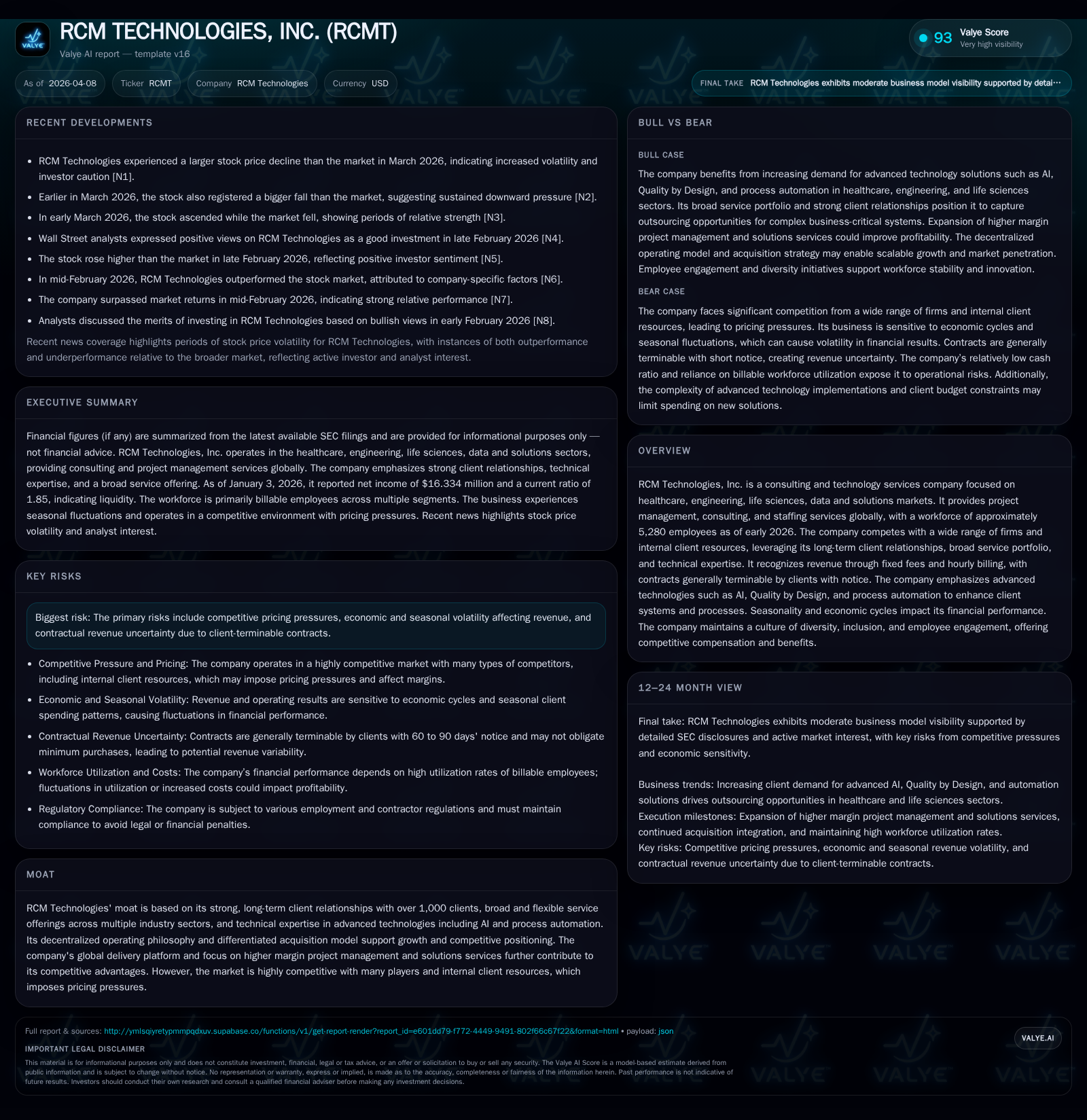
RCM Technologies has demonstrated resilient top-line growth of 5.8% and notable improvements in operating income and net profit despite ongoing pricing pressures and seasonality impacts. Its strategic emphasis on advanced technologies like Agentic AI, Quality by Design, and process automation supports a shift toward higher-margin project management and solutions services. Although explicit forecasts are lacking, continued margin expansion hinges on sustaining wins in these specialized offerings amid client budget cycles. The firm balances capital returns via buybacks with prudent reinvestment, maintaining a strong return on equity. However, the competitive environment remains intense with risks from contract terminability and internal client resource competition.
Revenue and Profit Growth: Drivers Behind Recent Gains
Historical performance (annual)
| FY | Net ($mm) | CFO ($mm) | OpInc ($mm) | Capex ($mm) | Net YoY |
|---|---|---|---|---|---|
| 2025 | 16 | 19 | 25 | 2 | +22.6% |
| 2024 | 13 | 6 | 22 | 3 | -20.8% |
| 2023 | 17 | 12 | 24 | 3 | -19.4% |
| 2022 | 21 | 28 | 29 | 1 |
Source: SEC companyfacts cache [F1].
Capital returns and efficiency (annual)
| FY | Buybacks ($mm) | FCF ($mm) | ROE% |
|---|---|---|---|
| 2025 | 7 | 17 | 35.5 |
| 2024 | 8 | 4 | 39.8 |
| 2023 | 26 | 10 | 65.3 |
| 2022 | 18 | 27 | 65.4 |
Source: SEC companyfacts cache [F1].
RCM Technologies posted solid top-line progress with revenue climbing 5.8% year-over-year to approximately $186.7 million in fiscal year 2025 [F1]. This rebound comes after several years of more modest fluctuations, signaling stabilization amid challenging market conditions characterized by cyclical budget constraints across its healthcare, engineering, life sciences, data, and solutions segments [S1].
Operating income exhibited accelerated growth relative to revenue, rising 12.4% to roughly $25.1 million for the same period [F1]. This outperformance reflects an intentional shift by the company toward higher-margin project management and comprehensive solutions engagements over commoditized consulting or staffing placements [S1]. Firm-wide margin expansion is thus grounded primarily in service mix evolution rather than one-off cost reductions.
Moreover, net income jumped 22.6% to $16.3 million [F1], underscoring improved operational leverage combined with favorable tax or interest factors not separately disclosed but consistent with reported results trends [F1]. Notably, operating cash flow surged over twofold (+207%) reaching approximately $18.9 million [F1], indicating efficient working capital management that has bolstered liquidity despite capex reductions.
| FY | Rev ($m) | OpInc ($m) | Net ($m) | CFO ($m) | Capex ($m) | Rev YoY % | OpInc YoY % | Net YoY % | CFO YoY % |
|---|---|---|---|---|---|---|---|---|---|
| 2025 | 186.7 | 25.1 | 16.3 | 18.9 | 1.6 | 5.8 | 12.4 | 22.6 | 207.4 |
| 2024 | 176.4 | 22.3 | 13.3 | 6.2 | 2.6 |
The marked jump in cash flow stems largely from better receivables collections and tighter expense controls during a year when macroeconomic headwinds might have pressured less agile competitors [F1]. Meanwhile, capital expenditures fell sharply (-38%) year-over-year due to reprioritization favoring operational efficiency over expansion capex [F1].
Advanced Technologies and Outsourcing Demand Shaping Future Opportunities
Central to RCM’s renewed momentum is its strategic embedding of advanced technologies such as Agentic AI—intelligent automation systems capable of autonomous decision-making—Quality by Design (QbD) principles ensuring quality integration throughout development lifecycles, and process automation aimed at reducing manual intervention across workflows [S1]. These innovations resonate particularly within healthcare, life sciences, data analytics, and engineering verticals where complexity escalates rapidly.
The company notes that while many clients grapple with tighter spending prioritizations—often requiring rigorous return-on-investment evaluations—outsourcing engagements involving these sophisticated technologies command premium pricing due to the expertise required and strategic value delivered [S1][N5]. Demand for outsourced business-critical system management incorporating AI-led predictive analytics or QbD-aligned compliance frameworks appears accelerating.
This technological focus aligns with broader secular trends where enterprises emphasize agility through external partnerships rather than expanding costly internal competencies amid talent shortages [N3]. Project management & solutions services generate higher billing rates compared to traditional consulting or contract staffing—a dynamic that RCM actively cultivates to enhance margins as evidenced by recent financials [S1]. Layered atop this is the company’s decentralized operating philosophy allowing nimble capture of niche opportunities across varying client environments.
Key Financial Milestones and What Investors Should Monitor
RCM Technologies has not provided explicit future financial guidance or forecast models in recent disclosures or news articles [N3][S3]. Consequently, observers should focus on quarterly earnings releases for confirmation of margin sustainability and further uplifts linked to the higher-margin service mix especially involving AI-driven outsourcing projects.
Key developments warranting attention include client contract renewals emphasizing project management roles versus pure consulting or temporary staffing; any notable shifts reflecting seasonality effects such as Q3 dips related to educational sector recesses; plus management commentary on competitive intensity or pricing pressures [S1][N3]. Widespread industry shifts toward digital transformation amid economic uncertainties also create volatility risks that will manifest in results timing.
Additionally critical will be monitoring cash flow trends given their outsized impact on valuation metrics alongside any planned adjustments in capital deployment dynamics including share repurchases or possible dividend reinstatement absent since FY2018 [F1][N3].
Capital Allocation: Balancing Buybacks, Dividends, and Investment
Capital discipline remains evident at RCM Technologies with the firm executing $7.36 million in share buybacks during fiscal year 2025 after substantial repurchases over prior years totaling tens of millions cumulatively [F1]. This buyback cadence reflects confidence in underlying free cash flow generation which stood at an estimated $17.37 million (operating cash flow minus capex) for FY2025—a healthy buffer supporting shareholder value return while preserving balance sheet flexibility [F1].
No dividends have been declared since fiscal year ended December 2018 reflecting management’s prioritization of reinvestment into strategic capabilities over routine payout [F1]. Given the company’s sizable free cash flow conversion alongside robust return on equity approaching ~35.5%, this allocation approach aligns with ordinary course build-out of differentiated service offerings rather than yield-focused market signaling [F1].
Capex cuts (-38%) signal measured investment restraint possibly driven by shrinking need for physical infrastructure as digital delivery models mature—consistent with a service model pivot emphasizing intellectual capital and software-enabled solutions over asset-heavy deployments [F1][S1]. This conservative investment posture may continue unless new technology platforms warrant significant spend.
Competitive Environment and Risk Factors Impacting Performance
RCM operates within an intensely competitive ecosystem encompassing traditional consulting firms, systems integrators branching into application development/services, software firms extending into consulting lines, specialized staffing agencies, as well as internal teams at major clients who represent fixed-cost alternatives potentially limiting external vendor budgets [S1]. The widening breadth of rivals exerts persistent pricing pressure constraining margins.
Nevertheless RCM’s moat resides in longstanding relationships exceeding 1,000 clients worldwide paired with multi-sector technical expertise focusing on healthcare, life sciences, engineering domains coupled with cutting-edge technology proficiency (Agentic AI/QbD/process automation). Its decentralized entrepreneurial acquisition strategy empowers rapid adaptation absent cumbersome central control—a meaningful differentiation relative to larger competitors reliant on rigid hierarchies [S1].
Key risk factors stem from contractual revenue uncertainty since most engagements are client-terminable upon notice restricting long-term revenue visibility especially during economic downturns or fiscal budget resets common early each calendar year [S1]. Seasonal demand fluctuations tied partly to educational clients’ summer recesses further amplify revenue variability quarter-to-quarter complicating forecasting efforts.
Moreover legal contingencies from professional liability suits or government inquiries remain an endemic concern given the complex regulatory environment inherent to healthcare-related consulting as noted in filings though no material adjustments have been flagged recently [S1]. Rigorous risk management remains essential.
Seasonality and Contract Structures Influencing Revenue Stability
RCM’s revenues show clear seasonality patterns shaped predominantly by client budgeting cycles—with reduced expenditures typically observed during first-quarter budget finalizations impacting Engineering & Life Sciences projects negatively—and season-end holidays or vacations often dampening fourth-quarter billing volumes despite non-seasonal offsets like catch-up efforts post-year-end closeout periods [S1].
Notably the Specialty Health Care segment experiences pronounced third-quarter declines due largely to summer recess closures among major customers like New York City’s Department of Education plus other academic institutions—a cyclicality that manifests materially despite diversification elsewhere within the portfolio [S1].
The firm invoices under both fixed fee arrangements for well-defined projects and hourly billing for staffing/consulting services; this hybrid model adds complexity around rate realization influenced by skill mixes and workforce utilization levels amongst consultant cohorts ensuring nuanced profit margin dynamics across contracts [S1]. Understanding this interplay between contract structures helps explain quarter-level earnings volatility beyond pure demand drivers.
This analysis draws solely from publicly available financial statements filed with the SEC as well as credible market reports without speculative projection beyond documented figures or disclosed strategic priorities detailed therein.[F1][S1][N3] Market participants should continue monitoring official quarterly disclosures for evolving performance patterns within RCM Technologies’ multifaceted operations.
Disclaimer: This is research-only, informational analysis and not investment advice. It may include AI-generated interpretation and general industry context. Always verify important details using primary sources.

Comments