
WEED, INC.'s Pursuit of Cannabis Genomics and Asset Diversification Confronts Liquidity Constraints
WEED, INC. centers on cannabis genomic research and real estate assets but grapples with ongoing negative cash flows and funding uncertainty.
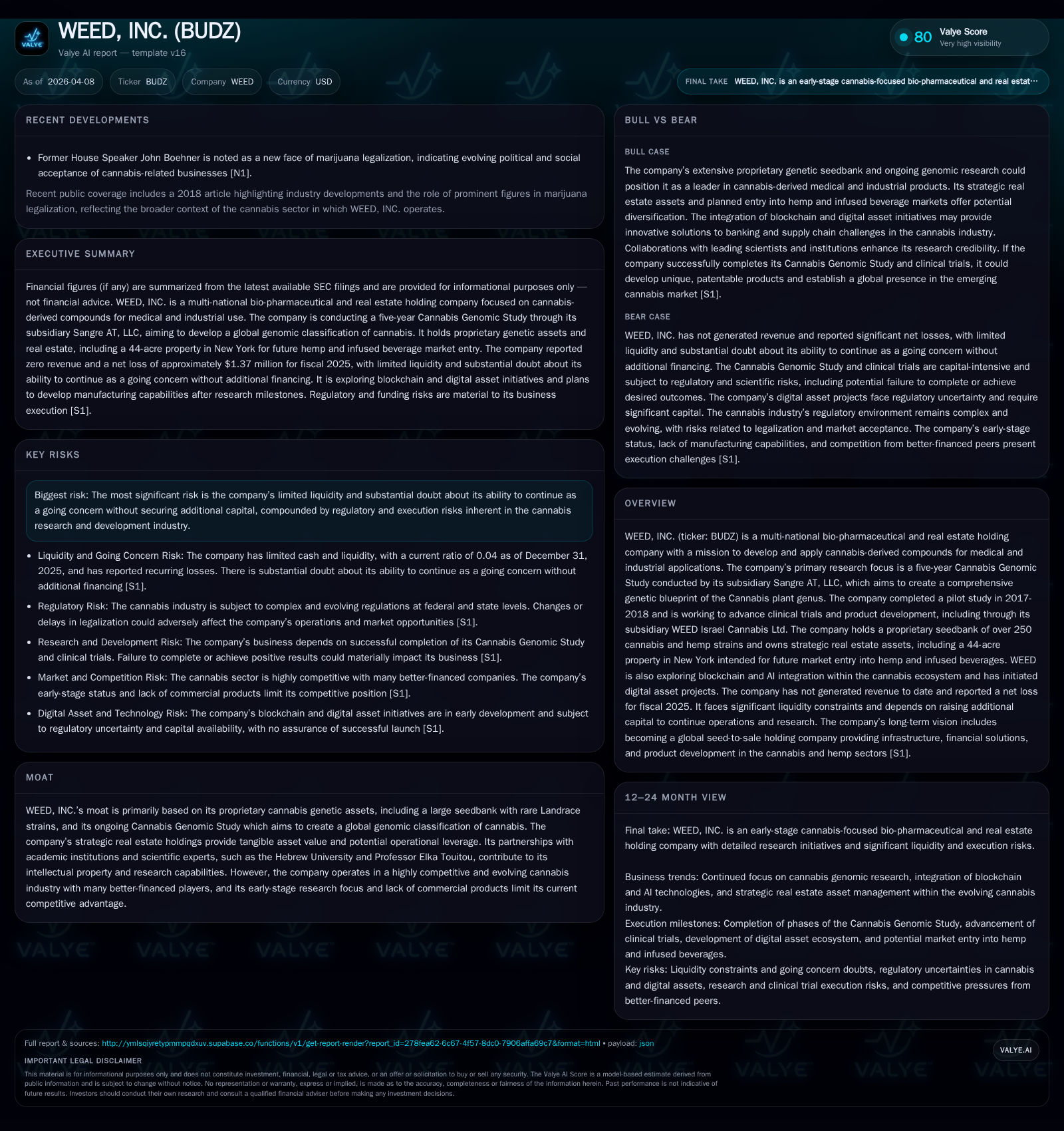
WEED, INC. (BUDZ) is a multi-national company focused on cannabis-derived pharmaceutical research and strategic real estate holdings. The company operates through subsidiaries conducting a five-year Cannabis Genomic Study and maintains a proprietary seedbank of rare cannabis strains. Despite asset diversity and promising research initiatives, WEED has generated no revenue to date and faces persistent operating losses, negative cash flows, and material doubt about its ability to continue as a going concern without additional funding. Future growth hinges on successful clinical trials, completion of its genomic study, market entry into hemp-infused beverages, and digital asset development amidst complex regulation.
Company Background
WEED, INC. (ticker: BUDZ) is engaged primarily in the development of cannabis-derived compounds for medical and industrial applications through scientific research alongside strategic real estate investments. Emerging from mineral exploration origins pre-2015, the company pivoted toward cannabis-focused biotechnology approximately eight years ago. Its core operations emphasize a multi-year Cannabis Genomic Study led by its subsidiary Sangre AT LLC which aims to produce a comprehensive genetic classification of the Cannabis genus. This initiative follows a pilot study executed in 2017-2018 that assessed thirty cultivars globally.
Apart from R&D endeavors, WEED owns a proprietary seedbank comprising over 250 varieties including rare Landrace strains such as Panama Red and Acapulco Gold — assets believed to underpin future pharmaceutical product pipelines. The firm also holds significant real estate including a noteworthy 44-acre property in New York intended as a strategic entry point for hemp cultivation and the infused beverage market.
Historical Financial Performance
The company has recorded zero revenues since inception, consistent with its early-stage biotech focus without commercial product sales or licensing income. Operating losses have been persistent with notable deterioration in fiscal 2025:
Historical performance (annual)
| FY | Rev | Net ($) | CFO ($) | OpInc ($) | Net YoY |
|---|---|---|---|---|---|
| 2025 | 0 | -1372206 | -195136 | -1327679 | -168.7% |
| 2024 | -510716 | -415524 | -529992 | ||
| 2023 | 0 | -1074087 | -770568 | ||
| 2022 | -1528105 | -812975 | -1505274 | +46.2% |
Source: SEC companyfacts cache [F1].
Capital returns and efficiency (annual)
| FY | FCF ($) | ROE% |
|---|---|---|
| 2025 | 199.3 | |
| 2024 | -425524 | 231.1 |
| 2023 | -1084087 | |
| 2022 | -1084208 | -900.0 |
Source: SEC companyfacts cache [F1].
(Data sourced from year-end filings) [F1]
Key observations include:
- Operating income worsened significantly by over 150% year-over-year from negative $530k in FY2024 to negative $1.33M in FY2025.
- Net loss similarly expanded reflecting increased operational expenditures.
- Cash flow from operations remained negative across multiple years but showed improvement in FY2025 compared to prior years.
- Capital expenditures stabilized at modest levels ($10k) post heavy investments in prior periods.
- Equity position declined into negative territory indicating accumulated deficits exceeding shareholder capital.
These trends illustrate rising operational burn tied likely to intensified research phases and overhead without offsetting revenues.
Strategic Assets and Initiatives
Cannabis Genomic Study
This hallmark program conducted by Sangre AT LLC is envisioned as a rigorous five-year investigation into cannabis genomics aiming to establish a global blueprint for the plant’s genetics [S13]. After completing a $1 million pilot analyzing diverse cultivars in Texas during 2017-18 involving multiple female and male strains across continents, the full study requires an estimated additional $15 million investment for completion including advanced clinical trials projected for phases two and three. Success here is critical to enabling future patent filings on novel strains targeted for therapeutic application; however risks around funding continuity and lengthy validation timelines are considerable [S4][S7].
Proprietary Seedbank
The company possesses an extensive collection of over 250 cannabis/hemp strains cataloged largely through recent acquisitions such as Hempirical Genetics LLC [S18]. Rare Landrace varieties with historical medicinal reputations like Panama Red provide foundational IP value with potential for unique therapeutic compounds. These genetic resources form core trade secrets allied with genomic data but remain recorded at cost basis presently given evolving regulatory acceptance [S19].
Real Estate Holdings
A tangible component is the "Four Winds Lake Erie" property acquired in November 2021—a lakeside site roughly spanning 44 acres in Portland/New York. This land conveys water extraction rights enabling potential hemp cultivation aligned with plans for entering the infused beverage sector that continues growing nationally amid expanding state-level legalization [S17][S23]. The company anticipates needing approximately $5 million capital infusion to develop this opportunity plus erect complementary infrastructure such as "cannabis-friendly" residential or hospitality ventures. This asset base provides some downside buffer despite illiquidity concerns given the company's constrained cash flow profile [S4][S18].
Digital Asset Ecosystem Development
In late 2025 WEED partnered with Remergify Inc. exploring blockchain use cases within regulated cannabis supply chains aimed at solving banking difficulties endemic in the industry via launching proprietary cryptocurrencies named WEEDCoin and BUDZCoin. These projects remain early stage dependent heavily on securing further capital and navigating uncertain digital asset regulations including potential SEC evaluations constraining crypto-project rollouts [S18][S21]. The initiative underscores efforts to modernize business models beyond purely biotech-focused paths.
Future Growth Prospects & Constraints
Growth will largely rely upon:
- Successful continuation and conclusion of the Cannabis Genomic Study inclusive of positive clinical trial data enabling patent grants on patented strains or formulations.
- Commercialization pathways either through licensing agreements or direct product development based on intellectual property derived from these studies.
- Capitalizing on New York real estate positioning linked to emerging hemp markets especially infused beverages where conventional competitors remain limited.
- Potential monetization or operational rollout of blockchain-powered financial solutions enhancing ecosystem efficiencies.
Conversely growth may be capped or impaired due to:
- Ongoing federal illegality of cannabis complicating patent protection credibility domestically plus impeding broader financing access or partnerships.
- Substantial dependence on equity raises which pose dilution risks alongside possible unfavorable terms given microcap/penny stock trading status causing limited liquidity [S4][S7][S10].
- Execution uncertainties particularly clinical trial failings or delays truncating expected valuation inflection points.
- Competitive pressures from better-funded pharmaceutical firms vying for cannabinoid drug development primacy potentially overshadowing smaller entities like WEED.
- Regulatory unpredictability both on cannabis using jurisdictions but also evolving scrutiny over cryptocurrencies affecting digital asset launches.
Returns & Capital Allocation
Since inception:
- WEED has reported no revenues thus generating no earnings returns; approximate return on equity calculation based on latest net loss yields an approximate negative figure demonstrating no profitability nor capital returns [F1].
- Cash flow remains consistently negative reflecting ongoing expenditures towards R&D plus holding costs for properties; free cash flow was negative –$205k in FY2025 after accounting for modest Capex spending reflecting tight liquidity conditions [F1].
- There have been no dividend payments or share repurchase programs disclosed given the company’s developmental stage with focus oriented squarely on capital preservation while attempting business model expansion via financing rounds rather than internal cash generation [S4][F1].
Risks Summary
Prominent risk themes outlined include:
- Credit risk stemming from poor liquidity: Operating cash deficits coupled with dwindling working capital intensify existential risks absent successful fundraises leading to potential curtailments or insolvency proceedings [S7][S15].
- Legal environment uncertainty: Federal prohibition casts shadows over patent efficacy plus exposes company assets or activities potentially triggering enforcement actions restricting operations severely despite state law allowances [S3][S6][S16].
- Litigation exposure related patents: Costly intellectual property defenses could drain scarce resources diverting focus despite the critical importance of securing strong patent moats [S3][S14].
- Market competition: Larger incumbents in medical cannabinoid space wield more capitalization hence innovation capacity placing pressure on WEED’s niche offerings[S26].
- Technological risks: Early-stage blockchain/digital currency initiatives face volatile regulatory regime increasing possibility projects never reach commercial fruition impacting strategic plans negatively[S18][S21].
- Personnel recruitment difficulty: Industry stigma combined with specialized scientific headcount needs exacerbate talent acquisition challenges critical for sustaining research momentum[S5].
What To Watch Going Forward (Analysis)
The near-term outlook hinges substantially on milestones such as securing incremental funding rounds sufficient to progress genomics study phases two/three clinical trials alongside planned commercial steps into hemp beverage markets connected to their New York real estate assets. Progress or setbacks here will materially shift strategic trajectories given current financial constraints. Likewise developments around launch or abandonment of digital currencies will reveal managerial execution capabilities under complex regulatory pressures.
The successful transition from an asset-preservation phase dominated by accumulating IP/biobank value towards credible revenue-generating activities remains uncertain but essential for overcoming substantial going concern risk flagged prominently throughout recent annual statements. Monitoring SEC filings for capital raising announcements coupled with any patent grant statuses or preliminary clinical trial results would be key indicators indicating advancement beyond the current research-heavy non-revenue profile.
Conclusion
WEED Inc.'s approach combining deep genomics research targeting sophisticated cannabinoid drug discovery with opportunistic real estate plays presents an intriguing yet inherently risky business model stretched thin between early-stage biotech development needing large capital injections against precarious federal regulatory headwinds affecting the entire U.S. cannabis industry ecosystem. Financial metrics underscore continued operational losses without revenues intensifying doubts about sustainable operations absent new funding sources inevitably dilutive or restrictive given their OTCQB penny stock trading context.
The company's intellectual property foundations centered on rare genetics coupled with academic collaborations afford it differentiation distinct from typical recreational cannabis producers though converting this science into commercial success will require overcoming formidable execution challenges along with navigating a labyrinthine legal milieu that persistently threatens their strategy viability.
This report is prepared solely for informational purposes summarizing publicly available disclosure about WEED Inc., detailing its historical performance, strategic initiatives, risks inherent in its operating environment as well as potential growth dynamics without offering any investment recommendations.
Disclaimer: This is research-only, informational analysis and not investment advice. It may include AI-generated interpretation and general industry context. Always verify important details using primary sources.

Comments