
Hubilu Venture’s Struggle with Profitability and Liquidity in Student Housing
Hubilu Venture Corp’s concentrated student housing portfolio and microcap structure underpin growth challenges marked by losses and liquidity strain.
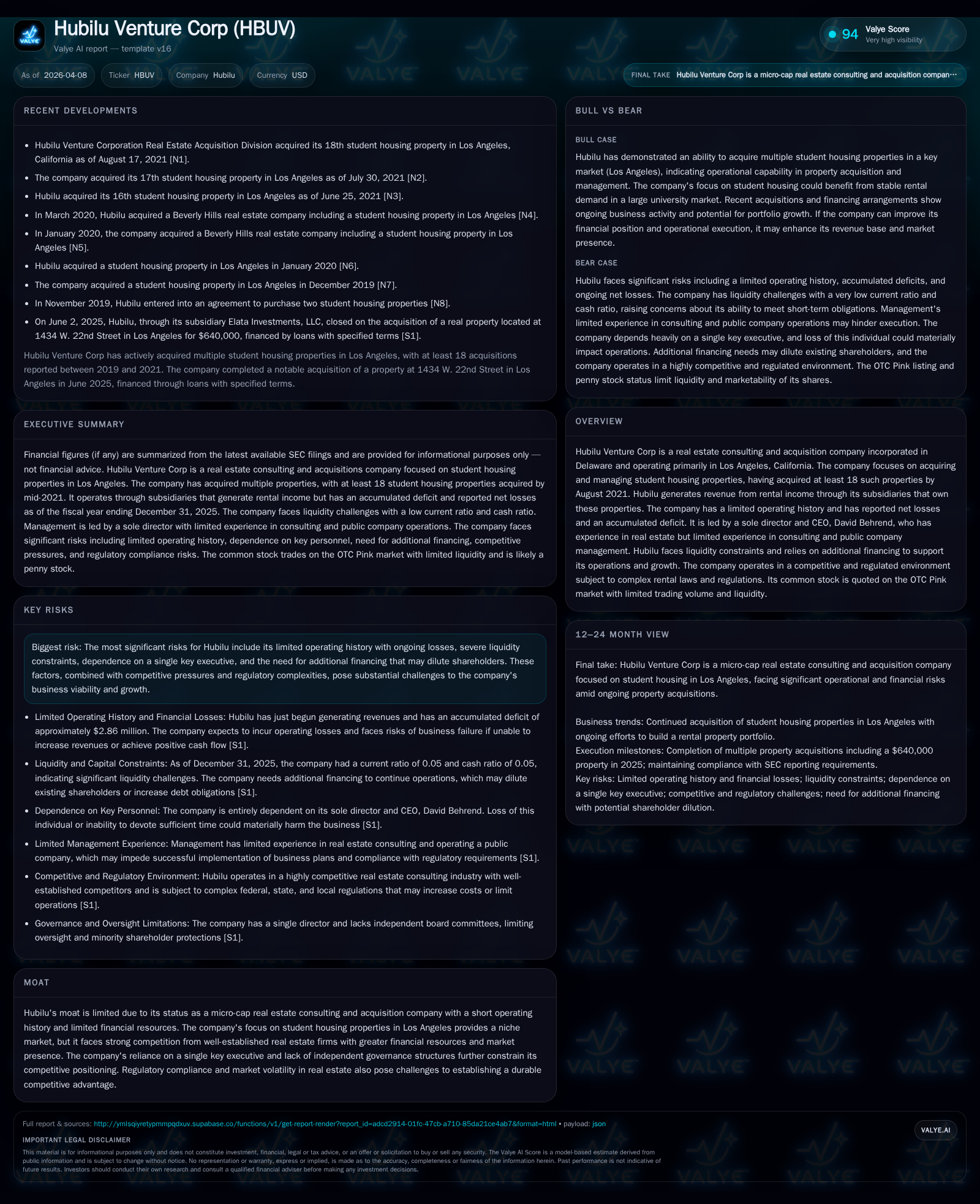
Hubilu Venture Corp operates a niche portfolio of student housing properties in Los Angeles but struggles with persistent net losses and severe liquidity constraints. Despite nearly 80% revenue growth in FY2025 driven by rental income expansion, escalating expenses and capital expenditures have deepened the accumulated deficit beyond $2.8 million. The company’s growth prospects hinge on securing financing and expanding its consulting client base amid intense competition and complex regulation. Governance reliance on a sole key executive amplifies operational risks, while upcoming milestones revolve around capital raises and lease expansions necessary to reach profitability and positive cash flow.
From Modest Beginnings: Revenue and Operating Income Evolutions
Hubilu Venture Corp has shown notable revenue growth since its inception, progressing from modest rental income levels to a more substantial top line by the end of FY2025. Revenues increased from just $33,501 as of fiscal 2017 to approximately $930,955 in fiscal 2025 — a striking near-28x jump over eight years [F1]. This surge aligns with the company’s acquisition strategy focused on student housing properties within the Los Angeles market. As these acquisitions proliferated (at least 18 by August 2021), rental income naturally expanded.
However, this growing revenue base remains relatively small compared to established players in the LA real estate space where rental yield optimization and scale economics are critical. Operating income tells a nuanced story: after peaking at about $1.12 million in FY2024, it declined by 17.1% to around $930K in FY2025 despite higher revenues [F1]. These fluctuations likely stem from increasing operational costs including property management expenses, maintenance outlays typical in student housing, and rising administrative overhead—a sector-native characteristic as tenant turnover rates among students can drive elevated refurbishing costs.
Historical performance (annual)
| FY | Net ($) | CFO ($) | OpInc ($) | Capex ($) | Net YoY |
|---|---|---|---|---|---|
| 2025 | -551442 | 110810 | 930955 | 781649 | -196.1% |
| 2024 | -186237 | 188394 | 1123115 | 525856 | +32.4% |
| 2023 | -275332 | 110233 | 743947 | -140.9% | |
| 2022 | -114286 | 241335 | 781123 |
Source: SEC companyfacts cache [F1].
Capital returns and efficiency (annual)
| FY | FCF ($) | ROE% |
|---|---|---|
| 2025 | -670839 | 31.0 |
| 2024 | -337462 | 14.5 |
| 2023 | 23.3 | |
| 2022 | 12.8 |
Source: SEC companyfacts cache [F1].
Note: Some years lack full revenue or operating income data; reported figures correspond to available SEC filings [F1].
Losses Amid Expansion: The Persistent Net Deficit and Its Roots
Despite top-line growth and recovering operating income figures earlier this decade, Hubilu has not yet achieved net profitability. The net loss widened significantly from about $186K deficit in FY2024 to roughly $551K negative earnings in FY2025 [F1]. This deterioration is material given the company's limited financial cushion.
Contributing factors include rising operating expenses such as property upkeep in one of the most regulated U.S. real estate markets — Los Angeles — where tenant protection laws increase compliance costs [S6][S10]. Additionally, financing costs related to debt or equity raises may have intensified amid attempts to fuel acquisitions and expansion [S4][S7].
The accumulated deficit stood near $2.86 million at fiscal year-end 2025 [F1], constraining Hubilu's ability to absorb further short-term losses without external funding support. The company explicitly states its ongoing losses and need for future capital injections directly threaten its viability as a going concern [S1][S4]. Cash burn dynamics are acute given Hubilu's micro-cap size with minimal cash reserves ($52K cash on hand end-2025) juxtaposed against substantial liabilities (~$2.56 million current liabilities), producing a perilous liquidity gap [F1][S9].
Growth Outlook Hinged on Financing and Market Penetration
Hubilu’s future growth materially depends on successfully obtaining additional funding through private placements or debt instruments [S4][S7]. The company openly cautions that further equity sales will dilute shareholders’ value but are necessary to continue operations.
Moreover, their consulting business arm lacks significant traction due to management's limited experience in third-party consulting engagements; this imposes an added barrier when diversifying revenue streams beyond rentals [S1][S4]. Given the firm’s concentrated geographic focus on Los Angeles student housing—a niche that carries demographic-driven demand—the potential upside exists but is capped by steep competition from far larger real estate firms with deeper pockets [S6][S8].
Practitioner terminology is apt here: Hubilu's pipeline for new client acquisition and property purchases must align closely with fundraising capabilities because without adequate working capital it cannot responsibly commit to long-term contracts or capex-heavy refurbishments vital for rental yield improvements.
Navigating Regulatory Complexities and Competitive Pressures
Operating primarily within Los Angeles brings regulatory complexity unparalleled in many U.S. markets. The city's stringent rent control ordinances and tenant protections require careful compliance lest penalties arise or eviction moratoriums disrupt cash flows [S6][S10]. Such regulations inflate operating costs—ranging from legal oversight to administrative paperwork—and suppress flexibility in rent setting compared with other markets.
Externally, Hubilu contends with well-funded competitors entrenched in multiple facets of the student housing ecosystem—from property developers to specialized managers offering bundled services—a dynamic that limits Hubilu’s negotiating leverage both with tenants and suppliers [S6]. The company admits it may be unable to sustain competitive positioning over time without significantly increasing scale or operational efficiencies.
Capital Allocation Under Pressure: Equity, Cash Flow, and Dilution Risks
Financial metrics reveal stark capital allocation challenges at Hubilu. Operating cash flow declined markedly by over 41% year-over-year to just above $110K in FY2025 while capital expenditure jumped nearly 49% higher to roughly $782K during the same period reflecting investment into property assets [F1]. This yielded an estimated free cash flow gap exceeding $670K—unsustainable without external funding.
The current ratio is alarmingly low (approximate ratio of ~0.05), underscoring a negative working capital position close to negative $2.44 million as of December 31, 2025 [F1]. This points toward imminent liquidity stress if near-term financing sources do not materialize.
Notably absent are dividends or share repurchase programs—a standard microcap practice conserving scarce resources for reinvestment amid ongoing operating losses [S5]. Reported return on equity appears positive (+31%), which is misleading here due to negative equity base stemming from cumulative deficits—the metric warrants cautious interpretation.
Governance Dynamics and Dependence on a Single Executive
David Behrend wields outsized influence as the sole director serving concurrently as CEO and President [S1][S9]. This concentration introduces 'single-key-man' risk uncommon among even small public real estate firms given the absence of independent directors or board committees overseeing compensation or audit functions [S27][S29].
Behrend’s background spans real estate operations but reveals scant experience specific to consulting services or managing public company compliance demands—a potential impediment for executing Hubilu's complex business model involving acquisitions plus consulting revenues [S1][S4]. Without robust governance frameworks typically mandated under Sarbanes-Oxley provisions (which the company does not yet fully comply with), minority shareholders face limited protections against conflicts of interest or self-dealing concerns given control via Jacaranda3 Investments owning ~95% shares controlled by Behrend himself [S16].
Milestones to Watch: Capital Raises, Lease Expansions, and Operational Break-Even
While no explicit forward guidance is provided beyond general cautionary statements regarding capital needs [N/A], industry watchers should focus on several tangible inflection points:
- Successful completion of private placements or debt arrangements reducing liquidity strain.
- Acquisition or leasing commitments expanding Hubilu's tangible property footprint supporting incremental rental income.
- Progress in securing clients for consulting ventures which could diversify revenue beyond leasing alone.
- Evidence of narrowing net losses toward break-even indicating improved cost controls and operational leverage achievement.
Absence of these developments increases risk that Hubilu may fail either technically as going concern or through forced dilution detrimental to existing shareholders value.
This analysis synthesizes publicly available filings without projecting speculative financial outcomes beyond documented data points. Hubilu Venture Corp embodies the classic microcap real estate challenge balancing niche market opportunity against acute financing pressures plus governance concentration risks—a combination warranting careful scrutiny as it endeavors towards sustainable profitability.
Disclaimer: This is research-only, informational analysis and not investment advice. It may include AI-generated interpretation and general industry context. Always verify important details using primary sources.

Comments