
Dynagas LNG Partners LP Shows Resilient Cash Flows Despite Revenue Dip
Long-term charters underpin operational efficiency and stable capital returns amid geopolitical headwinds and fleet constraints.
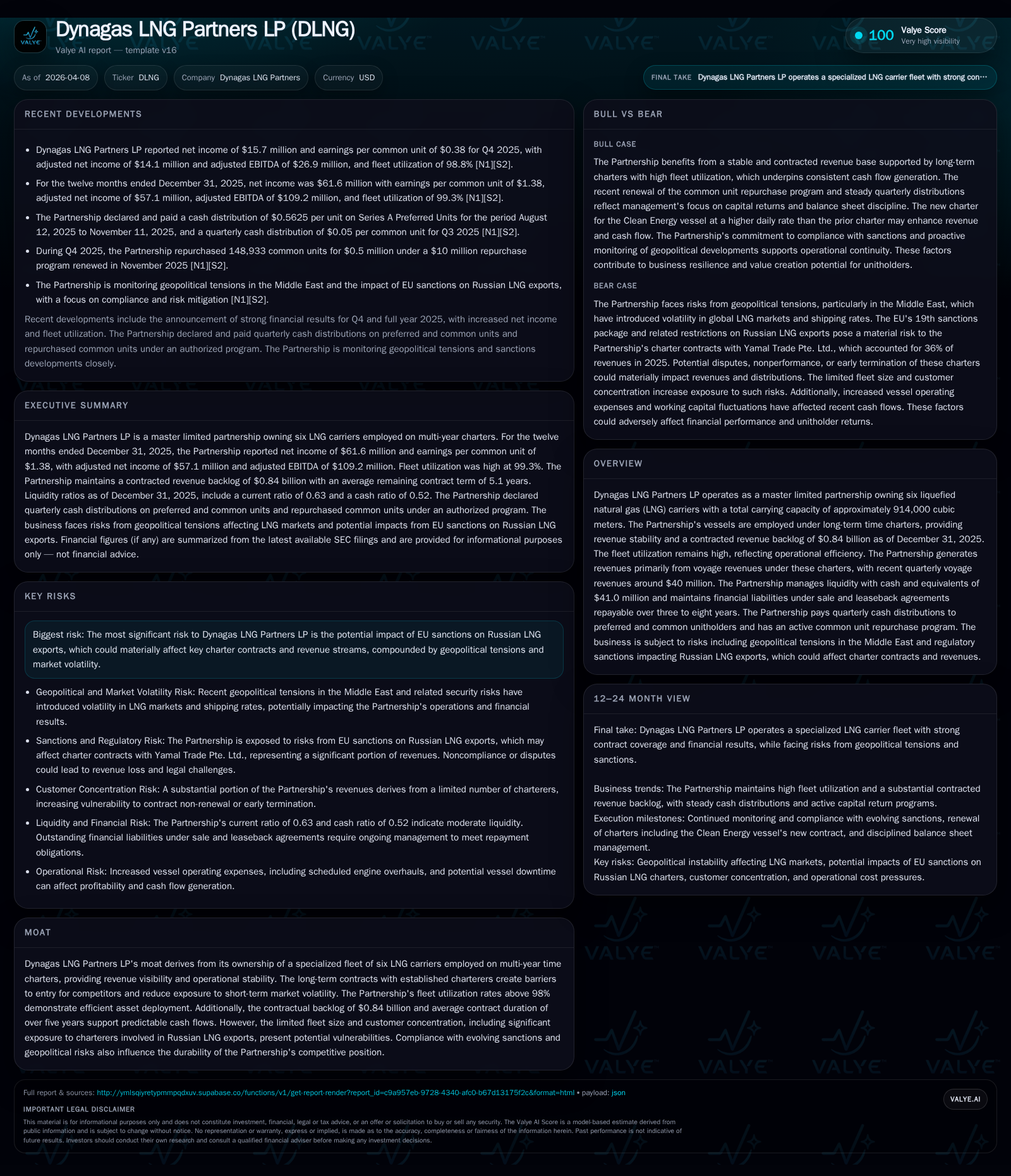
Dynagas LNG Partners LP operates a fleet of six LNG carriers fully engaged under multi-year time charters, providing a contracted revenue backlog of $0.84 billion and supporting fleet utilization above 98%. Despite a modest decline in annual revenue by 4.4%, the partnership’s net income improved nearly 20% year-over-year, reflecting operational leverage and effective cost management. Capital deployment features consistent quarterly distributions to preferred and common unitholders alongside an ongoing common unit repurchase program. However, growth prospects are moderated by external risks including EU sanctions targeting Russian LNG exports and the limited scalability imposed by its relatively small fleet.
Performance Overview: Historical Growth and Operational Efficiency
Dynagas LNG Partners LP owns a highly specialized fleet comprising six liquefied natural gas (LNG) carriers with a total cargo capacity nearing 914,000 cubic meters. This compact yet efficient fleet has anchored the firm's financial performance across recent years. Between fiscal years ended December 31 from 2019 through 2025, the company saw revenues hover around the $130–137 million range, with a slight dip to $131.7 million noted in FY2022 and continuing into FY2025 representing a cumulative top-line decline of roughly -4.4% year-over-year relative to the prior year.
Despite this modest revenue contraction, operating income was resilient at $75.3 million in FY2025—down only 2.7% from the previous year’s $77.4 million—while net income demonstrated notable improvement (+19.5%) reaching$61.6 million for FY2025 [F1]. This divergence indicates enhanced operational efficiencies and cost controls supporting earnings quality.
Fleet utilization rates exceeding 98% consistently have been critical operational metrics underpinning stable earnings generation; such high utilization levels limit idle ship days thereby maximizing fixed asset productivity as reflected in reported voyage revenues near the quarterly range of $40 million [N1][S2]. Capital expenditure levels have remained nominal (~$27,000 in FY2025 vs over $3 million earlier), confirming minimal expansion or major refurbishment by design to preserve returns rather than drive fleet growth [F1].
Historical performance (annual)
| FY | Net ($mm) | CFO ($mm) | OpInc ($mm) | Capex ($mm) | Net YoY |
|---|---|---|---|---|---|
| 2025 | 62 | 90 | 75 | 0 | +19.5% |
| 2024 | 52 | 92 | 77 | 0 | +43.8% |
| 2023 | 36 | 64 | 65 | 4 | -33.6% |
| 2022 | 54 | 57 | 45 | 4 |
Source: SEC companyfacts cache [F1].
Capital returns and efficiency (annual)
| FY | Div | Buybacks ($) | FCF ($mm) |
|---|---|---|---|
| 2025 | 1315000 | 90 | |
| 2024 | 0 | 247000 | 92 |
| 2023 | 0 | 60 | |
| 2022 | 54 |
Source: SEC companyfacts cache [F1].
*Latest fiscal data as of December 31, 2025; operating income & net income from reported figures [F1]
The Backbone of Stability: Multi-Year Time Charters and Contract Backlog
A defining feature of DLNG’s business model is its reliance on multi-year time charters which average more than five years each, ensuring durable contracted revenues largely insulated from spot market fluctuations—an important moat within the volatile shipping sector . The Partnership's current contracted revenue backlog stood at approximately $840 million as of end-2025 (down slightly from prior estimates but consistent with prior backlog disclosure), maintaining a robust base for future cash flows [S2][S18][S23].
The Partnership’s fleet achieves utilization surpassing 98%, a signifier of both contractual employment stability and effective maintenance scheduling enabling maximum operational days per vessel annually [N1][S2]. Vessels operate predominantly under fixed freight contracts providing reliable Time Charter Equivalent (TCE) rates that bolster earnings predictability.
However, about two of DLNG's vessels service charterers linked to Russian LNG exports—the Yenisei River and Lena River ships leased through Yamal Trade Pte Ltd—through contracts expiring in the early-to-mid-2030s [S25]. This creates complexity due to forthcoming European Union sanctions prohibiting maritime transport services for Russian-origin LNG starting January 1, 2027 on long-term contracts exceeding one year—a risk that requires ongoing compliance diligence.
Evaluating Recent Financial Trends: Revenue Decline Against Profit Growth
While voyage revenues faced pressure evidenced by a marginal reduction in consolidated revenue (-4.4% YoY), adjusted EBITDA remained strong at $109 million for FY2025 supported by prudent cost management policies [F1][N1][S6]. Operating income only dipped slightly (-2.7%) reflecting tight control over operating expenses including bunker fuel costs and drydocking schedules.
Sale and leaseback financing arrangements entered effective mid-2024 have afforded the Partnership favorable capital structure flexibility combined with certain accounting treatments affecting reported net income favorably through lease expense amortization dynamics versus outright asset ownership impacts [S4][S5]. This financial engineering helps smooth earnings volatility while preserving cash flow.
Adjusted EBITDA margin dynamics reveal operating leverage whereby costs did not rise proportionally despite revenue softness—enhancing margins temporarily while offsetting cyclical shipping demand factors seen across LNG carrier markets globally during this period.
Future Outlook and Market Constraints: Navigating Sanctions and Fleet Size Limits
Looking ahead, significant caution attends the geopolitical landscape enveloping Russian LNG export sanctions imposed by the EU effective January 1, 2027 along with additional UK restrictions involving maritime transport services for Russian-origin LNG [S11][S19][S25]. While DLNG states no material disruption has occurred yet given compliance efforts with counterparties fulfilling contracts to date—the potential impact remains a key vulnerability especially considering two of its vessels’ charterer concentration linked directly to Russian cargoes.
Further constraining growth is DLNG's relatively small fleet size consisting solely of six vessels limiting scalability or diversification potential—a recognized ceiling when juxtaposed with larger peers capable of leveraging scale economies or asset rotation strategies more aggressively . Therefore, expansion would likely require external capital deployment or strategic partnerships albeit tempered by sanction-related investment risks.
Capital Deployment: Distribution Policy, Buybacks, and Return Metrics
Capital allocation highlights center on quarterly cash distributions paid consistently—common unitholders receive a steady dividend of $0.05 per unit quarterly while Series A Preferred Units command higher yield distributions ($0.5625 per quarter) reflecting their preferred status [S6][N1]. Distributions align with available cash generated from operations after satisfying financial covenants detailed in debt agreements including subordination periods which expired in early-2017 enhancing distribution rights for common holders [S1][S4].
An active common unit repurchase program authorized up to $10 million annually was renewed recently; during FY2025 buybacks amounted to approximately $1.3 million supporting underlying unit prices and signaling management confidence in intrinsic value [F1][S6][S7].
Free cash flow after minimal capex commitments hovered near $90 million for FY2025 underscoring robust internal capital generation capacity allowing both deleveraging initiatives alongside sustained shareholder returns without reliance on incremental debt issuance.
Return on equity approximates a healthy ~13%, demonstrating efficient capital usage within partnership constraints though potential upside may be limited absent material expansion or charter renewals at improved rates.
Risk Factors in Detail: Geopolitical Sensitivities and Credit Covenants
DLNG explicitly flags geopolitical sensitivities arising principally from EU sanctions regime targeting Russian-linked LNG exporters as core risk; failure or inability of counterparties to fulfill contractual obligations would materially affect revenue streams forecasting beyond January 2027 commencement date [S11][S12][S19][S20]. Concurrently counterparty credit risk escalates amid global economic uncertainty impacting trade flows.
Debt arrangements impose covenant restrictions including limitations on distributions predicated upon maintaining specified debt service coverage ratios—a safeguard to creditors but a factor restricting cash deployment flexibility during adverse market conditions or unexpected downturns [S4][S8][S23].
Additionally exposure concentrated in charterers linked to Russian export infrastructure places DLNG in a niche vulnerability versus more diversified operators minimizing sanction compliance impact.
What to Watch: Key Financial Ratios, Charter Extensions, and Unit Repurchases
Key forward-looking indicators warrant close observation include any notices around early termination or renewal terms concerning existing long-term charters particularly those associated with Russian LNG operations exposing sanction risk realms [N1][S23]. Monitoring quarterly variations in fleet utilization against prevailing spot market dynamics may yield insight into operational adaptability amidst market shifts.
Liquidity dynamics reflected by changes in cash balances ($41 million as end-December ’25) along with any new debt or sale-leaseback financing arrangements will inform balance sheet resilience during uncertain macro-environmental backdrops.
A continuation or alteration in unit repurchase volume signals management’s stance on valuation attractiveness under current share price conditions offering additional perspective on capital return execution strategies beyond mandatory distribution payments.
This analysis synthesizes data primarily drawn from audited financial statements as filed under U.S SEC Form 20-F through April 8, 2026 ([F1], [S#]) along with recent earnings press releases ([N#]). All numeric figures strictly adhere to sourced disclosures without extrapolation or speculation beyond documented evidence where noted as interpretive commentary explicitly indicated as analysis or outlook perspective rather than factual assertion.
Readers should consider ongoing developments impacting Dynagas LNG Partners LP given rapidly evolving geopolitical contexts affecting energy supply chains alongside conventional shipping industry cyclicality when forming views about future performance trajectories.
Disclaimer: This is research-only, informational analysis and not investment advice. It may include AI-generated interpretation and general industry context. Always verify important details using primary sources.

Comments